

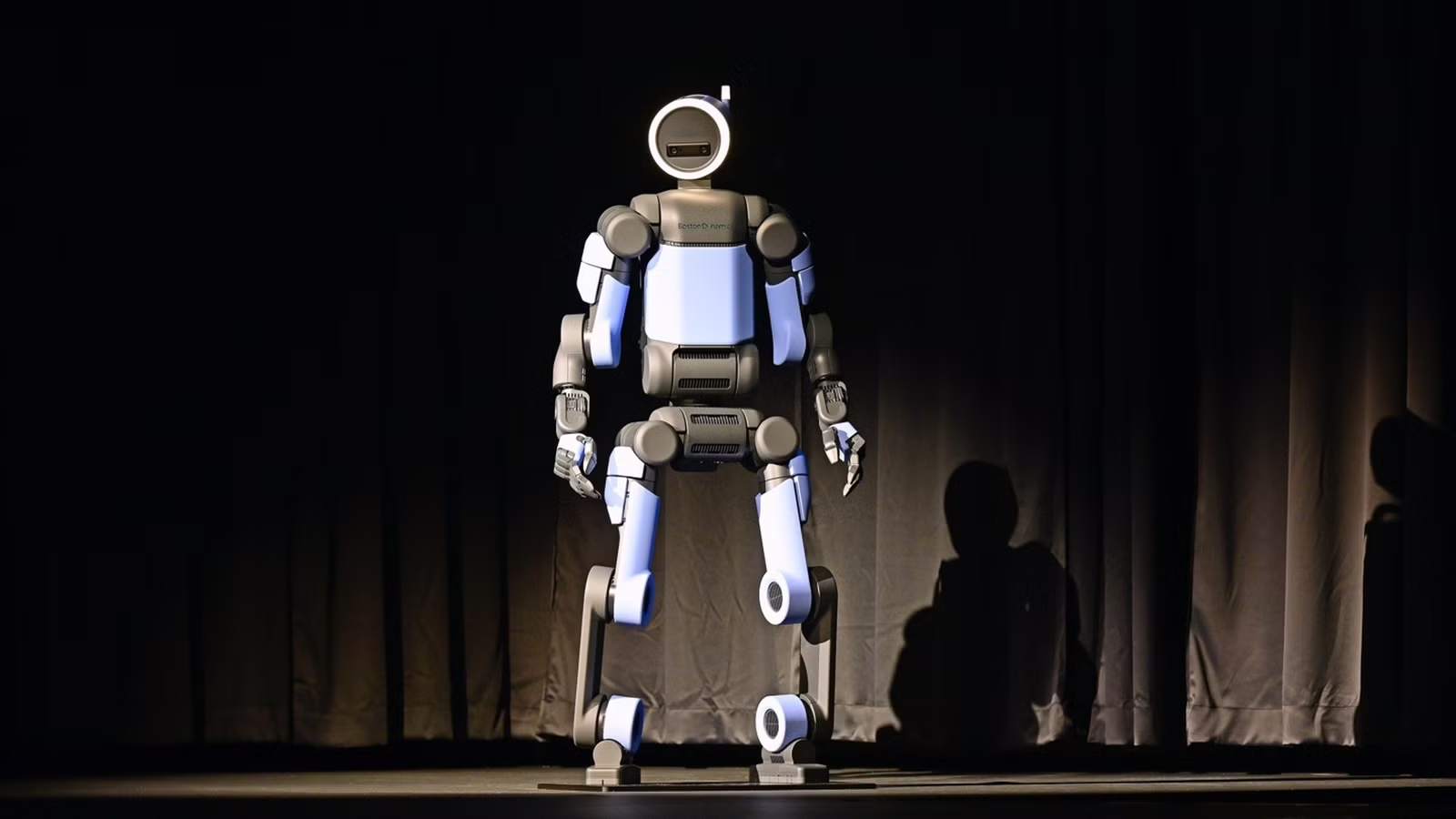
You’ve probably seen the Boston Dynamics robot model with a round face, called Atlas. The robots went viral earlier in the year with gymnastic demonstrations, and more recently, the company released a video of some of its robots performing the Viking Row football chant that Norway’s fans made popular at the World Cup. Hyundai Motor Group has been involved with the company for some time, and now, it’s very involved.
By that, we mean Boston Dynamics, a US robotics company, is now a wholly-owned subsidiary of Hyundai. The automaker bought out SoftBank Group’s 10% stake. What does that mean for the acrobatic robots and the auto industry? That’s a good question.
Automakers Going All In On Humanoid Robotics
Boston Dynamics Atlas (Hyundai)Boston Dynamics
In terms of the US, Hyundai plans to begin deploying Atlas at a manufacturing plant in Georgia from 2028. It will start by handling parts-sequencing tasks, with the aim of taking on more responsibilities, including component assembly, by 2030. By owning Boston Dynamics outright, Hyundai can make long-term decisions on investments, business strategy, and, potentially, an initial public offering.
It all sounds great for Hyundai, but there are issues. Recently, Hyundai’s South Korean labor union has intensified industrial action over annual wage negotiations. Hyundai buying a robotics company likely won’t help the situation – there have already been partial strikes, and four-hour strikes from July 20 to July 22 are planned.
Understandably, the union has concerns about robotics and artificial intelligence on vehicle assembly lines and how that may negatively impact human workers. The labor union is demanding that Hyundai set aside 30% of its net income for bonuses and guarantee job security for workers. Kia is also developing humanoid robots, so workers and the union are concerned that the intention here is to replace humans with Atlas and whatever variations may turn up.
It’s Not Just Hyundai, Either
Boston Dynamics Atlas (Hyundai)Boston Dynamics Atlas (Hyundai)
Robotics are far from new in manufacturing as a whole, but they are heavily used in the automotive industry due to the size and number of parts used to build a car or truck. It’s not the only reason, but that’s why, when a huge new multi-billion dollar factory is built, there are only a couple of thousand jobs created.
It is notable, however, that the race is specifically to produce humanoid workers. Mitsubishi also recently announced plans to manufacture and deploy humanoid robots in 2027, partnering with the Japanese robotics startup Highlanders Inc. Toyota, BMW, and Renault are also working on humanoid robotics. And lest we forget, Tesla is retooling an entire factory that once built cars to make Optimus robots.
CarBuzz Insight – Why This Matters:
car production hyundai factoryHyundai Motor Group/Pexels
Robotics in automotive manufacturing isn’t new. The human form isn’t ideal for much on a production line, in much the same way it isn’t ideal for a robot vacuum cleaner or placing a box on a shelf. It’s overkill. The human form isn’t ideal for lifting heavy objects, which is why forklift trucks exist – and they can be, and are being, automated in factories.
However, humanoid robots would be great for replacing humans that use tools designed for humans. There is a telling quote from Mitsubishi Motors CEO Takao Kato, offered when the brand’s partnership with Highlanders Inc. was announced. “As an automaker, we really have to start thinking now about how we’ll utilize humanoid robots in our factories going forward,” he said. This sounds suspiciously like a solution in search of a problem.
We suspect this is automakers looking at the tech industry with its high-profile, cash-burning but highly valued companies working on science fiction-level ideas that capture the public’s imagination – meaning AI companies and SpaceX. However, humanoid robots will have limited use cases, and will be more useful in a home, a care facility, or dangerous environments such as firefighting or tower construction, than in an already mostly automated car factory.
Sources: Reuters / American Automakers
