

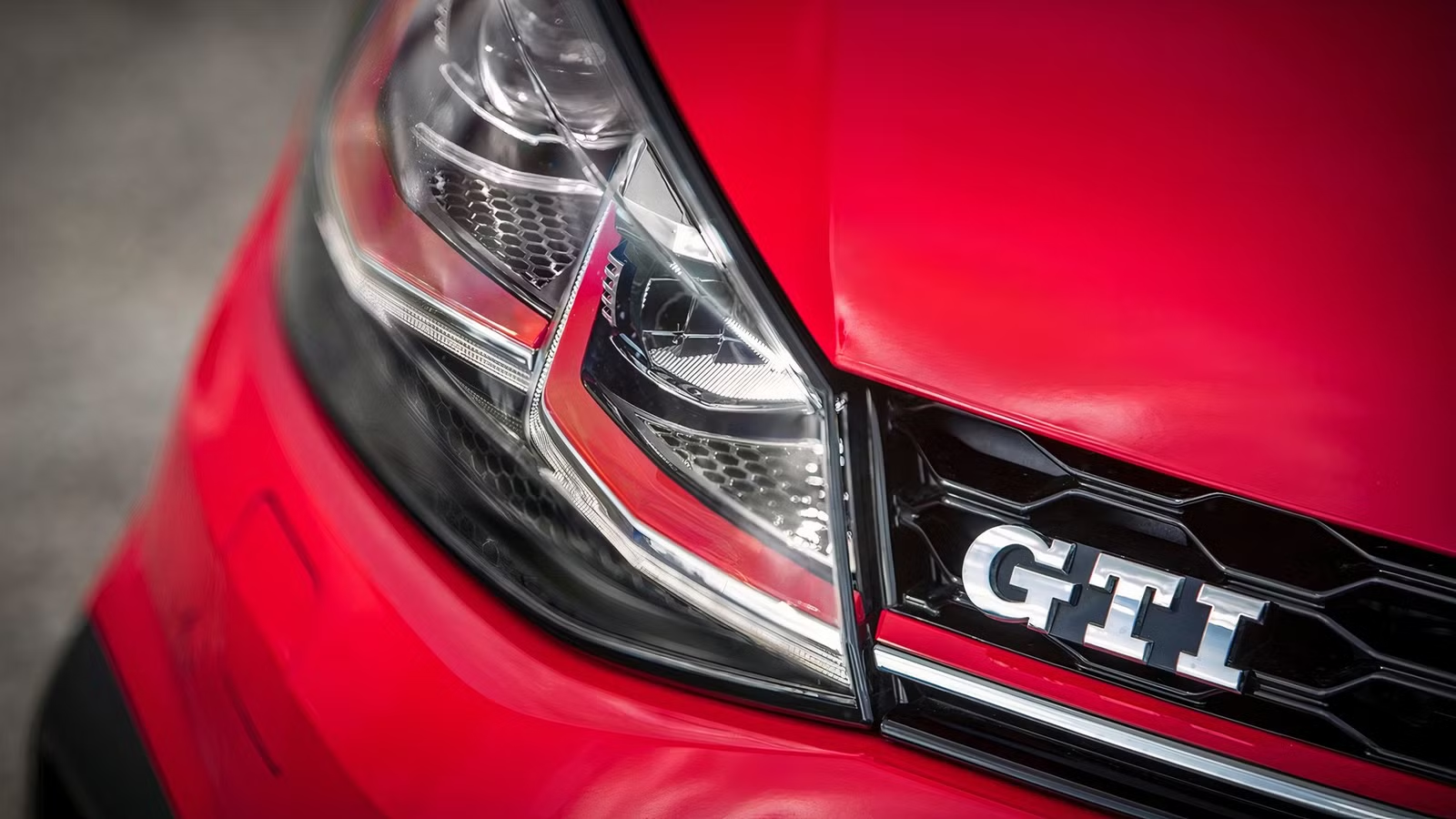
The Golf GTI is as old as the hills, and is often considered the grandfather of the hot hatch segment. While each generation has its fans and enthusiasts will rarely agree on which the best is, there is one generation that is shining through as quite possibly the perfect daily-driver choice right now, and it’s not the latest.
The MK7 is quickly shaping up as a future classic in any guise. It’s recent enough to pack enough tech for most buyers, it’s sprightly enough for most too, so more and more are seeing it as the better purchase over its current and refreshed successor. Here’s why.
How The MK7 And MK8 Golf GTI Compare
2018 And 2022 Volkswagen Golf GTI Specs Comparison
Model
2018 GTI
2022 GTI
Engine
Turbocharged 2.0-liter inline-four
Turbocharged 2.0-liter inline-four
Transmission
6-speed manual or 6-speed dual-clutch automatic
6-speed manual or 7-speed dual-clutch automatic
Power
220 horsepower
241 horsepower
Torque
258 lb-ft
273 lb-ft
0 to 60 mph
6.3 seconds
5.8 seconds
Top speed
155 mph
155 mph
The GTI is the performance trim of the Golf, so naturally, how each iteration of the iconic hatch performs is of particular interest. On paper then, it might seem bizarre that the MK7 would even be recommended over the MK8, as the latter car sports more power, more torque, and a brisker 0 to 60 mph time. Both enjoy the same restricted 155 mph top speed, which is more than fast enough for 99% of buyers. It’s natural for automakers to inject a little more performance into new models, so this jump up in pace is nothing surprising.
2021 Volkswagen Golf GTIVolkswagen
Faster alternatives of both generations are available, such as the Anniversary and Clubsport models, although these unfortunately didn’t make it Stateside. The R was available though, as an even more performance-focused variant of the Golf for both generations, sporting all-wheel-drive, more aggressive bodywork, and an extra helping of grunt.
Back to the standard GTI models though. The MK8 received an electronically controlled limited-slip differential as standard, something reserved for Performance Pack MK7 models, in addition to revised suspension and larger brakes. On the face of it then, Volkswagen did a great job updating the Golf GTI, and it’s hard to see why anyone would lust after the older MK7 for any reason other than affordability. As it happens though, there are hidden benefits to picking the older model that see it staying truer to the GTI’s original formula as a high-thrills hot hatchback.
Why Buyers Should Be Prioritizing The MK7
2017 Volkswagen Golf GTIVolkswagen
Any generation of Golf GTI should be heaps of fun to drive, with a chuckability not found in many other family-friendly cars, a playful transmission — whether auto or manual — and a hard-wearing, frustration-free interior that’s easy to get on with day in and day out. Sure, the MK8 delivers a more purposeful punch on paper, but when it actually comes to delivering on the real-world GTI-factor, the MK7 stands out as the better performer.
2017 Volkswagen Golf GTIVolkswagen
Drivers have found that, while the MK8 certainly is fun to hustle down twisting backroads, it somehow lacks the ease and willingness of the previous generation. The manual transmission, which has since died a depressing death for the GTI nameplate, is simply too light and just isn’t as satisfying. Behind the wheel, drivers have noted the feedback feels somewhat disconnected in comparison to the MK7, and while it may be faster, that playfulness comes so much easier in the older car.
2021 Volkswagen Golf GTIVolkswagen
It should be noted that this isn’t due to any unnecessary bulk on the new car. In fact, it sports dimensions and a curb weight that’s impressively similar to the older model.
2018 & 2022 Volkswagen Golf GTI Size Comparison
Model
2018 GTI
2022 GTI
Length
168.0 inches
168.8 inches
Width
70.8 inches
70.4 inches
Height
57.8 inches
57.6 inches
Wheelbase
103.6 inches
103.6 inches
Curb weight
3,128 lbs
3,190 lbs
No-one is saying that the MK8 GTI is a bad drive, far from it in fact, but the MK7 just seems that little bit more eager to have fun. It might not be as quick around a track, but drivers don’t need to work quite so hard at extracting the pace from it; the older car offers it right from the get-go.
Related
Volkswagen Golf GTI Generations: Everything You Need To Know In One Place
As a segment-defining hot hatch, the GTI has persisted through eight generations to offer buyers the perfect blend of practicality and performance.
The MK8’s Interior Is Its Weak Point
Frustratingly for buyers, the interior is really where the MK8’s flaws begin to show. Cheap plastics and capacitive buttons seem like a major downgrade when compared to the wonderfully tactile and easily navigated cabin of the MK7.
2021 Volkswagen Golf GTIVolkswagen
Volkswagen has said that nobody can really agree on what buttons they do or don’t want to find, but our test driver, Ian Wright, certainly found the MK8’s touch capacitive units a letdown in the real world.
At night, the already fiddly volume and heat controls aren’t lit up, and almost everything else is controlled through the awkwardly layered menu system. The touch-sensitive controls on the steering wheel are fine, but occasionally you will realize you inadvertently turned the steering wheel heating on in the middle of summer. Overall, interacting with the Golf GTI in the cabin becomes infuriating.
— Ian Wright, Test Driver, CarBuzz
Cheaping out on the MK8’s interior has damaged one of the GTI’s main attraction points. This is supposed to be the perfect one-car solution for gearheads, serving as both a fun weekend tool and a delightful daily driver.
Which MK7 Buyers Should Be Seeking Out
2017 Volkswagen Golf GTIVolkswagen
Volkswagen really got nothing wrong with the MK7, and as a result, it’s already being pegged as a future classic. Buyers should act fast and buy one before prices begin to climb, but beforehand, it’s important to first understand which variant they should be hunting down. The first question to answer is if buyers should be hunting down a pre- or post-facelift model.
Pre-facelift models ran from 2015 through 2017 and offered slightly less grunt. The main drivetrain was still very much the same, but power came in at 210, in comparison to the later car’s 220. The styling was also refreshed for the facelift car, plus more tech was included as standard, so as a general rule it’s a post-facelift car that buyers should be hunting down.
Whether buyers should be seeking out a manual- or DSG-equipped GTI depends entirely on circumstance and personal preference. Commuters who will be sitting in traffic each morning will more than likely prefer a DSG model, whereas those buying the car primarily for weekend thrills would no doubt benefit from buying a three-pedal model instead.
Really, any trim is a solid buy, even the base ‘S.’ Sport and SE models saw an extra bump up in power, sending early-car outputs matching that of the facelift car, in addition to sporting leather seats and uprated audio with the SE. The top trim is the Autobahn grade, and it sports everything the others do, in addition to power-adjustable seats, dual-zone climate, adjustable dampers, and more.
Then there was the Rabbit special edition. These came with slight power bumps and unique cosmetic upgrades, both inside and out. Volkswagen enthusiasts treasure a special GTI, so these do command a premium on the used market today.
Related
Golf R vs GTI: How These VW Siblings Compare
Volkswagen’s Golf R and Golf GTI may share some DNA, but they are two very different performance hatchbacks.
How Much To Pay
2017 Volkswagen Golf GTIVolkswagen
Buyers can spend as much or as little as they like here. Early MK7 models will be the cheapest, and according to current listings on the CarBuzz Marketplace, 2015 cars can be picked up for less than $10,000 with north of 100,000 miles. Picking up a smart example of a facelift car, however, commands a little more.
Manual cars command an extra $500 premium, which would suggest the market does favor the more involved driver’s car, certainly as a base model. Shelling out for the top-spec, DSG-equipped Autobahn model commands more, but smart examples still come in south of $20,000 — just about. Low-mileage cars with big specs can be had easily for $25,000, and while that might seem like a lot for a Golf that’s rapidly approaching 10 years old, compare that to the price of an entry-level MK8.
Buyers will be shelling out north of that figure simply for a lower-spec MK8 with the manual ‘box. All of a sudden, the argument for a low-mile, big-spec MK7 with all the benefits that generation brings seems like a deal worth taking.
What To Watch Out For
The great thing about a Golf GTI is that it’s really quite easy to own. Unlike many other performance cars which perhaps house hotter engines, maintenance and repairs need not break the bank here, but with that being said, there are a few common issues to watch out for. These include:
- A failing PCV; these commonly deteriorate around 80,000 miles, resulting in contaminated oil and unusual whistling noises. Repairs aren’t hugely expensive, factor in around $500 for parts and labor at a specialist garage.
- Carbon build-up is common on direct-injection cars, and can affect performance and smooth running. Carbon cleaning is something to think about, especially as these cars now age.
- Water pumps are another weak point — watch out for leaks, and if in doubt, have it changed preventively. Low coolant levels and puddles beneath the car are easy-to-spot warning signs, so there’s no excuse for missing this one.
- DSG transmissions are upsettingly expensive to repair or replace, so ensure it has been serviced according to manufacturer guidelines, and keep that maintenance up after purchase. These cars are plentiful, so don’t be tempted by the first one that presents itself if the service history isn’t strong.
Summary: The MK7 Is A Future Classic In The Making
2017 Volkswagen Golf GTIVolkswagen
It’s slower, sports more dated styling, and doesn’t boast the same level of tech that the later car brings. Still, it’s the one enthusiasts crave, and they’re right to favor it. It’s playful, looks ace, and doesn’t break the bank to buy, even at the very highest level. Nothing against the MK8, but it’s unlikely to captivate fans quite like its predecessor has.
Sources: Volkswagen.
