

The biggest car news and reviews, no BS
Our free daily newsletter sends the stories that really matter directly to you, every weekday.
The Honda CB650R E-Clutch is a spectacular vehicle with a beautiful balance of traits. It’s approachable and modern while still being soulful. Lively, but not intimidating. You can set the clutch to automatic, but shifting remains your responsibility. This is a great bike for new riders or old heads looking for new tech that makes the ride better, not just easier. For me, specifically, riding a Honda E-Clutch bike was nothing less than life-changing.
We don’t publish motorcycle reviews here all that often, but this story is for anyone with a casual interest in vehicles. If you’ve never ridden a motorbike at all, here’s the only bit of technical context you need:
- Pretty much all motorcycles have a sequential manual transmission configured the same way
- The clutch is the left handlebar lever
- The shifter is a rod you move up (upshift) or down (downshift) with your left foot
- Braking is done on the right side
- The right handlebar lever actuates the front brake
- The right foot pedal actuates the rear brake
Here’s a visual:
Motorcycling With a Crippled Hand
I’m uniquely equipped to appreciate an auto-clutch motorcycle because my left hand is crippled. It’s a long and sad story. The short version is that I flipped a UTV in deep wilderness, and as I tumbled, my paw got caught between the Earth and the vehicle’s roll cage. Would you believe I was supposed to get married a few hours later that same day? As a matter of fact, I still did—my wife and I were officially hitched in a hospital hallway minutes before I was wheeled into surgery.
In the year following that crash, the only thing I was riding was an endless carousel of medical visits. I resisted selling the bike I owned at the time, a Yamaha WR250R with completely custom suspension tuning, thinking it could be my motivation to get my hand’s functionality back. But as months went by, doctor bills piled up while clutch-pulling didn’t seem to be getting any closer. The Yammie got sold, and motorcycles were forced off my list of loves.
That crash happened eight years ago now. Today, few seem to notice that my left hand is a little gnarled and missing a pinkie. Less luckily, I still have severely limited dexterity and strength. There’s also a distant hum of pain I can never completely muffle.
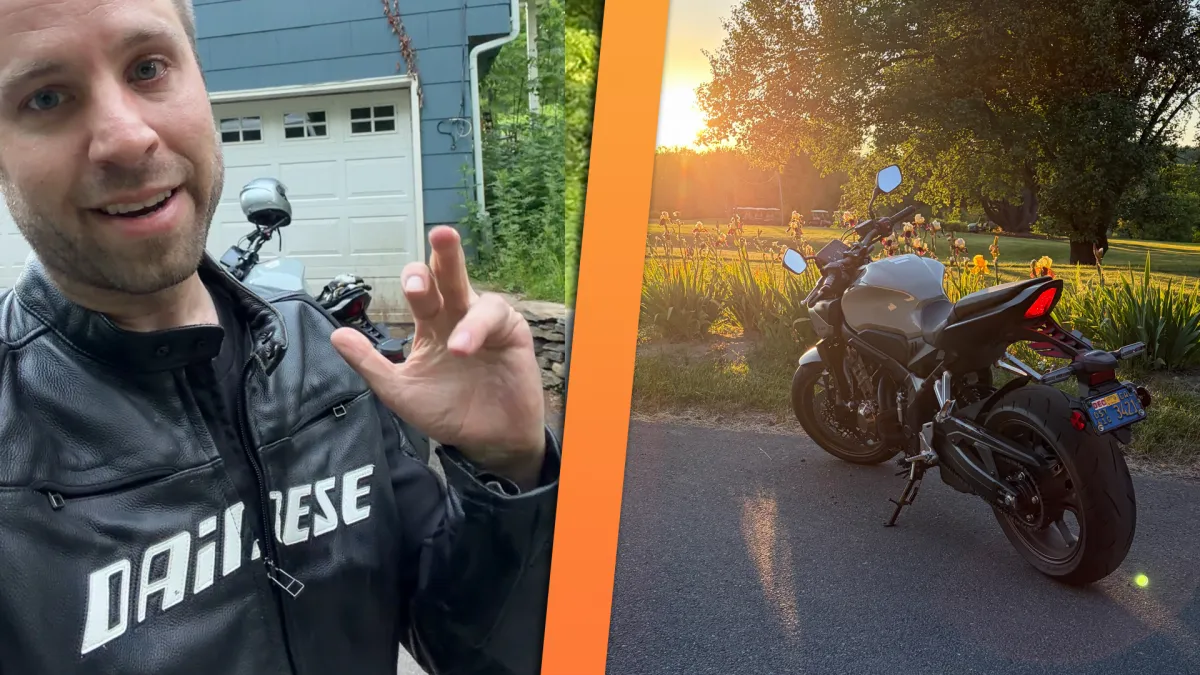
But I promised this would be the “short version,” so let’s get back to bikes. I pretty much hadn’t ridden a proper motorcycle since 2018—I think my last loaner was a Honda Rebel 500. So, throwing a leg over this CB650R and zooming down my driveway was a pretty emotional experience. The craziest thing is, by the time I’d ridden from my garage to my mailbox, I felt at home on a steel horse again. And I was instantly convinced that Honda’s E-Clutch is awesome.
I forgot how hard it is to take a picture of yourself riding a motorcycle. You’ll have to make do with a screen grab of a tripod iPhone video! Andrew P. Collins
What is Honda’s E-Clutch?
Practically speaking, the Honda E-Clutch lets you have a full and proper manual-transmission motorcycle, except you don’t have to touch the clutch. You still shift and fully manage the throttle, but clutching is optional. Yes—optional, it’s not removed. If you want to use the clutch, it still works fully manually, and you can deactivate the E-Clutch in the CB650R’s settings menu. It’s slightly annoying to find, but as we’ll discuss in this post, I doubt most owners will want to turn it off often. E-Clutch functionality is on “auto” by default.
A no-touch-clutch motorcycle is not a new idea. There are aftermarket auto-clutches (like Rekluse), and there are even some dual-clutch automatic motorcycles now (Honda’s big with that, too). Honda’s E-Clutch came out in 2024 on the CB650R and the sportier-looking CBR650R—all this to say, it’s been on the road for years now, but it’s new enough that many people still aren’t familiar with it.
I love the design of this thing. Andrew P. Collins
How Does E-Clutch Work?
While the programming and engineering that make E-Clutch work are complex, conceptually it’s pretty simple: The clutch has two input methods. It can be controlled by a hand lever or by a computerized lever. With the E-Clutch off, the rider directly controls clutch engagement with the lever, just like on any other motorcycle. With E-Clutch active, the rider indirectly controls when the clutch is used through their regular riding behavior—the bike’s ECU extrapolates when to engage the clutch based on the wealth of information it has from a raft of sensors.
Honda E-Clutch structure and control overview
In practice, having E-Clutch means you never have to pull the lever, even at a stop. You can idle in first without clutching in. Just remember that you’re in gear before you go to rev the bike—you can unintentionally bump yourself forward if you forget you’re not in neutral! Luckily, there’s a big ol’ gear indicator on the dash.
E-Clutch Reference Material
If you want to go really deep on E-Clutch technology and development, Honda has published some cool cutaway diagrams, a tech briefing, and a great interview with the engineers who brought it to life.
Pricing, Value, and Rivals
Motorcycles are an amazing price-to-performance deal compared to cars. A brand-new CB650R E-Clutch lists at $9,299, including the destination fee, placing it squarely between the larger and smaller models in Honda’s lineup. E-Clutch isn’t an add-on you select at the dealership; it’s baked into a few Honda models. In this middleweight standard-moto category, there are a few alternatives that I haven’t ridden, but we can compare their specs.
The Kawasaki Z650 S is considerably cheaper at about $7,700. Other rivals include the Triumph Trident 660, Suzuki GSX-8S, and Yamaha MT-07, which many consider the benchmark in this mid-weight no-fairing category. Honda’s value proposition is that it’s a four-cylinder (smoother than rivals powered by a twin) and, of course, the E-Clutch, which no rivals in this size have.
If you want to get into E-Clutch as cheaply as possible, the CB750 Hornet E-Clutch is a parallel-twin that rings up at about $8,600 with destination.
Honda CB650R E-Clutch Ride Review
If I had to name the ultimate “car-dork cliché,” and I am absolutely guilty of this myself, it’s talking about “pure” driving experiences in terms of vehicular engagement over raw speed. It’s true, though—if we’re going for a fun drive, give me a 90-horsepower Caterham 7 over a Tesla Plaid any day of the week. That’s why the Miata is a perennial darling of auto writers, and why people who never off-road buy a Jeep—it just feels good to drive something that feels alive. It makes you feel, and here comes the line: “one with the machine.”
After about 60 seconds on the CB650R, I remembered: holy crap, motorcycling feels more badass than driving a McLaren (which is a comparison I can actually make, since I just reviewed one). Now, hang on. No biker on the planet would call this middleweight standard motorcycle “badass.” Its aesthetic and personality are more khakis and a blazer over a t-shirt; the maturity of crisp lines with an aura of youthful irreverence.
However, when it comes to feeling united with your machine, there is simply no comparison between a car and a motorcycle. Forget searching for steering feel in a coddling leather seat. On a bike, you’re out in the same freaking wind as your engine. A car is a vehicle; a motorcycle is more like a prosthesis.
I’m harping on this to underscore how important rider engagement is and why riders are right to be skeptical of experience-easing aids like E-Clutch. But also to emphasize that I really didn’t feel like I was missing any joy riding in clutchless mode. That was my biggest takeaway: This makes riding better, not just “easier.” I still felt completely engaged with the motorcycle as I clicked up and down the gears without needing my left hand—and to me, that’s the best endorsement anybody could give this concept.
I toggled between E-Clutch on and off a lot during the weeks I had this CB650R on test. While I was pleased to realize I could use the clutch lever more easily than I thought I might, I barely used it. The E-Clutch made me enjoy riding more, full stop.
The screen and interface are easy enough to use and offer some customizability, but the display doesn’t look particularly … cool. Andrew P. Collins
As for the rest of the bike’s attributes—the CB650R is best described as “balanced.” It handles predictably and consistently, and feels reasonably responsive, but it’s certainly no sport bike. It’s fast enough to be entertaining, but the suspension isn’t punishingly stiff, and you’re in no danger of accidental wheelies.
The bike is very accessible to new riders, with an upright, comfortable riding posture, but also welcomes experienced riders who don’t necessarily feel an intense need for speed. The CB650R felt exciting and engaging to me without encouraging dangerous behavior, which I think is a great place for powersports equipment to live. It’s not annoyingly loud, either, which I also appreciated.
The only real disappointment for me is the gauge cluster. It’s serviceable and fine, and it does afford you some freedom (there are a few scene-changing display modes), but a big rectangular display is just kind of bleh. An analog tach would really go a long way toward making this thing look and feel cool.
Still, I enjoyed the heck out of riding it, and I’m now completely sold on Honda’s E-Clutch concept. It should be a great catalyst for getting more people to ride. And as engaging cars get harder and harder to find, more driving enthusiasts should really start looking at motorcycles as the next frontier of fun machinery.
Andrew P. Collins
Want to talk bikes? Drop me a line at andrew.collins@thedrive.com.
Automotive journalist since 2013, Andrew primarily coordinates features, sponsored content, and multi-departmental initiatives at The Drive.
