

The Wards Auto Best Engine awards, now the Wards Best Engine & Propulsion Systems Awards, are revered by many in the North American automotive industry. It began in 1995 to showcase the cutting-edge and noteworthy technology developed by powertrain engineers. Since then, it has become a bragging point for manufacturers whose engines have been nominated for and won the award.
In the three decades since its founding, there has been only one engine that has had to return its award during that time. That engine was the Volkswagen 2.0-liter turbocharged diesel, which was the cause of one of the biggest automotive scandals of the last two decades.
Volkswagen’s 2.0L TDI Engine Praised In 2009
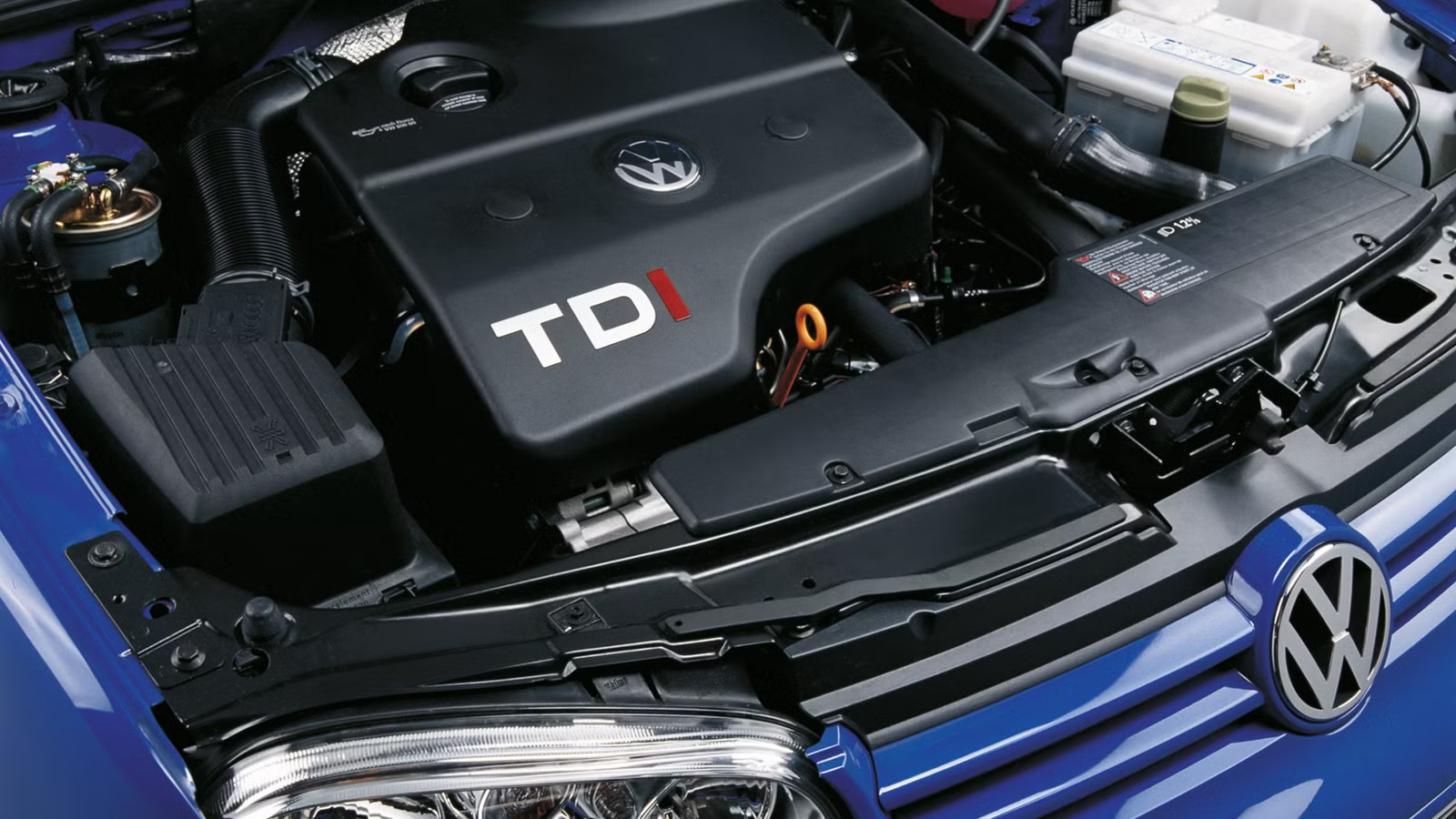
2010 Volkswagen Golf GTD Exterior Engine Close-UpVolkswagen
The Volkswagen 2.0L TDI engine was one of only two turbodiesel engines that received the Wards Auto Best Engines award for 2010. For those years, the award was given to engines that aligned with Wards Auto’s emphasis on engines that highlighted the automotive industry’s move toward higher fuel economy and lower emissions. In the case of the VW 2.0L TDI engine, the Wards Auto team was impressed by its energy, throttle response, and driving characteristics, which differ from those of conventional diesel engines.
Beyond that, it was distinguished by the fact that it met the 50-state emission requirements, specifically the Tier 2 Bin 5, which sets a lower emissions limit for pollutants such as Carbon Monoxide, Non-Methane Organic Gas, Formaldehyde, and Particulate Matter. Volkswagen’s means of achieving lower emissions was by utilizing a new BorgWarner turbocharger that employed a nano-coated compressor wheel and housing, allowing it to achieve lower Nitrogen Oxide emissions. This lauded engine was used in several models within Volkswagen’s model range, including the Volkswagen Jetta, Volkswagen Beetle, Volkswagen Beetle Convertible, Volkswagen Golf, Volkswagen Golf SportWagen, Volkswagen Passat, and Volkswagen Jetta SportWagen, with the latter attributed to its being awarded the Wards Auto Best Engines award in 2009, 2010, and 2011. However, that award was later revoked.
And Then, Volkswagen’s Skeletons Came Out Of The Closet
2011 Volkswagen Passat Exterior Finished In Black DrivingVolkswagen
It would be less than five years before news broke that the Wards Auto Best Engine awards that were given to Volkswagen’s praised turbodiesel engine would be returned. This was the first and last time in the history of the Wards Auto Best Engines awards that an engine award was returned. The decision to have the award returned was not made by Wards Auto, but rather Volkswagen, whose CEO at the time stated in a letter addressed to Wards Auto:
“In light of the recent action by EPA concerning our 2.0L TDI vehicles and associated allegations, out of respect for you and your esteemed publication, we feel it best at this time to return the 10 Best Engines awards that you gave to us for our TDI engine in 2009 to 2011,” – Michael Horn.
The decision was made after it was revealed that Volkswagen had manipulated the software used in an electronic control device that would deactivate the emissions sensors, except when the cars were being tested for their emissions. As we mentioned previously, a significant reason why VW’s 2.0L TDI engine won the award was that it met the emissions requirements at the time.
This method of side-stepping emissions would result in cars equipped with this engine having greater performance and fuel economy, but at the cost of emissions that were far above the allowed and regulated levels. Millions of vehicles were recalled due to this issue, and it became one of the biggest scandals in modern automotive history, now commonly referred to as Dieselgate.
The Infamous Dieselgate Scandal
2011 Volkswagen Jetta Exterior Rendering Showcasing Mechanical UnderpinningsVolkswagen
Volkswagen’s emissions scandal, known as Dieselgate or Emissiongate, refers to the scandal surrounding Volkswagen’s efforts to circumvent emissions regulations by utilizing software that allowed Volkswagen’s models with the 2.0L TDI engine to appear to comply with emissions regulations. This all started when the International Council on Clean Transportation commissioned the West Virginia University Center for Alternative Fuels, Engines, and Emissions to conduct on-road testing, which found that Volkswagen’s models, specifically the Volkswagen Passat and Volkswagen Jetta, produced more nitrogen oxides than allowed.
After this discovery, the ICCT published its findings. The United States Environmental Protection Agency (EPA) would later issue a Notice of Violation of the Clean Air Act to Volkswagen. The agency claimed that Volkswagen had utilized software in various models from 2009 to 2015 to circumvent the EPA’s emissions standards, and these vehicles were found to emit up to 40 times more pollution than allowed.The software Volkswagen introduced in models powered by the 2.0L TDI engine allows for adjusting the air-fuel ratios and exhaust flows under test conditions. The software was designed to detect emissions test conditions, and, as we’ve said, would alter the engine’s characteristics to achieve lower emissions, with the vehicle’s NOx filter playing a crucial role in this system.
2011 Volkswagen Passat Exterior Engine Close-UpVolkswagen
Roughly 11 million cars were affected worldwide, and in the fallout, Volkswagen would shell out billions of dollars to atone for the scandal. Volkswagen would also plead guilty to three felony counts. However, a few years after the ICCT’s findings, it was revealed that other models powered by the 3.0L TDI engine, which were used in a handful of models outside the VW stable, included the Porsche Cayenne, Audi A7, Audi Q7, Audi A8, and Audi Q5.
Wards Best Engine Award In 2025
2026 BMW XM engine close-upBMW
Since the Dieselgate scandal, the Wards Auto Best Engine awards have continued without another incident, like Volkswagen’s emissions scandal. However, that’s not to say that the engines that have been in the winners’ circle of the Wards Auto Best Engines award. One of these engines was the Ford EcoBoost 1.0-liter engine, which won the award in 2014 and 2015, but was notorious for its suboptimal temperature control, which led to several issues and ultimately cost Ford a lot of money through multiple class-action lawsuits. BMW’s Prince engine, which won the award in 2011, was notorious for its lackluster reliability, stemming from issues related to the engine’s timing chain that could lead to complete engine failure.
2025 Chevrolet Corvette ZR1 5.5L Twin-turbo LT7 V8 EngineChevrolet
Wards Auto recently revealed the winners of the 2025 Wards Auto Best Engines & Propulsion award. For the first time in the awards’ history, the overwhelming majority of the winners were partially or completely electrified, with the only exception being the most power-dense engine that Chevrolet has ever built, the 5.5-liter twin-turbocharged LT7 V8 engine. Two engines returned for the 2025 awards: the Ford 3.5L turbocharged V6 HEV and the Honda 2.0L inline-four HEV engines. As for the complete list of winners, that includes:
- BMW 4.4L turbocharged V8 PHEV
- Chevrolet 5.5L twin-turbocharged V8
- Dodge Charger Daytona electric propulsion system
- Ford 3.5L turbocharged V6 HEV
- Honda 2.0L I4 HEV
- Hyundai Ioniq 9 electric propulsion system
- Lexus 3.4L turbocharged V6 HEV
- Lucid Gravity electric propulsion system
- Mercedes-AMG 3.0L turbocharged inline-six PHEV
- Nissan Leaf electric propulsion system
Sources: Wards Auto, Volkswagen, United States Environmental Protection Agency, International Council on Clean Transportation
