

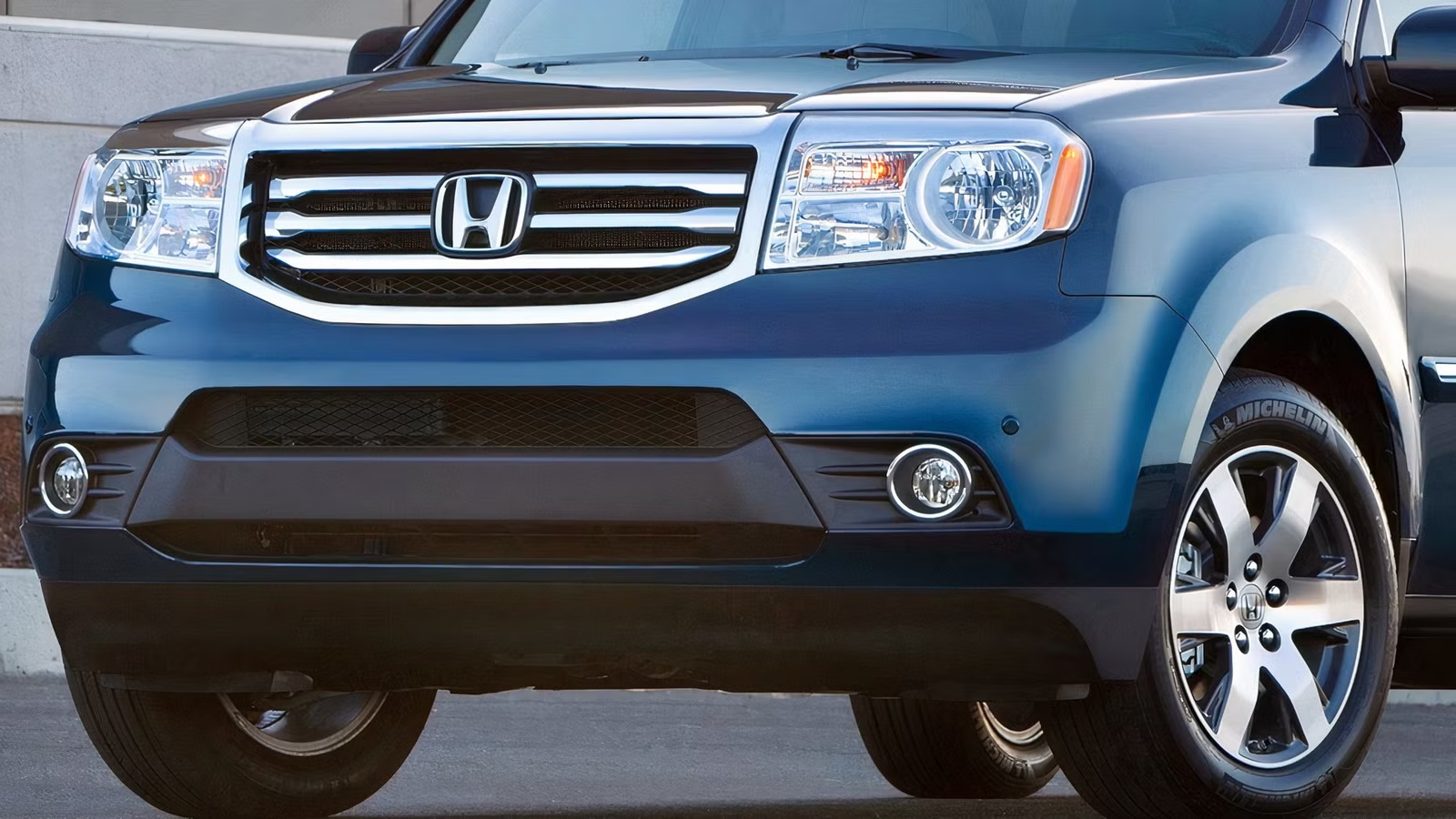
If you want to learn about engine longevity in the real world, a good place to start is a particular vehicle owners’ club. Here you might learn a lot about an engine like the V6 known internally as the J35, fitted to the Honda Pilot and other family vehicles, and discover just how good such a motor can be.
One post on the Pilot Owners Club forum noted that their vehicle had racked up a strong 300,000 miles with zero issues, and that says a lot more than a spec sheet ever could. Meanwhile, the newer Honda turbocharged four-cylinder engines might have better packaging, fuel economy, or emissions logic, but they may also have a narrower long-term margin for error. The situation raises the question of whether the older naturally aspirated V6 could be the smarter high-mileage bet.
A 300k-Mile Honda Makes The Argument Hard To Ignore
2016 Honda Pilot front 3/4 angle in gray while drivingHonda
2015 Honda Pilot Specifications
Engine
3.5-liter SOHC i-VTEC V6 J35Z4
Transmission
Five-speed automatic
Drivetrain
Front-wheel drive or available all-wheel drive
Power
250 hp
Torque
253 lb-ft
The experience of that Honda Pilot owner’s club member may not be isolated, and general chatter suggests the J35 V6 engine is an excellent all-rounder with solid fundamentals. Certainly, good maintenance will likely be a very important part of that durability, with most of the engine work likely to focus on the usual suspects, like timing belts, plugs, mounts, and fluids.
Much of this longevity may be down to Honda’s initial positioning. The company never marketed the J35 as an exotic power plant, but ensured the unit was large enough, smooth enough, and unstressed enough to do its job very well without needing to lean on boost. While not every Honda V6 from this family can reach 300,000 miles, a pattern suggests that this conservative engine suits ordinary long-term use very well.
The J35 Advantage Is Mechanical Margin And Not Nostalgia
2005 Acura RL 3.5L J35 V6 EngineAcura
This V6 engine, in its J35Y6 form, appears in vehicles like the 2016 Pilot, 2018 Odyssey, and modern Ridgeline. In these vehicles, it displaces 3.5 liters and produces 280 hp and 262 lb-ft of torque, which works out to about 80 hp per liter in a vehicle like the 2026 Ridgeline. By comparison, Honda’s alternative 1.5-liter turbo inline-four in the 2017 CR-V) produces 190 hp and 179 lb-ft, which is around 127 hp per liter, and that comparison underlines an engineering trade-off.
Honda’s 1.5-liter turbo engine uses direct injection and turbocharging to return the type of low-RPM torque that buyers tend to look for, and it’s clever, efficient, and rational in its own way, from a regulatory and packaging standpoint. The J35, however, goes in the opposite direction with more displacement, more cylinders, and no turbocharger. That simplicity means fewer boost-related components, lower thermal concentration, and less dependence on high cylinder pressure to return the expected torque.
The older 2009-era engine is the single-overhead-camshaft J35Z4, with multi-point fuel injection and i-VTEC on the intake side. The later 2016-era Pilots moved to the J35Y6, now with direct injection and more power. The newer engine in the latest Pilot is the J35Y8. In many respects, it’s much more advanced, with direct injection, variable cylinder management, and VTC on both intake and exhaust camshafts. However, like its predecessors, this one still values displacement where it really matters.
The Turbo Four Trade-Off Was Real, Even If It Made Sense
Honda’s 1.5 T engineHonda
Like many other OEMs, Honda was under considerable pressure to improve fuel economy and emissions worldwide, and it’s easy to understand why it chose some smaller turbocharged engines to achieve this goal. These engines, in vehicles like the turbo 1.5-liter Accord or CR-V, can still feel perfectly usable in normal driving, even with reduced displacement, as the turbo can fill in the torque curve quite early. However, the long-term concern is what happens after many years of cold starts, short trips, and possible gaps in second-owner maintenance.
There is evidence of what can happen in these conditions, as seen in Honda Canada’s 2018 engine oil dilution reapir campaign. Here, some 2016 to 2018 Civic models fitted with the turbocharged 1.5-liter four-cylinder direct-injection engine suffered from overly diluted oil due to fuel ingestion, particularly after repeated short trips at low temperatures. This condition can lead to misfires, rich running conditions, low oil pressure warnings, and even abnormal camshaft noise due to rocker arm roller bearing wear.
A separate service bulletin issued in the US covered 2016 to 2018 Civic models with the 1.5-liter turbo engine. Here, Honda extended the powertrain warranty for these vehicles to six years with unlimited mileage, covering concerns such as misfires, rich-running codes, whirring noises, and possible repairs to camshafts, rocker arms, and spark plugs.
While none of these issues suggest that Honda’s turbocharged 1.5-liter powerplant is an inherently bad engine, they do suggest that this smaller turbo engine could experience issues with combustion control, oil warm-up, or oil dilution. And while the J35 may have its own issues, this engine doesn’t need any boost pressure to do its job, and there are no possible longer-term complications.
What 200,000 Miles Can Do To Each Engine
2015 Honda Accord EX-L Coupe V6 engine bayHonda
After 200,000 miles of everyday motoring, there are likely to be issues of some kind for every type of engine. For a high-mileage J35, an owner may need to focus on the timing belt, water pump, engine mounts, and possibly valve adjustment on older models. They may also have to focus on variable cylinder management-related oil consumption or vibration complaints, in addition to the expected perishable work. These may not be minor costs when taken together, but they are understandable and the kind of bills an owner can plan around.
Meanwhile, the owner of a small turbocharged direct-injection engine might face a different set of pressure points. The turbocharger relies heavily on clean oil and proper heat control, which can lead to issues with intercooler plumbing, the PCV system, the intake tract, the wastegate, boost control, or the high-pressure fuel system. Direct injection can also lead to intake valve deposit concerns, as the system injects fuel directly into the cylinder rather than washing the back of the intake valves.
Related
Best Honda Pilot Model Years
What is the most reliable Honda Pilot model year? And which ones might let you down?
These comparisons show the key differences between naturally aspirated and turbocharged solutions. The J35 does not have to make family-SUV torque by trying to press too much air into a smaller chamber. Instead, it can spread the work across six cylinders and 3.5 liters, creating a wider comfort zone for heat, oil, and combustion stress. While the turbo fours are excellent engines and offer better packaging, the J35 could still be the better bet given its likely performance and the costs there could be at around 200,000 miles.
The Best J35 Hondas Are The Ones With Receipts
Front quarter shot of a 2017 Acura MDXAcura
While the J35 has a strong reputation in the marketplace, it’s still important to find used vehicles with a documented service history. But enthusiasts looking for the sharpest J35 experience might turn to the 2013-2017 Accord V6 that make 278 hp and 252 lb-ft. There are also Acura versions of the same 3.5-liter family, where the 2017 Acura MDX produces 290 hp and 267 lb-ft.
It’s also important to carefully review any recall notices, particularly those related to engine bearings. A safety recall notice from Honda in November 2023 covered almost 250,000 vehicles and detailed a J35 engine crankshaft manufacturing defect that could lead to premature wear of connecting rod bearings and seizure.
Another NHTSA evaluation covered more than 1.4 million vehicles. It is related to con-rod bearing failure in some Acura TLX and MDX models, as well as Honda Pilot, Odyssey, and Ridgeline models, all within different manufacturing windows. So, when shopping used, it’s important to check the recall status, review the oil exchange history, verify timing belt work (if applicable), and listen for any lower-end noises.
The 300,000-Mile Lesson Still Points To One Honda
2016 Honda Pilot V6 engineHonda
The Honda J35 engine isn’t going to win the durability debate simply because it sounds better than a turbo-four. However, in the right application and with the right maintenance, it certainly makes a strong case. The unit seems to have a rare ability to absorb mileage, without turning itself into the central ownership drama around an older Honda.
Related
Every 2025 Honda Engine Ranked By Horsepower
Honda offers an impressive array of powerplants in its American models. Here’s what you need to know about all of them.
This may be why Honda continues to use this 3.5-liter V6 in the Ridgeline. It may not be the most fashionable powertrain in an industry where you typically see hybrids, turbos, or smaller engines. The setup is nevertheless a confident choice built around a sterling track record.
Overall, Honda’s J35 V6 is one of the finest examples of reliability as an engineering discipline, with known long-term longevity. And while the turbo 1.5-liter unit still has a valid place in the company’s lineup, it may face a broader set of issues than the J35 V6 over time. For used Honda buyers, this doesn’t come down to a simple choice between old and new. Instead, those buyers can choose the right engine for their case, where known weaknesses and maintenance histories match the mileage that they intend to keep.
Sources: Honda, NHTSA, Piloteers.
