

Smart collectors know they’re on to a winner if they discover a bargain third-generation Mazda RX-7 from the 1990s. This was a defining vehicle for the company, and clean ones are increasingly expensive, especially if they have the original rotary engine and factory spec.
Some even smarter collectors are turning to a different rotary-powered Mazda coupe that was more powerful, more ambitious, and exclusive to Japan. It wasn’t a lean sports car like the RX-7 but a luxury grand tourer coupe, and it’s now federally importable. It also represents a lot of 1990s Mazda history for a lot less cash than a comparable FD-generation RX-7. It’s the Mazda Eunos Cosmo.
The Mazda That Almost Nobody Recognizes
1990 Mazda Eunos Cosmo JC Red Front Angle Parked at WaterMazda
Take a look at an FD-generation RX-7, and you can see all of its familiar attributes on the Eunos Cosmo. There’s a low nose, subtly pronounced wheel arches, and taut proportions. But the Eunos Cosmo generates a very different reaction altogether, and many people may never have even seen it before, apart from in a video game. Its body has restrained detailing and doesn’t display any of the aggressive graphics, large wings, and prominent vents that you’d often find on many 1990s performance cars. It’s got a long hood and a low roof, with broad rear pillars and frameless side glass.
Some might say there’s no comparison between the Eunos Cosmo and the RX-7, and in many respects, they’d be right. The RX-7 is a compact two-seat sports car that weighs around 2,800 pounds. The Cosmo is 700 pounds heavier, and it’s a four-seat grand tourer designed for covering distance rather than overpowering a winding road.
But the Cosmo’s significance in this argument lies in what’s beneath that conservative body and inside its cabin. This luxury flagship experiment features much of the same unconventional engineering as the RX-7, and you could argue that this makes the Cosmo the more audacious automobile.
Mazda Built The Cosmo As A Bubble-Era Flagship
1990 Mazda Eunos Cosmo JC Beige Front AngleMazda
In the 1990s, Japanese manufacturers were increasingly ambitious. The country’s economy was doing very well, and OEMs were in experimentation mode, investing heavily in new technology. Mazda spun up its Eunos operation as a separate sales channel, and the Cosmo was its flagship offering.
The Cosmo came as a Type S model, which was slightly firmer in terms of its character, and a Type E version, which focused on comfort. The most lavish Type E CCS had the company’s iconic three-rotor engine, real wood trim, power-adjustable equipment, and Mazda’s Car Communication System.
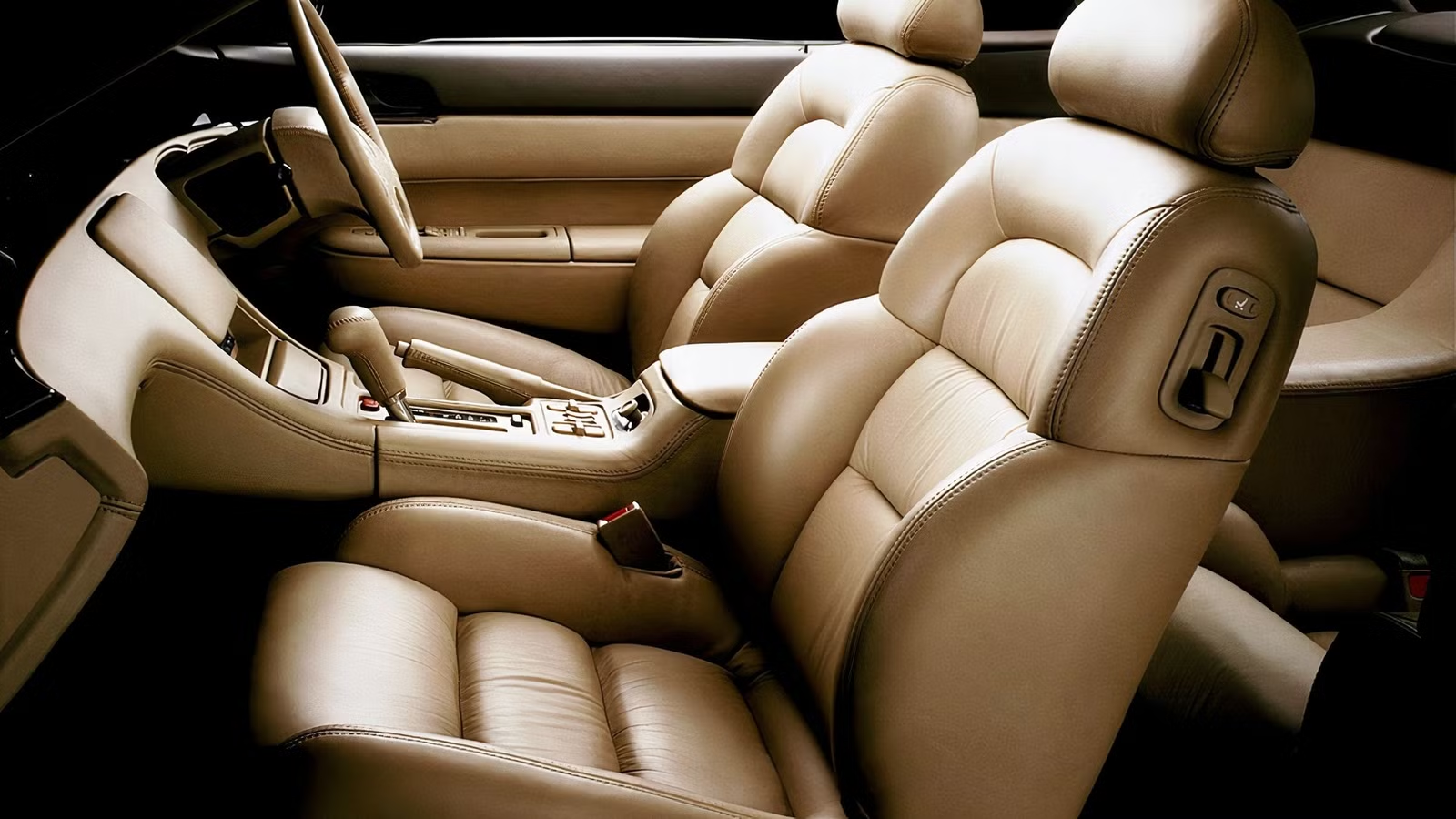
In those heady days, Mazda was really trying to match other serious Japanese and European luxury manufacturers, and the Cosmo’s pricing reflected its ambitions. For example, a 20B-powered Type S sold for approximately ¥4.2 million when new ($26,000 in today’s money), and the fully equipped Type E CCS reached ¥5.3 million ($32,860). Inside, the Cosmo lived up to its billing with a wraparound interior, a dark instrument display, a substantial center console, and a curved dashboard.
Some records show that Mazda produced around 8,850 JC Cosmos through 1995. Of them, 60% had the two-rotor 13B engine, and the rest got the three-rotor 20B. Those figures are significantly below production totals for the FD-generation RX-7.
The Three-Rotor Engine Is The Real Collector Payoff
1990-1996 Eunos Cosmo 3-rotor Twin-Turbo 20B EngineMazda
The most defining feature of the Eunos Cosmo is its 20B-REW engine option. Each of its three rotors displaced 654 cc, totaling 1,962 cc, and it had sequential twin turbos to help push out 276 hp, in line with Japan’s contemporary manufacturer power agreement. It also produced roughly 296 lb-ft of torque, which was quite impressive for a large luxury coupe at the time.
The Eunos Cosmo was the world’s first mass-produced vehicle with a three-rotor rotary engine and sequential twin turbos. One of the turbos handled lower-speed operation, with a second kicking in as speed increased. This was the same kind of arrangement found in the FD RX-7’s smaller 13B-REW setup. The Cosmo came with a four-speed electronically controlled automatic, and there were no manual transmission options. Power went to the rear wheels, and the 20B was known for its smooth delivery.
The Cosmo also had a sophisticated chassis with a double-wishbone front suspension, a multi-link independent rear suspension, ventilated disc brakes, and available anti-lock braking. The Type S models had firmer suspension settings and wider 16-inch wheels compared to the Type E cars. And while current collectors looking for genuine sports car response may still turn to an RX-7 every day, the Cosmo does feature a production three-rotor rotary engine, this time wrapped in a factory-built luxury coupe.
The Car’s Touchscreen Was Astonishing Tech In 1990
1990-1996 Eunos Cosmo JC Beige Interior DashboardMazda
Moving beyond the engine and looking at the Cosmo’s cabin reveals a lot about Mazda’s ambition. For a start, the company introduced its Car Communication System on certain models, featuring a color cathode-ray tube touchscreen that offered vehicle and entertainment functions in a single interface. This allowed drivers to control the climate system, radio, TV, CD changer, and navigation, while in some versions, an integrated telephone was available.
Mazda reckons that this was the world’s first mobile communication system incorporating GPS. And all of this appeared decades before large center displays and software-based vehicle controls would become standard across the business. The display was part of a sweeping center stack, and the digital instrument panel would light up brightly when the driver switched the ignition on.
Today, collectors may find this ambitious technology to be relatively limited, and its age could create complications. After all, it features Japan-specific navigation data, and the TV function is certainly well out of date. Also, it’d likely prove very hard to replace some of those electronic controls or screen components should they fail. However, the entire touchscreen arrangement does make its own statement about both the car and the manufacturer. The technology may look very quaint alongside a modern smartphone, but it shows Mazda’s interpretation of a rotary-powered luxury coupe during a high point for Japanese vehicles.
The Cosmo Is Cheaper Than An RX-7 But It’s Not A Cheap Car
1990 Mazda Eunos Cosmo JC Beige Interior OverviewMazda
In July 2026, you can expect to find a JC Cosmo for somewhere around $32,000. FD RX-7 values are generally higher, with market benchmarks ranging from around $44,000 for a US-market car to $55,000 for the desirable R1 and R2 variants. Special Japanese-origin models could cost substantially more, but much will depend on condition, originality, mileage, and modification history.
However, this suggests that the Cosmo is going to be far less costly than the same-era RX-7. Much of this may come down to the Cosmo being a right-hand drive importable machine, with no factory US sales history and a smaller buyer pool. The Cosmo also comes with a complex sequential turbo system, and those aging electronics and 20B engines (in particular) need very careful inspection. Potential buyers should conduct a rotary compression test and investigate the vehicle’s cooling system, turbo operation, and maintenance documentation.
Today, the Eunos Cosmo is importable under the 25-year rule, but buyers should look into state emissions and registration requirements carefully. But if they do discover a good example of sensible money, they’ll be buying a vehicle with an engine the RX-7 never received. It also comes with more unusual technology, and with low production figures, it represents a unique place in 1990s Japanese car history.
Many collectors may still opt for an FD-generation RX-7, knowing it has an exceptional chassis, low weight, and timeless styling. But the Eunos Cosmo is attractive enough in its own right. It’s Mazda’s interpretation of a sophisticated luxury flagship, featuring the company’s most advanced rotary technology. The three-rotor 20B model also offers greater historical novelty compared to an RX-7, and the good news is that the Cosmo will typically cost thousands of dollars less. And while there’s a lot of complexity to consider regarding long-term ownership, the Cosmo has to be one of the most remarkable Mazdas of the period.
Sources: Mazda, Bring a Trailer, Classic.com.
