

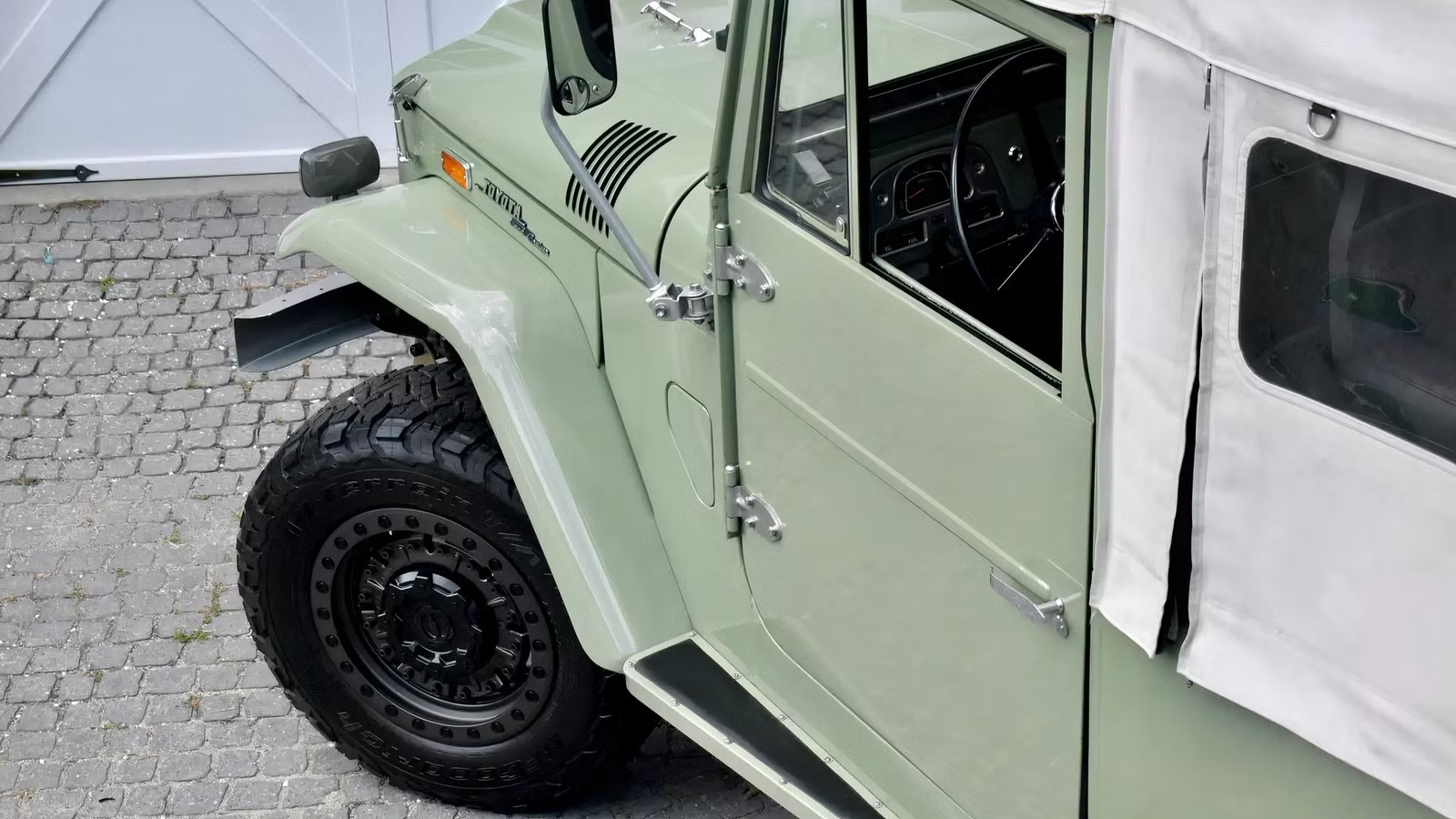
It’s reasonable to ask why someone would pay the same kind of money for a 1977 Toyota FJ40 as they would for a brand-new shiny Land Cruiser. After all, Toyota is tempting the new vehicle market with a 326-hp hybrid powertrain, locking differentials, and full-time four-wheel drive aboard today’s Land Cruiser, to say nothing of modern safety technology and factory warranty coverage.
But still, some individuals are opting for early Land Cruiser FJ40s in strong condition and are spending in the mid-$50,000 range. It seems that they’re paying for a very specific set of deliverables that Toyota may not be able to reproduce on its modern assembly line.
The Mid-$50,000 Cluster Is Real, But It’s Not The Whole Market
1977 Toyota Land Cruiser FJ40 front quarterBring a Trailer
In recent times, collectors have noticed a flurry of activity on the auction circuit related to Toyota FJ40s from the mid to late 1970s. In October 2025, a 1979 example sold for $57,000, and in January, a custom 1980 truck sold for $55,000. Meanwhile, in April of this year, a refurbished 1977 example changed hands for $56,500 after no fewer than 42 bids. Taking those three results together, the average is just a little under the current $58,080 base MSRP of a 2027 Land Cruiser. And this means that there’s clearly some interest in a particular kind of FJ40, even if it’s not fully representative of the entire FJ40 market.
Classic.com shows that the average recorded sale price for a typical FJ40 sits at around $36,560. There are some very significant outliers within its records but an FJ40 selling in the mid-$50,000 range would generally sit in the premium slice of that broad market. Needless to say, much will depend on condition, specification, originality, workmanship, documentation, and the selling venue itself.
A Late 1970s FJ40 Concentrates The Entire Land Cruiser Myth
1977 Toyota Land Cruiser FJ40 close-up frontBring a Trailer
Toyota introduced the FJ40 in 1960, and it immediately sparked the market’s imagination. It came with a short overhang front and rear, a fold-down windshield, leaf springs, plus solid front and rear axles. It went on to become Toyota’s best-selling vehicle in the US through 1965. Notably, the late 1970s trucks represented some of the most recognizable FJ40s in that lineage.
Toyota retained the original 3.9-liter F-series inline-six through 1974 before introducing the 4.2-liter 2F, which became the defining engine for the range. The company continued to sell the FJ40 with its short wheelbase and body-on-frame formula all the way through to 1983 in the US.
In the late-1970s FJ40, Toyota’s 4.2-liter overhead-valve inline-six generated 125 net horsepower at 3,600 rpm and 200 lb-ft of torque at 1,800 rpm. It had a four-speed manual and a dual-range transfer case, and that entire package was more for low-speed durability rather than get-up-and-go.
This also meant that the FJ40 was a quintessentially analog machine and its driver definitely needed to remain active behind the wheel. And that’s probably part of the market’s current attraction, where collectors are turning away from vehicles that all-too-often deliver software-managed outcomes. After all, the FJ40 had a narrow cabin, an upright windshield, and exposed hardware, and all that helped to turn an ordinary journey into an event.
The passage of time would probably not be kind to this type of vehicle if its owners had left it to its own devices. And this means that people who are willing to pay in the mid-$50,000 range for a 1977 truck will typically need to hold out for something quite special. For example, the previously cited $56,500 example had been completely refurbished, including rust repair, powertrain, and interior work, plus it had been retrofitted with electronic ignition, long-tube headers, and Old Man Emu suspension components. The latest buyer would therefore take ownership of a machine where the previous owner had already accounted for parts sourcing, troubleshooting, cosmetic work, and labor.
The New Land Cruiser Wins Most Objective Comparisons
2027 Toyota Land CruiserToyota
It’s tough to compare a late 1970s Toyota FJ40 with a 2026 Toyota Land Cruiser 1958, and some think that the latter is automatically superior as a method of transportation. After all, it features a 2.4-liter turbo i-Force Max hybrid system generating 326 hp and 465 lb-ft of torque. It uses an eight-speed automatic transmission and full-time four-wheel drive, features a two-speed transfer case, as well as locking center and rear differentials. The model can tow up to 6,000 lbs. and comes with a trailer brake controller and Crawl Control for difficult environments. It also carries an EPA-estimated 23 mpg combined figure.
New vehicle buyers can also take advantage of Toyota’s Safety Sense 3.0 system and a comprehensive warranty. The basic warranty runs for three years or 36,000 miles, with a powertrain package providing five years or 60,000 miles of coverage. The hybrid battery gets ten years, or 150,000 miles and hybrid components themselves get eight years or 100,000 miles of coverage.
So, the modern Land Cruiser is surely the logical choice when everyday usability and peace of mind come into the picture. It offers more power, more torque, more comfort, more safety equipment, greater towing capability, and less day-to-day risk. But for some FJ40 collectors, none of that makes a difference. To those buyers, the advantages of the modern Land Cruiser are not the only things worth paying for.
The Premium is For Condition, Authenticity, Or Work Already Done
1977 Toyota Land Cruiser FJ40 engineBring a Trailer
While some collectors will be ready to pay their premium if someone has already refurbished the FJ40 in question, others may yet look at an original FJ40 through a different lens. One may clearly reward a high-quality restoration and usability upgrade, but another may be willing to pay for some preserved factory character.
However, for the latter group, due diligence is essential. Many FJ40s received Chevrolet V8 conversions over the years, and this would clearly have replaced those stock drivetrains. While those seeking factory character may not automatically turn down some improvements or upgrades, they’ll certainly want to know if the work was appropriate, well documented, and completed to an excellent standard.
Meanwhile, although many collectors may relish the idea of driving an FJ40 in today’s modern and sanitized world, they should still be aware of its potential liabilities. They should know how rust repair, metal finishing, paint, weather seals, upholstery, brake work, and drivetrain rebuilds can eat up a restoration budget. And this helps to explain why they may be willing to pay new-car-money for a nicely finished and restored FJ40.
When potential buyers look at how broad the FJ40 market currently is, they’ll realize how important it is to conduct a proper pre-purchase inspection. They may know that not every $55,000 example is automatically exceptional, and want to examine its frame, body mounts, floor, rear quarters, and hard top door alignment. They’ll also need to document the quality of any engine conversion or suspension work and look carefully at restoration invoices and dated photographs.
The FJ40 Isn’t Better — And That’s Just The Point
1977 Toyota Land Cruiser FJ40 interior jump seatBring a Trailer
Buyers looking at any auction bids will, of course, have to consider that a winning bid will be subject to costs like a typical 5% buyer fee, tax, registration and possible transportation. Those costs could well take their FJ40 to a level above Toyota’s current Land Cruiser, even considering dealer processing and handling fees. In this case, those buyers may pause to wonder whether a new Land Cruiser would be the more rational choice when it comes to commuting, long-distance travel, towing, family use, or frequent off-road work. They may also start to wonder about the familiar risks of an old vehicle in terms of prior repairs, corrosion, parts sourcing, and restoration work quality.
But this is the point where rationality is not the only game in town. Collectors will know that the older truck has a visual and mechanical character that the new vehicle may reference but cannot duplicate. To these collectors, the imperfections of the old FJ40 are simply part of the interaction. After all, this was a time when transportation was simpler and focused more on durability, and before the vehicle itself took over the driving experience with all its cameras, selectable modes, and hybrid control software. And crucially, while the new Land Cruiser tackles almost every driving task more effectively, those buyers know that the FJ40 provides far fewer layers between the driver, the machine, and the terrain.
Sources: Toyota, Barrett-Jackson, Bring a Trailer, Classic.com.
