

UPDATE: 2026/08/12 08:30 EST BY DAN CLOUGHER
Mazda’s Uniquely Persistent Approach To Engineering And Development
We’ve included a section that focuses on Mazda’s historic record of taking the path less trodden in the auto industry.
The automotive world spent more than two decades chasing a white whale: a gasoline engine that ignites its fuel the way a diesel does — through compression alone, without a spark. Mazda claimed it had finally cracked the code. The technology was called Skyactiv-X, and it arrived with the kind of fanfare reserved for genuine breakthroughs. It was billed as the holy grail of combustion engines and a credible lifeline for internal combustion at a moment when electrification was rapidly reshaping the industry.
Mazda unveiled its revolutionary Skyactiv-X technology in 2017, priming it for use in nearly every facet of its vehicle lineup. It was positioned as proof that the combustion engine still had meaningful ground to gain — that efficiency and performance could improve dramatically without plugging anything in.
It took a few years to reach production, but before it could make a splash, it was quietly dragged out of the limelight. The technology meant to give combustion a new lease on life never made it into more than a few models, and it never reached American shores. Even in the markets where Skyactiv-X was present — sold exclusively for the Mazda3 and CX-30 — it is now on the way out, and Mazda has already lined up a replacement. Where did it all go wrong?
Why Mazda’s Skyactiv-X Technology Failed
Before delving into why Mazda’s Skyactiv-X technology failed, it’s important to understand what it is. The Skyactiv moniker refers to a series of technologies developed by Mazda to improve fuel efficiency and power output, which consists of a series of engines, transmissions, and other pieces of hardware. The Skyactiv name is less important than the prefixes and suffixes attached to it, with single letters used to denominate different technologies:
Variations Of The Mazda Skyactiv Naming Convention
- Skyactiv-G – Mazda’s primary family of gasoline-powered Skyactiv combustion engines
- Skyactiv-D – Mazda’s diesel-powered Skyactiv engines that were promised but never arrived in America
- Skyactiv-X – An advancement of Skyactiv-G using compression ignition for better efficiency
- Skyactiv-Z – The next generation of Skyactiv combustion engines
- e-Skyactiv – Hybrid powertrains from the Skyactiv family, often combined with other suffixes like G and X
- e-Skyactiv R-EV – Range-extender electric powertrains using a small rotary engine as a generator, as seen in the MX-30 e-Skyactiv R-EV
Skyactiv-X Combined The Best Of Diesel And Gasoline
Skyactiv-X was arguably the most exciting of these, as it promised something not seen before in mainstream use. Effectively, it combined the principles of diesel and gasoline combustion into a single engine, utilizing the clean, rapid-burning combustion characteristics of gasoline and the high-compression efficiency of diesel. At its core was something called Spark Controlled Compression Ignition (SCCI), which relied on a high compression ratio of 16.3:1 — later reduced to 15.0:1 when a mild hybrid system was added — to ignite the gasoline and maximize its energy density and efficiency. This compression ratio resulted in an exceptionally lean fuel-air mixture, reducing the amount of unburnt fuel that could be emitted.
The spark plug didn’t completely ignite the fuel-air mixture. Instead, it aided in controlling the compression by creating a shockwave opposing the movement of the piston, producing a controlled, complete burn in the most efficient way possible. This was supposed to extract more power from every drop of fuel and, by ensuring it burned more completely, reduce emissions as well. So why did it fail?
Not Enough Power, Not Enough Efficiency, Too Expensive
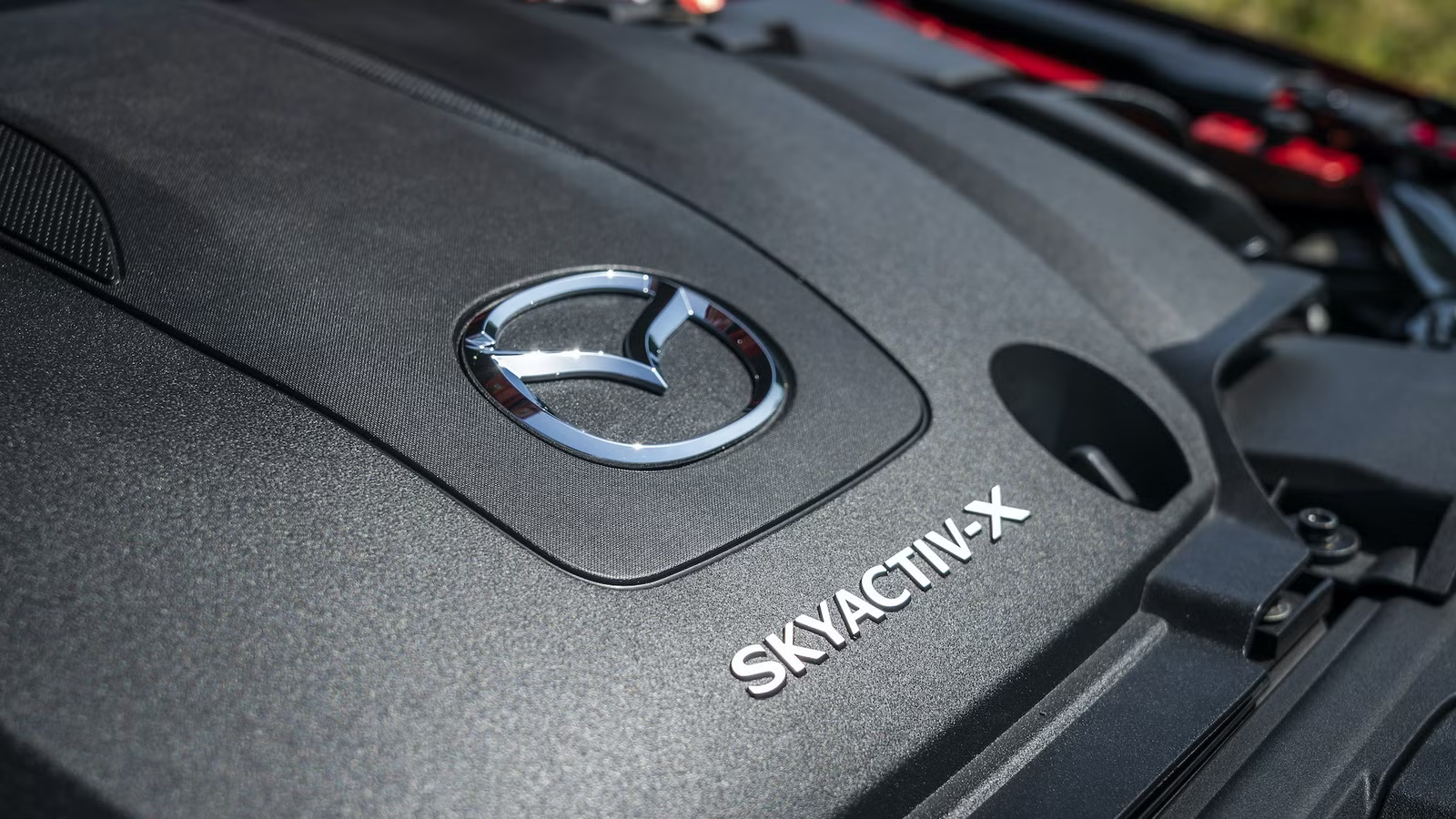
The Mazda Skyactiv-X engine on display.Mazda
First of all, it wasn’t a complete failure. It reached the market in 2019, launching in Europe’s Mazda3 first and then in the CX-30 crossover, and in some countries like the UK it is still available in those models, now with mild hybrid assistance and lower compression ratios. So the term ‘failure’ is used loosely here. However, what’s abundantly clear is that it didn’t reach the heights it was supposed to — not least of all because it never reached the US (just like Mazda’s diesel CX-5), which would have been a critical market to prove itself in. While Mazda won’t ever say outright that it didn’t succeed, or offer justification for that, three major reasons stand out for why Skyactiv-X fell short:
Not enough power: America is power-hungry, and we don’t mean politically so. Americans like powerful cars, just as we prefer larger vehicles than the rest of the world. Skyactiv-X never delivered enough power to justify a switch away from the standard Skyactiv-G engines it was meant to replace. Mazda acknowledged this when it told Automotive News that it was concerned Americans wouldn’t be happy with getting less power than they were accustomed to. The 2.0-liter Skyactiv-X four-cylinder produced 178 horsepower and 165 lb-ft of torque, while the 2.5-liter Skyactiv-G engine still used across a variety of Mazdas managed 186 hp and the same torque figure. Considering the turbocharged 2.5-liter engines in many of Mazda’s models produce around 250 hp, the Skyactiv-X was a relative letdown. Later updates — the integration of a 24-volt electric motor — increased power and torque to 183 hp and 177 lb-ft, respectively, but even that wasn’t improvement enough.
Not enough efficiency: A small reduction in power is one thing, but what if it were offset by massive fuel savings? That might have been enough to convince buyers, but Mazda couldn’t extract enough from Skyactiv-X, claiming only a 9% improvement in fuel economy on the WLTP cycle. And it probably would have fared worse under EPA certification. The Mazda3 Hatchback achieves an EPA-rated combined figure of 30 mpg, while the non-hybridized Skyactiv-X version managed only 36 mpg on the WLTP cycle. EPA figures are typically much stricter, usually averaging 20–30% less than WLTP claims. Even at the lower end of that range, there is little evidence to suggest Skyactiv-X would have been meaningfully more efficient in real-world US driving. We’ve lamented the current 2.5’s modest fuel economy in the past, but Skyactiv-X didn’t present a great enough leap to justify its cost.
Too expensive: For less power and only a marginal increase in efficiency, Skyactiv-X would have added a 27% premium over the base engine in a Mazda3. That was perhaps the biggest nail in the coffin of its American dream. Why pay significantly more for such a marginal benefit?
The Mazda Skyactiv-X engine on display.Mazda
Skyactiv-X Spec Comparison
Technology
Skyactiv-G
Skyactiv-X
e-Skyactiv X
Engine
2.5-liter four-cylinder
2.0-liter four-cylinder
2.0-liter four-cylinder mild hybrid
Horsepower
186 hp
178 hp
183 hp
Torque
186 lb-ft
165 lb-ft
177 lb-ft
There was also the complexity aspect to consider. The high compression ratios necessitated high-octane fuel at all times. Any reduction in fuel quality meant retarded timing to prevent engine knock, and a resulting drop in both performance and efficiency. The later updates — which introduced the e-Skyactiv X nomenclature — reduced the compression ratio, but at 15.0:1 it remained far higher than any traditional gasoline engine.
Mazda had previously stated it was working on a six-cylinder engine with Skyactiv-X technology, but that never came to fruition.
Close
Skyactiv-Z: Killing Two Birds With One Stone
Mazda’s upcoming Skyactiv-Z engine will replace the Skyactiv-G used in vehicles sold in the North American market and the Skyactiv-X engines sold overseas. According to Mazda, the new engine will be an inline four-cylinder that leverages the experience and knowledge gained from developing and implementing the previous Skyactiv engines to deliver lower emissions. These advancements may also be applied to larger inline-six motors.
Details for the anticipated Skyactiv-Z engine remain scarce. However, Mazda has mentioned that the new engine will employ a ‘lambda one’ combustion method, which utilizes the lambda value of 1.0 to achieve an ideal air-fuel ratio for combustion — the same principle achieved by Porsche’s T-Hybrid system in the 992.2 911 GTS.
Mazda states that this method will allow the engine to achieve high thermal efficiency by utilizing very lean-burn combustion over a wider portion of the rpm range, striking a balance between lower CO2 emissions and driving performance without sacrificing one for the other. Mazda has stated that this ability to reduce emissions significantly will allow it to meet the requirements of regulations such as the CARB-approved LEV IV emissions standards. The latter is an important point, as the fact that Mazda specified US emissions regulations signals its intent to bring the new engine family stateside.
Mazda’s Uniquely Persistent Approach To Engineering And Development
The Mazda Cosmo’s 20B three-rotor engine is a bit of a unicorn in the rotary community.Mazda
What the Skyactiv-X engine, and indeed the other aforementioned Skyactiv engines, demonstrate so clearly, is that Mazda has never been one to settle down and accept the status quo. It famously pioneered rotary power for many decades throughout the 20th century, even when other automakers had ruled it out, and even to this day it looks as if Mazda still has big plans for the propulsion type.
It’s unfortunate that Mazda is often seen as an underdog in comparison to the Japanese giants it competes with, because Mazda’s relentless approach to thinking outside the box and continued development is without a doubt a story that represents one of the more exciting chapters of the modern auto industry.
Sources: Mazda, Automotive News
