

Automakers have always chased the next big thing — and not every swing connects. For every touchscreen infotainment system or wireless charging pad that became a modern staple, there’s a forgotten gimmick that seemed brilliant at the time and looks baffling in hindsight. Some of these features were genuinely ahead of their era but let down by the technology available; others were simply solutions in search of a problem.
Either way, they didn’t last — and looking back at them tells us a lot about how far the car industry has come. While some features have stood the test of time and are still useful today, others have become obsolete, or were simply not that good of an idea to begin with, due to technological flaws. This list will focus on the latter: let’s take a look at some of the features offered by automakers over the years that haven’t aged so well.
Navigation SD Cards
2009-2010 Lexus IS – navigation screenLexus
Navigation is an essential part of modern cars, and before it was folded into a wider infotainment system, standalone satnav units were commonplace. Today, navigation is either integrated with your phone via Apple CarPlay or Android Auto — updating automatically — or delivered wirelessly over the air directly to the car’s own system.
Not too long ago, however, SD cards were the preferred method of storing navigation maps. This clunky approach required drivers to purchase physical cards and manually swap them in whenever map data went stale — which is precisely why it fell out of favor the moment reliable online updates became possible.
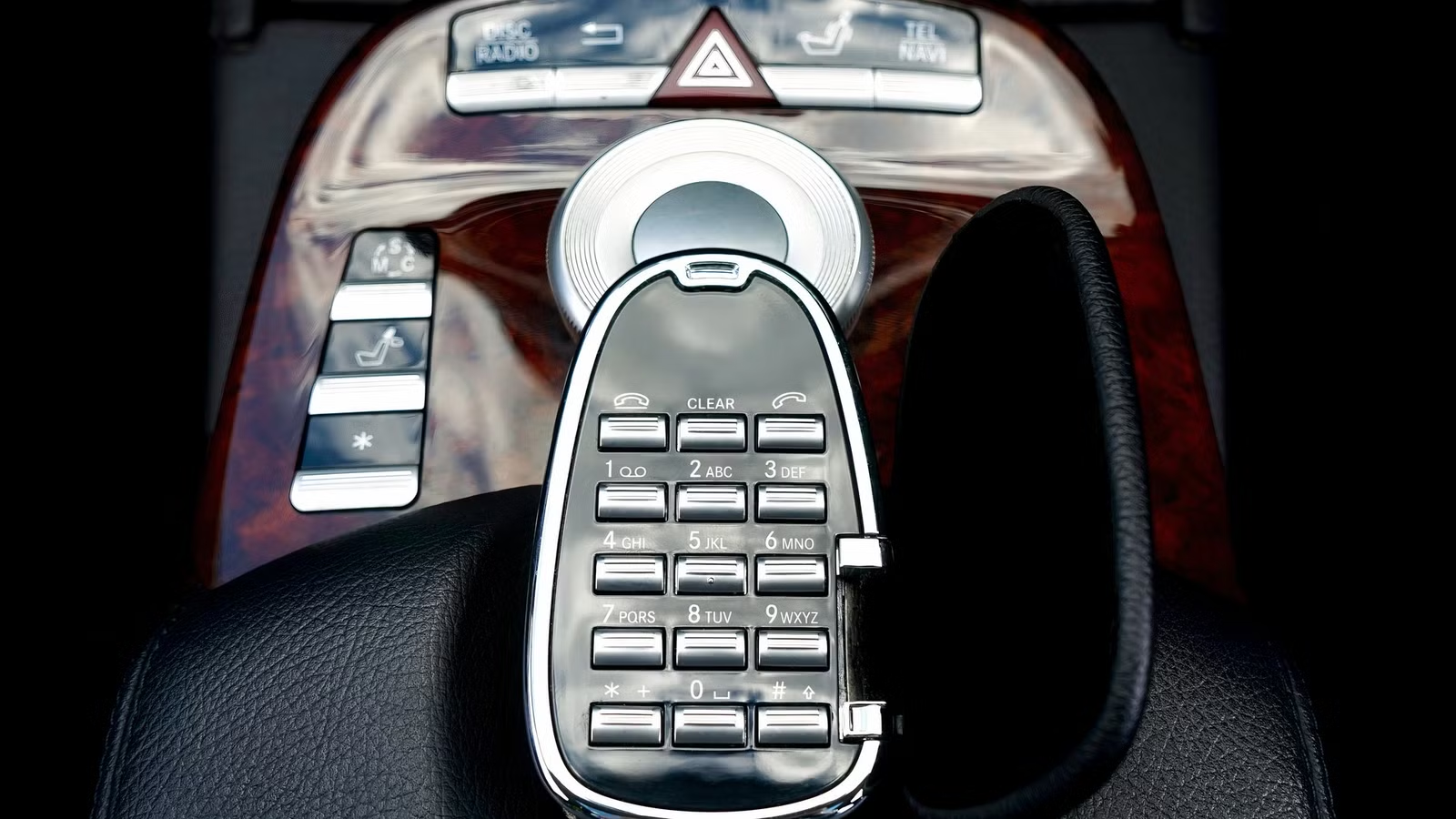
In-Car Phone
2008 Volkswagen Phaeton In-Cabin TelephoneVolkswagen
The ability to communicate from your vehicle has always been sought after, with the first examples of in-car phones arriving in the mid-1940s. Early systems were bulky and expensive, connecting to the landline network via radio technology.
Car phones continued to evolve throughout the following decades, and by the early 1980s they had become compact enough to gain broader popularity, while still remaining the almost exclusive preserve of high-level executives who needed to work on the go. The car phone’s heyday would, however, be a short-lived one: by the turn of the millennium, mobile phones had arrived on the market, making car phone technology obsolete and eventually replacing it completely.
CD/Cassette Player
Car Audio System w/ CD PlayerHelp Net Security
In-car entertainment options have varied across the decades: before we could stream music through our phones or other digital devices, the cassette player and, later, the CD player were the most popular options. However, both of these rapidly fell by the wayside once more modern listening methods arrived on the market; you can often date a car to a specific era just by glancing at its infotainment setup.
CDs were the most recent physical format available, occupying a large share of the music market until the early 2010s.
Surprisingly, there are still two new cars available with a CD player, both sold by Subaru, but at a hefty premium.
In-Car Vinyl Record Player
Chrysler Highway Hi-Fi systemFCA US
Before the CD player, there was (briefly) the in-car record player. This short-lived idea came about as a result of Chrysler attempting to find more ways to keep drivers and passengers entertained over long journeys. Up until 1956, AM radio was the only option for those who wanted something to listen to in the car; the Highway Hi-Fi, a built-in record player, was supposed to change that.
Rather than playing regular records, the Highway Hi-Fi was only compatible with custom discs: they were the same size as a standard 45 rpm record, but played at just 16⅔ rpm. This gave them a runtime of around 45 minutes per side, making them a plausible solution for long car journeys. The system was still clunky and riddled with issues, and Chrysler killed it off in 1959 due to poor sales.
Chevrolet Liquid Tire Chain
GM Liquid Tire ChainPushcar.ru
Today, we have technologically advanced vehicles and a wide choice of quality winter tires to keep us safe in snowy or icy conditions. In the 1960s, however, options were more limited, and poor weather conditions made accidents much more likely. Chevrolet attempted to find a solution to this problem in 1969, with a chemical solution referred to as a “liquid tire chain.”
This polymer compound was stored in a canister, positioned strategically to spray directly onto the rear tires when needed. The system could be activated directly through a button on the instrument panel. This feature was only available as an option for the 1969 model year, with only 2,600 customers opting to have it installed.
VW Dash-Mounted Coffee Maker
VW Hertella Coffee MakerOpenCulture
The Volkswagen Beetle is best known for its iconic design, worldwide popularity (it was the first car in history to sell over 20 million units) and mechanical simplicity; it is not commonly associated with luxury features. Volkswagen did, however, briefly produce a coffee maker accessory designed to be installed in the Bug in the late 1950s.
The coffee maker was called the “Hertella Auto Kaffeemaschine.” Very few surviving examples exist and information is scarce, but we know it consisted of a simple heated pot — which brewed coffee much like steeping tea — and a set of cups with a magnetic disc on the bottom that secured them to the unit. The machine was attached to the dashboard with a bracket in what appears to be a fairly precarious arrangement. It would be another half-century before the art of in-car coffee making was perfected by the Italians, with the Fiat 500L.
Automatic Seatbelts
Automatic SeatbeltsCurbside Classic
Automatic seatbelts were once near-ubiquitous in the car world, but disappeared almost as quickly as they arrived. First introduced in the late 1970s, they were seen as offering both a safety improvement and a convenience boost, sparing drivers and passengers from having to fasten their own seatbelt. The system consisted of a sliding mechanism that traveled from the A-pillar to the B-pillar, draping the belt across the occupant’s chest. The lap portion of the seatbelt was frequently separate and still had to be fastened manually.
Automatic seatbelts had many issues, chiefly a complex mechanism that was prone to failure and did not meaningfully improve safety outcomes. The convenience benefit was also negligible, and by the turn of the millennium, the conventional seatbelts we use today had become universal.
Talking Cars
Talking DashboardPetrolblog
The idea of a “talking car” might call to mind modern voice assistants like Siri or Alexa, but the concept is actually much older, dating back roughly four decades. The 1980s automotive world was captivated by futuristic graphic interfaces and tech-forward features, riding the cultural wave of the decade’s obsession with computers and technology.
Automotive voice technology of the era — whether it used pre-recorded messages or a speech synthesis system — was part of this trend: the car could alert its driver when fuel was low, a door was ajar, or a light had been left on. These systems weren’t particularly popular and had faded away by the end of the decade, but the concept of a talking car lives on in today’s voice-control systems, albeit in a far more sophisticated form thanks to AI.
Toyota Van Ice Maker
Toyota Van Ice MakerStarsDouar
In the second half of the 1980s, Toyota’s unimaginatively named Van promised practical and comfortable travel for the whole family. Its unusual layout — including an engine mounted under the cabin floor, accessible through the driver’s seat — already set it apart from the crowd; but one optional feature makes it particularly memorable.
The Van’s LE trim offered a refrigerator complete with an ice maker, nestled between the front seats. The air conditioning refrigerant lines doubled as the mini-fridge/freezer’s cooling mechanism. This feature was discontinued when the Van was replaced by the Previa in 1990; one can imagine several practical problems, including the proliferation of germs from moisture and the build-up of odors over time.
Eco-Friendly Wiring
Rat and car wiringHabCert
Sometimes, attempts at being environmentally friendly backfire badly, as many automakers discovered when choosing greener materials for wiring insulation. The soy-based coating that became popular in recent years, and is still used on many models today, is known to be very attractive to rats: there have been numerous cases of rodents chewing through soy-based wiring, causing catastrophic damage to vehicles.
While some — including the automakers themselves — insist that the material is not the root cause, and that rodents will gnaw through conventional plastic just as readily, the volume of anecdotal evidence suggesting they find soy-based wiring to be a particularly tasty snack is hard to ignore. Given the number of lawsuits filed by frustrated owners, it’s safe to say this is one well-intentioned feature that has not aged well.
Sources: News24, Toyota, Chevrolet, Volkswagen, Car Trade Insider, McCarthy Collision Centers, Throwin’ Wrenches
