

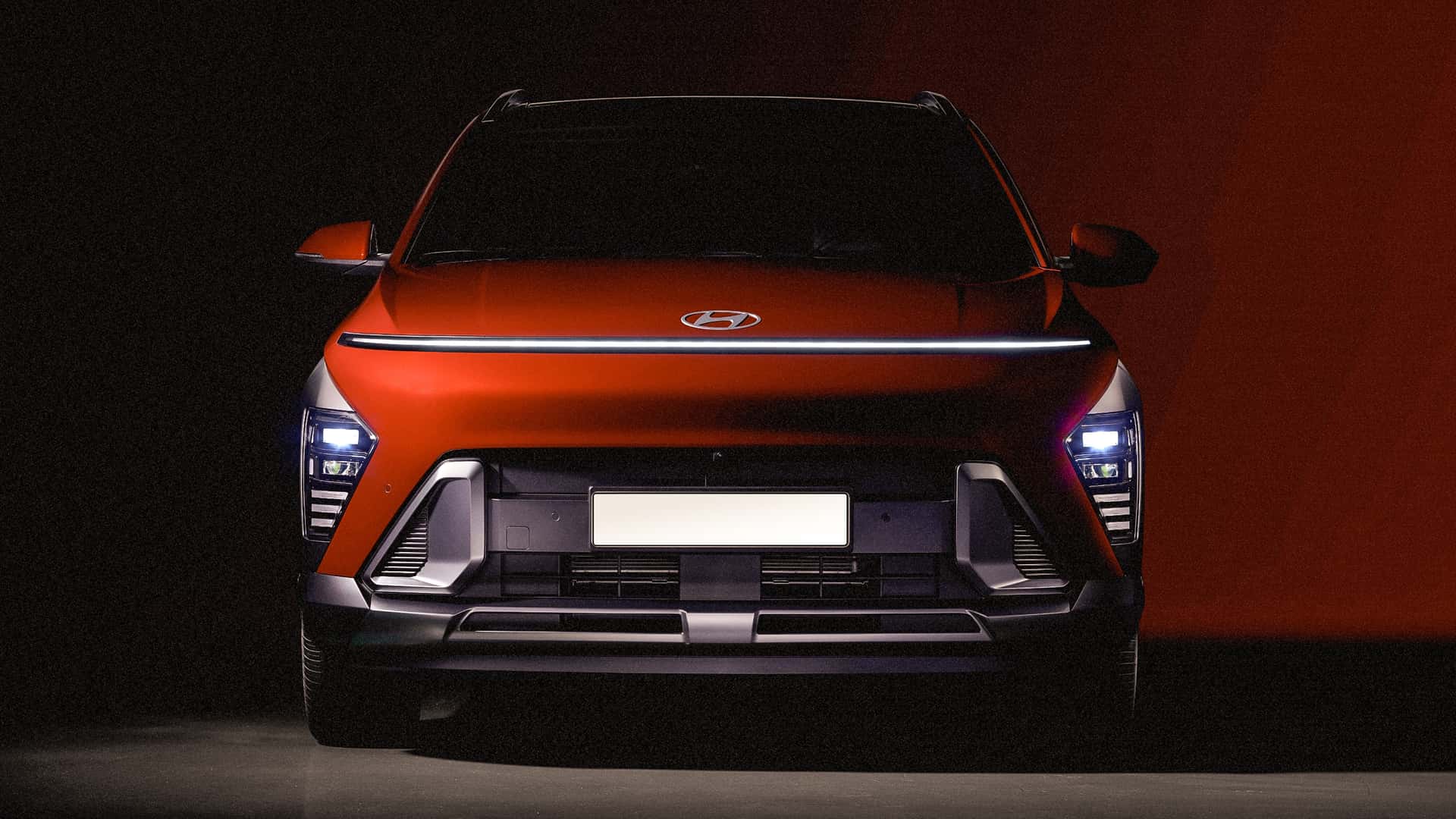
Forget the classic look of two large headlights at each corner of the front end. Today’s cars see the world with new eyes: slim, sharp, and high on the bumper. LED daytime running lights (DRLs) have taken center stage visually, while the main headlights are now often hidden in the bumper, out of direct view, or seamlessly integrated into the bodywork.
This “split headlight” design has become increasingly popular, with SUVs, sedans, and even some station wagons all sporting the look. Originally a clever solution to a technical problem, split headlights are now a defining style choice for many automakers.
Take the Ferrari Purosangue, for example, with its barely visible slim lights above massive air intakes. Or the Hyundai Kona and Tucson, which have built an entire visual identity around this setup. Even several recent Citroen models sport the split headlight look.
The question is: Why are so many automakers splitting their light fixtures in two?
It’s largely due to the LED daytime running lights, which have become more of a design statement than a technical feature. Positioned high on the front end, they act like glowing eyebrows, while the actual headlights—both high and low beams—are tucked lower down, often integrated directly into the bumper.
The Ferrari Purosangue takes this design approach to the extreme, combining it with a bold, sporty setup. Meanwhile, the Hyundai Santa Fe and the new Kona turn the lighting signature into a graphic element, using full-width DRLs or integrating them directly into the grille.
The Citroen C5 X, a flagship example of this design language for the French brand, traces its roots back to the 2016 C-Xperience concept. That concept car introduced the idea of a high-mounted lighting signature integrated into the double chevron emblem, with the main headlights hidden below.
Originally a clever solution to a technical problem, split headlights are now a defining style choice for many automakers.
Within the Stellantis group, the new Lancia Ypsilon also adopts a similar approach: a high-mounted LED light signature that echoes the brand’s stylized “chalice” emblem, while the main headlights are positioned lower down, hidden within the bumper’s sculpted volume.
This separation of function and form isn’t just technical—it establishes a new visual language, where light becomes thin and sharp, and the car’s face takes on a hi-tech, futuristic look.
Alongside the split between DRLs and main headlights, continuous light strips have emerged as a unifying element. Some brands have started connecting the DRLs with a single LED strip, as seen on the Volkswagen ID.4, the Cupra Tavascan, and the latest Smart models—though many of those vehicles still feature larger headlight elements at each corner.
Others, like the Skoda Enyaq or the latest Peugeot 308, create true illuminated “masks” with crystalline effects. Meanwhile, the Audi Q6 E-Tron and BMW i7 experiment with ultra-thin LED units in more traditional positions, but designed like fragmented jewels, capable of dynamic lighting sequences.
One of the most radical and advanced interpretations comes from the Tesla Cybertruck, which features a continuous horizontal LED strip as the only visible light signature across the top of the front end. The razor-sharp light fixture spans the entire width of the hood like a graphical element, while the actual headlights are fully hidden in the bumper, housed in two barely visible vertical modules.
In all these cases, lighting sheds its purely technical role to become an expressive element—a brand signature, a graphic statement. And the actual headlight? It’s increasingly smaller, more discreet—often nearly invisible until switched on.
In the case of the new Ferrari 849 Testarossa, light takes on a connective role: a slim front strip links the two headlight units without merging into a single bar. This respects regulatory constraints while still creating visual continuity across the front of the car. It’s an elegant approach that blends aerodynamic efficiency with stylistic identity—without sacrificing the prominence of the logo or instant recognizability.
With the rise of electric vehicles and the traditional front grille disappearing by the day, we’re entering a new era: the front of the car is no longer defined by its radiator—it becomes a display of identity. Split headlights and DRLs are already pointing in this direction: light becomes an active ornament, a coded language, a dynamic face.
Concepts like the BMW i Vision Dee introduce interactive LED panels that replace traditional headlights with digital displays. Meanwhile, Chinese brands such as HiPhi, Xpeng, and BYD are experimenting with lights that can change shape, color, and sequence depending on context.
As traditional headlights retreat from view and light moves upward, a vehicle’s “eyes” are now becoming a thing of the past.
We want your opinion!
What would you like to see on Motor1.com?
Take our 3 minute survey.
– The Motor1.com Team
