

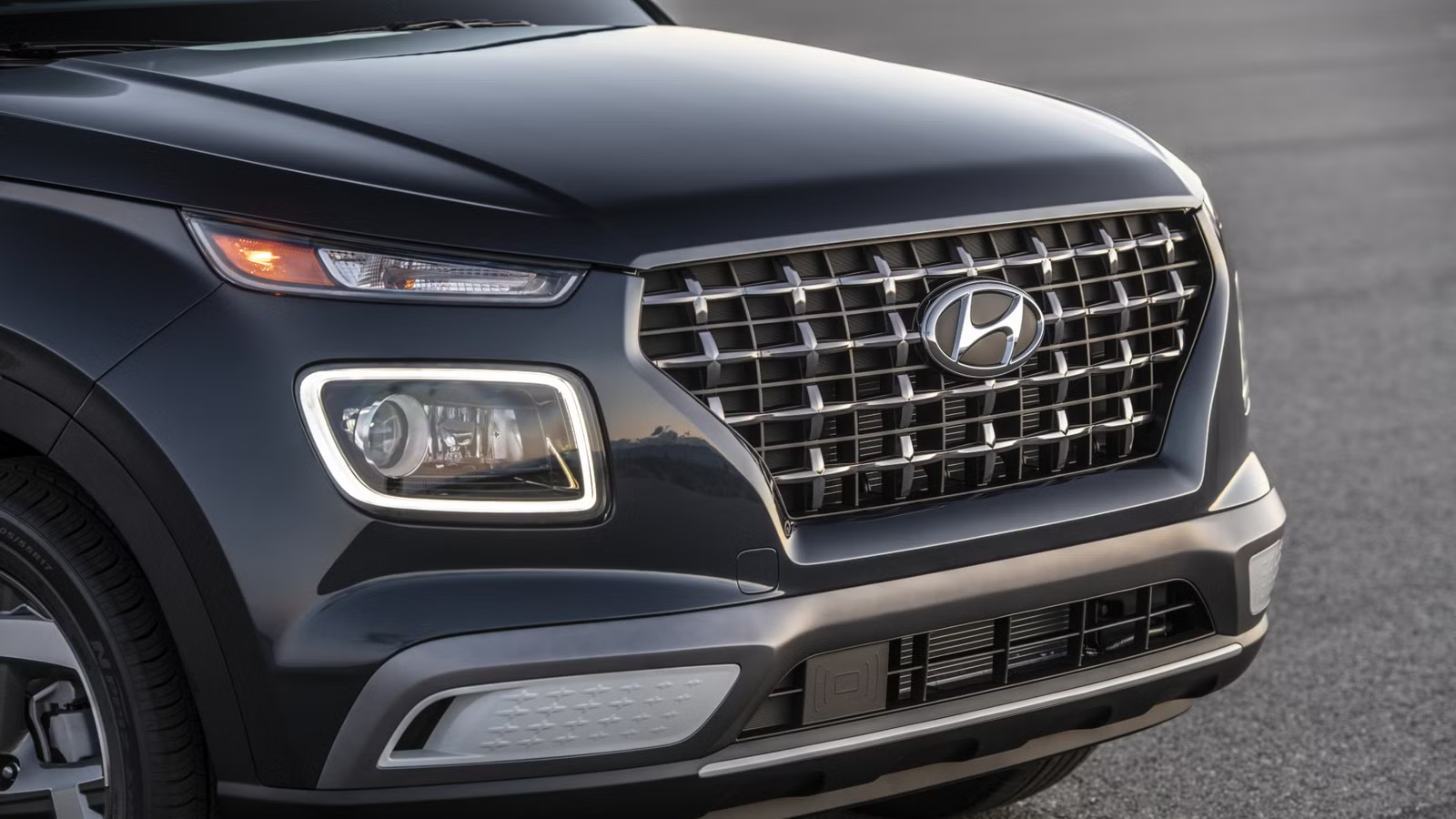
Money can’t buy happiness, but according to the American Customer Satisfaction Index, it buys surprising disappointment in the driveway. Despite cutting-edge tech and price tags starting well above $20,000, new cars rank lower in owner satisfaction than everyday essentials like smartphones, TVs, appliances, athletic shoes, and even soft drinks. Buyers expect a dream purchase, but the numbers prove that humbler products consistently deliver far bigger smiles per dollar.
Cars Can’t Beat Cell Phones, TVs, Or Fast Food
2026 Hyundai Venue interior steering wheelHyundai
In its 2026 automobile study, the American Customer Satisfaction Index (ACSI) put the auto industry at 78 points out of 100, a 1% drop over the previous year. The ACSI measures customer satisfaction across hundreds of companies and dozens of industries, so it’s a particularly useful tool for such a comparison. It uses a common 0 to 100 scale in every case and asks participants about their recent experiences with relevant brands.
ACSI Index
Score
Latest Study
Athletic shoes
83
2025
Soft drinks
83
2025
Televisions
81
2026
Household appliances
80
2026
Cell phones
79
2026
Quick service restaurants
79
2026
Automobiles
78
2026
Personal computers
78
2026
Vacuum cleaners
78
2026
The table indicates just how ordinary the automobile score appears alongside other industries, and it is on par with vacuum cleaners, of all things. The two highest-scoring everyday goods in the group are athletic shoes and soft drinks, with the latter being, of course, the ultimate consumable. So, even though a modern 2026-model-year automobile costs more than $20,000 at the very bottom end of the market, it cannot even match a quick drink or a visit to a quick-service restaurant.
And the auto industry score looks even worse when you consider that the average cost of a car in the US now hovers around the $50,000 mark.But if buying a cheaper car won’t help, what about spending more on a luxury badge?
Spending More On A Luxury Car Doesn’t Help
2027 Mercedes-AMG CLA 45 4Matic+ Electric (European Spec)Mercedes-Benz
The ACSI also splits its automotive findings between mass-market and luxury cars, and here the story is even worse for those high-end brands. The study found that mass-market satisfaction declined 1% to 78 for 2026, but luxury satisfaction fell 3% to its new score of 78. In 2025, luxury cars scored above mass-market vehicles, but the satisfaction advantage that premium brands once had has now disappeared. That should be of particular note to OEMs at the high end of the market, where a luxury badge usually adds tens of thousands of dollars to the sticker price.
As it turns out, none of ACSI’s measured luxury customer experience categories improved in 2026. Mobile app quality dropped 2% to 82 and website satisfaction declined 2% to 81. Driving performance fell 2% to 82, and gas mileage satisfaction tanked 3% to 78. In addition, the percentage of luxury customers reporting complaints jumped to 32%, representing a 14% relative increase.
Looking at individual brands, there’s some qualified good news for Mercedes-Benz. It leads the luxury group on 81, despite having fallen 1%. Lexus dropped like a stone from 87 to 78, despite leading the entire industry in 2025, while Cadillac was at the bottom of the ACSI’s luxury table, falling 15% to 69.
In the mass market, Toyota sits at the top with 83, while Chrysler is at the bottom, scoring 67. Subaru comes in at 81, Honda at 80, and Hyundai and Kia at 79. Buick is the biggest faller of the year, dropping 16% to 68.
So if paying more doesn’t buy satisfaction, what exactly is going wrong? The answer may be hiding in your glove box – or more accurately, on your phone.
All That Technology Isn’t Making The Apps Better
2016 Cadillac ELR Interior Touch ScreenCadillac
Modern cars are often called computers on wheels, and manufacturers tout their vehicles’ technological sophistication as much as their transportation capabilities. Large touchscreens, connected services, OTA updates, digital keys, and smartphone integration are now everyday features, even outside the luxury market. But there seems to be a bit of a disconnect between the actual vehicle technology and the software that surrounds it.
Among mass-market brands, satisfaction with technology — including displays, audio, navigation, video systems, and controls — actually increased 1% to 80. Mobile app quality, however, fell 4% to 80, which was the largest decline among mass-market customer experience measures. ACSI suggests that functionality and design may be causing more dissatisfaction than straightforward downtime or crashes.
Meanwhile, in its list of the leading mass-market complaint areas, electrical, battery, and software problems came out on top, followed by customer support issues and engine or powertrain concerns. Luxury manufacturers found that their mobile app quality scores dropped 2% to 82 and app reliability fell 1% to 82 as well.
As customers are increasingly taking advantage of digital technology in the automotive sector, these scores have become especially problematic. After all, today’s owners may use an app to check a vehicle’s charging status, precondition its cabin, locate the vehicle, lock or unlock it, or access other connected functions. Yet despite all these frustrations, one type of car is consistently bucking the trend — and it’s not the flashy EV.
Hybrids Are The Most Satisfying But They Aren’t Bulletproof
Close-up of the 2027 Nissan Rogue Hybrid badgeJoel Stocksdale / CarBuzz / Valnet
On the positive side, there are some clear advantages for hybrid vehicles in any powertrain comparison. Across the entire industry, hybrid satisfaction stays at 80 compared to 2025, but gas-powered vehicles fell 3% to 78 and EVs declined 1% to 72. In the mass market segment alone, hybrids scored 80 again, with gas vehicles at 78 and EVs at 69.
Some individual measurements within that broader study may help to explain the hybrid appeal. When it comes to rating driving distance on a full tank or charge, mass market hybrid owners came in at 76, compared to 74 for gas models and just 64 for EVs. Expected future resale or trade-in values seem to follow the same sequence, with hybrids at 75, gas at 71, and EVs at 63.
However, the hybrid picture isn’t universally positive. In the luxury hybrid sector, satisfaction dropped 4% to 80, and perceived value among luxury hybrid customers fell 5% to 80. Hybrid complaints across the industry jumped by 25%, although the handling of such complaints improved from 74 to 77.
Some of these drops may help explain why the overall satisfaction score for Lexus fell from 87 to 78. After all, electrified vehicles represented 35.6% of its US sales in 2025 and the decline in luxury hybrid satisfaction may be one key factor affecting this brand and its heavy electrified mix.
Strangely, EV owners do not appear to have very high levels of overall satisfaction with their vehicles, but they are nevertheless showing signs of loyalty. Mass-market EV repurchase likelihood jumped 13% to 72. Customer retention increased from 57% to 71%, and the “likelihood to recommend” score rose 9% to 73%.
A Car Has A Lot More Opportunities To Disappoint
Front shot of a 2022 Ford F-150 LightningFord
The automobile industry may be in a particularly vulnerable position in this type of study due to how much consumers have riding on any vehicle purchase. According to Experian, with its Q2 2026 figures, the average amount financed for a new car was $43,610, leading to an average monthly payment of $765 and an average loan term of 69.5 months.
By that measurement, consumers may take on an average of six years of payments and have a great deal more time to stew about their purchase. They can typically replace a phone without refinancing a major asset, gulp down a soft drink without thinking about it, or quickly forget a disappointing meal. But a troublesome car can create servicing costs, depreciation concerns, software frustrations, lost time, fuel or charging issues, and years of monthly payments.
The basic methodology behind the ACSI study revolves around expectations, perceived quality, and perceived value. With a car, all three of these are strongly tested against an unusually large financial commitment. The cheapest 2026-model-year vehicle in America is now the Hyundai Venue, which starts at $20,550, but with average transactions exceeding $50k, financed buyers often commit to hefty “marriages” stretching close to six years.
Perhaps it’s not a surprise that automobiles struggle to replicate the satisfaction scores for cell phones, fast food restaurants, and household appliances. After all, cars ought to expect a tougher time, given that they may have to transport a family safely for years on end. But when the price is high, customers will always expect a lot. And as almost every part of a car ownership experience now involves software, service, financing, and resale value, a technically impressive machine by itself is simply not enough.
Sources: ACSI, Kelley Blue Book, Hyundai,
