

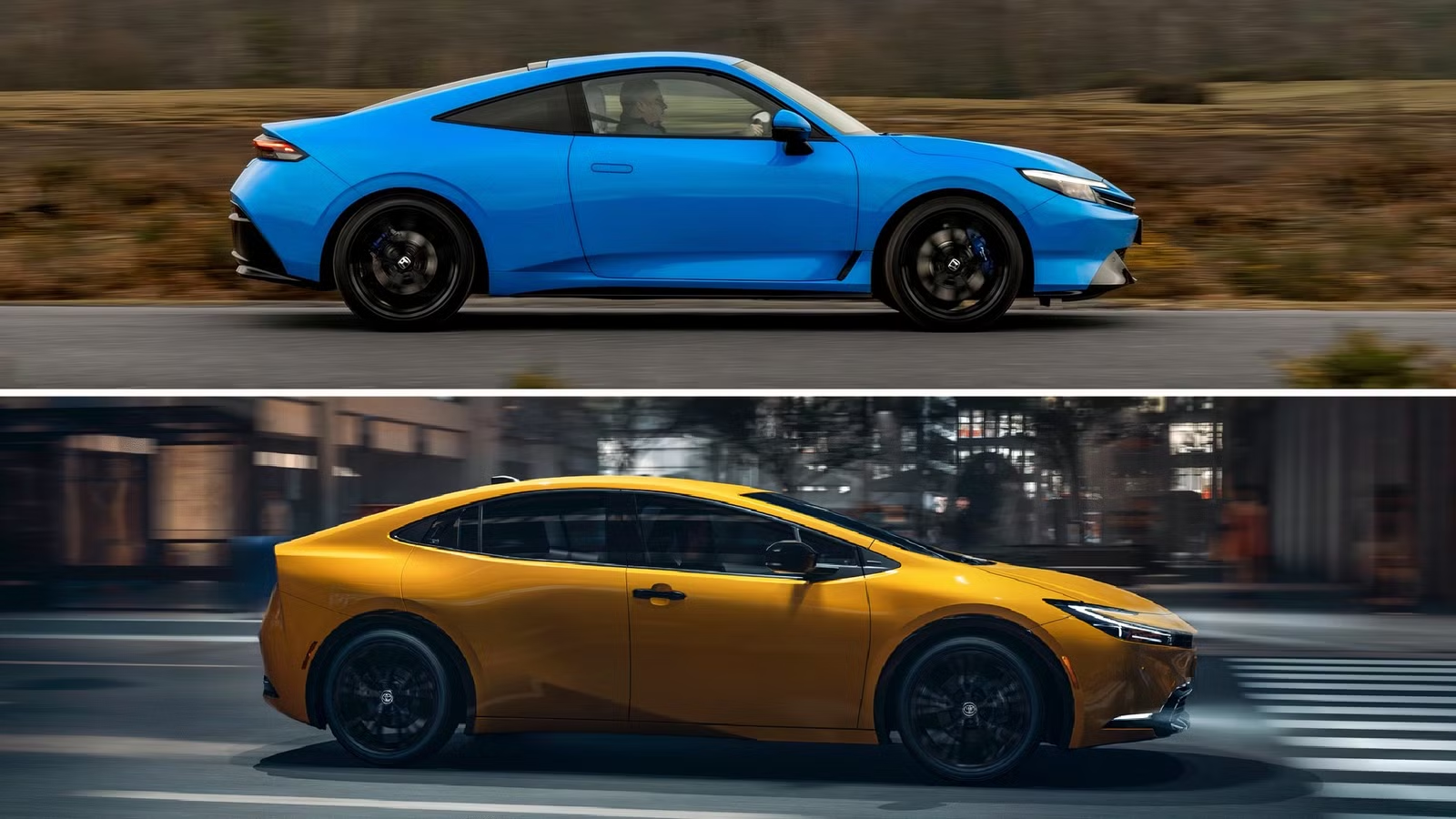
Along with a zillion other ways, the 2020s have been transformative for the Prius and Prelude nameplates. The Prius is no longer the frumpy, slow appliance it used to be. Now, it’s a nearly 200 hp hybrid sport compact with low, swoopy styling, while also still getting 52 mpg. The Prelude name has been raised from the dead after 25 years, but it too finds itself in 2026 as a 200 hp hybrid sport compact with low, swoopy styling, and no sign of the prior version’s high-rpm engine or 6-speed manual. So which one is better? Let’s compare them.
All prices cited are for the 2026 model year and destination fees are listed separately.
Exterior and Interior Differences
Starting with the exterior differences, the most obvious one is that the Prelude has 2 doors and the Prius has 4 doors. But that is pretty much where the differences end. There are far more similarities. Just look at them. They are strikingly similar to the point that one has to wonder if Toyota is annoyed at how much Honda copied its design. They have similar headlight designs that flow into similar black trim strips that divide the upper and lower front bumpers. Even their wheels are similar, and due to the hidden rear door handles of the Prius, their side profiles are fairly close as well. The Prius just adds an extra window and some length.
2026 Honda Prelude rear 3/4Jared Rosenholtz/CarBuzz/Valnet
Out back, there are many similarities as well. You get nearly identical tail lights with the same full-width red strip that has a glossy black trim strip underneath it. Both rear bumpers feature a healthy dose of glossy black on their lower parts that also house their license plates, and they both combine with the body colored segments above and at the sides. They both feature liftback designs too. Of course, the Prelude’s rear is more curved compared to the flatter rear of the Prius.
2023 – 2026 Toyota Prius exteriorToyota
At least their sizes and proportions differ somewhat. The Prelude is 2.5 inches lower and 3.8 inches wider than the Prius, but only 2.7 inches shorter due to its longer hood that adds length despite lacking the rear doors of the Prius. So the Prelude certainly has the advantage of sportier proportions.
2026 Toyota Prius Nightshade front 3/4Toyota
Moving on to the interiors, they look quite different, thankfully, and, of course, the Prius will have a much more usable back seat. It also seats 5 compared to the 2+2 configuration in the Prelude.
Up front, the Prelude has sportier seats with integrated headrests, but both cars feature digital gauges and touch screens. The Prelude has a more traditional gauge placement with a 10.2-inch screen compared to the smaller 7-inch screen mounted higher in the Prius in an attempt to make it a pseudo-head-up display. The center screens are more similar; it is 9 inches in all Preludes and 8 inches as standard in the Prius Nightshade, with a larger, more rectangular 12.3-inch touchscreen available. Fortunately, both cars have a decent number of real buttons and switches too, at least by 2026 standards.
2026 Honda Prelude static at Tochigi Proving GroundRoger Biermann/CarBuzz/Valnet
The Prelude will have the more premium-feeling interior of the two, with nicer materials and surfaces. As far as space goes, beyond the obviously tighter back seat, the Prius does have slightly more headroom and front legroom as well. Even with the Prelude’s extra width, the Prius wins in hip room, with half an inch more space there as well. Similarly surprising is that despite the extra length of the Prelude’s rear hatch, the Prius has about 25% more cargo space in cubic feet, making it the clear winner in all dimensional metrics. But we’re comparing a coupe versus a sedan, so this is predictable.
2023-2025 Toyota Prius interior view of the front cabin areaToyota
Powertrain Differences
2026 Honda Prelude engineJared Rosenholtz/CarBuzz/Valnet
What is less predictable is how similar these two are on the powertrain side as well. They both run 2.0-liter naturally-aspirated inline-4 engines combined with two electric motors for hybrid setups that power the front wheels, although the Prius is optionally available with all-wheel drive. The setup in the Prius does 194 horsepower (196 with AWD) compared to the Prelude’s 200 hp. Toyota doesn’t provide combined torque outputs, but Honda does, claiming 232 lb-ft of torque.
2025 Toyota Prius XLE 2.0L NA M20A-FXS I4 EngineToyota
That must be more than the Prius because the Prelude does at least put up a slightly quicker 0–60 mph time of 6.5 seconds compared to 7.1 seconds, according to Car and Driver. The Prelude makes a little more effort to feel sporty, too, with an “S+” mode that lets you simulate gear changes with the paddle shifters, but they only slow you down and will result in losing the 0–60 race with the Toyota.
2026 Honda Prelude white dynamicHonda
They both come with all-season tires, but the Honda has 235-wide tires versus the narrow 195s of the Prius. The Prelude also has more handling hardware in the form of a front suspension from the Civic Type R, along with that car’s large front brakes. So on a back road, the Prelude will be the sportier car, but in a straight line, there’s barely a difference.
2023 – 2026 Toyota Prius exteriorToyota
There is a more significant difference when it comes to fuel economy, though. The Prius Nightshade with its bigger wheels is rated at 52 MPG combined; the Prelude only manages 44 MPG combined. Clearly, the extra width and grip take a significant bite out of its efficiency. Even the Civic Hybrid in hatchback form does 48 MPG combined with the same exact engine and hybrid system.
Price Differences
2026 Honda Prelude sideJared Rosenholtz/CarBuzz/Valnet
If you’re sensing a theme here, it just continues when we get to pricing, where the Prelude also falls short, this time on value, sadly. The Prelude only comes in one fully-loaded trim that starts at $42,000 plus $1,195 for destination and handling fees. If that sounds high for a 200 hp front-wheel-drive hybrid, you would be right. Even Honda’s own Civic Hatchback Hybrid, with the same powertrain, most of the same interior, and more practicality, is only $33,595 plus that same destination fee for its top trim. Sure you don’t get the Type R front suspension or brakes, but you likely won’t miss either of those things in a 200 hp car. The Civic Si is plenty sporty without them.
The Prius comes in a wide variety of trims that can shrink or balloon the price difference depending on which grade you go for, but they all undercut the Prelude. The Nightshade Edition trim specifically, which is most comparable to the Prelude, only costs $32,800 plus a $1,295 destination fee. That is $9,100 cheaper, not to mention the extra 8 MPG of fuel savings and cheaper tire replacements down the road. You could even get the plug-in hybrid Prius that’s about $5k more with 220 horsepower and 47 miles of all-electric range, and you’d still be $4k under the Prelude’s price.
Which One Should You Buy?
2026 Toyota Prius Plug-In NightshadeToyota
As you can probably tell by now, the Prius pretty much crushes the Prelude in this comparison, coming out as the better car in nearly every way other than handling. This leaves the Prelude in a position where it only makes sense for those who insist on having only 2 doors, those nostalgic for the Prelude name, or the very few who want Type R-like handling but are willing to accept an automatic-transmission hybrid with 115 fewer horsepower. They would also need to be comfortable paying nearly Type R prices, given that the Type R offers far more car for just $5k more. Those prospective Prelude buyers must also dislike the Civic Hybrid Hatchback enough that saving roughly $8,500 by choosing the Civic does not sway them. But if you want a stylish and still fairly efficient grand tourer and have money to spare, the Prelude is worth considering.
For nearly everyone else — the large majority of buyers — the Prius is easily the better choice. While it is not as practical as the last generation, it is more powerful, stylish, and fuel efficient than ever before, and it is the far better value of the two.
Basically, the Prelude costs $9,000 more to gain less than a second to 60 mph.
Base Trim Engine
2L I4 Hybrid
Base Trim Transmission
2-speed CVTi-S CVT
Base Trim Drivetrain
Front-Wheel Drive
Base Trim Horsepower
150 HP @6000 RPM
Base Trim Torque
139 lb.-ft. @ 4400 RPM
Base Trim Fuel Economy (city/highway/combined)
57/56/57 MPG
Base Trim Battery Type
Lithium ion (Li-ion)
Infotainment & Features
8 /10
Sources: Honda, Toyota, Car and Driver
