

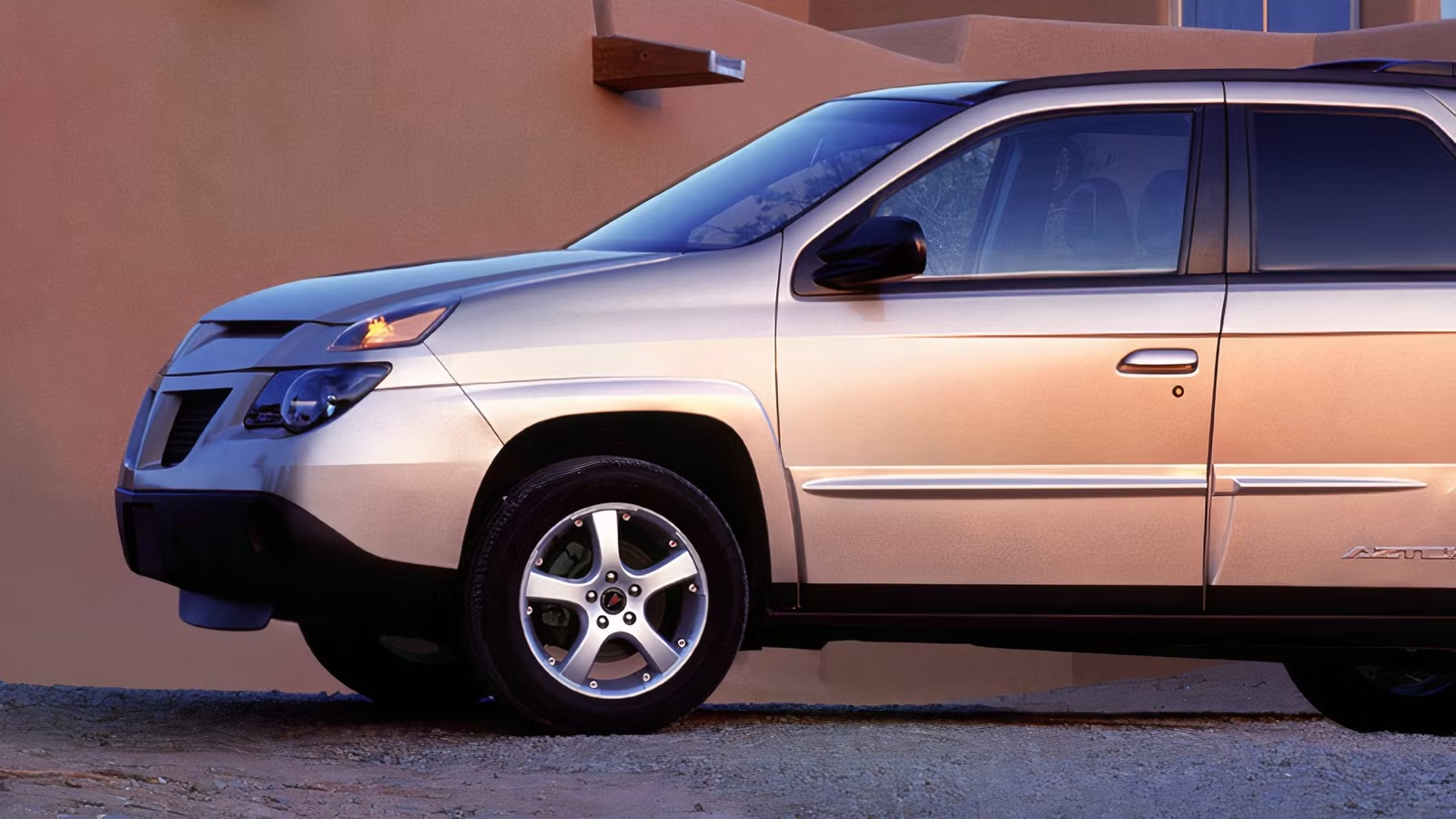
From its, shall we say, unique design to its appearance in Breaking Bad, the Pontiac Aztek is not a car that easily goes unnoticed. This early example of a crossover was built with young people in mind, and featured a number of accessories that suited drivers with an outdoorsy lifestyle. However, the finished package did not work as well on the market as it did on paper: The Aztek was only on sale for five model years before being discontinued.
You can, however, argue that this curious model was simply a few years too early. Many aspects of its character, including its unusual accessories, can now be seen in modern vehicles. Let’s take a look back at the Aztek and its legacy.
The Aztek: The Crossover That Came With A Built-In Tent (Before That Was A Thing)
2001 Pontiac Aztek exteriorPontiac
The Pontiac Aztek was a model quite unlike anything Pontiac had ever made. Introduced to the public in 1999 at the North American International Auto Show in Detroit, this proto-crossover shared a platform with another Pontiac model: the Montana minivan. It was, however, far stranger than the Montana.
The Aztek was a bizarre mishmash of features that incorporated elements of the car and the SUV, with plastic body cladding for a more “rugged” look and sharp corners blending into curved lines. In today’s crossover-obsessed world, this may not sound that strange, but at the turn of the millennium it was still very much a novelty.
The powertrain aspect was not that interesting: Only one engine option was available, a 3.4-liter V6 that produced 185 horsepower and 210 pound-feet of torque. A four-speed automatic transmission sent power to either the front wheels or all four wheels (with the optional Versatrak AWD system).
2001 Pontiac Aztec GT AWD rear 3/4 view with factory tent accessory.Cars and Bids
One of the most interesting aspects of the Aztek was its range of accessories. The Aztek was an ambitious “lifestyle” vehicle, intended to act as a practical hatchback during the week and a rugged camping vehicle on the weekend. Many of the optional features on offer reflected this unique character.
Aztek buyers could, for example, choose to have a front center console that doubled as a removable cooler, to keep beverages and snacks cold while on the move. This option was part of a broader camping package, which also included a built-in tent. The tent came with its own air mattress, and zipped onto the tailgate opening, effectively turning the small SUV into a camper. The idea was to create a vehicle that was not specifically made for off-roading purposes, but was versatile enough for the occasional jaunt off the beaten track.
A few other optional features were also available that weren’t related to the world of camping but improved the vehicle’s day-to-day practicality, such as a sliding cargo floor with grocery compartments and rear stereo controls in the cargo area.Decades later, it turns out Pontiac wasn’t wrong – just early. The same ideas are now showing up in vehicles from Porsche, Volkswagen, and Rivian.
The Aztek’s Legacy: How Porsche And Rivian Proved Pontiac Right
2025 Porsche 911 Carrera with roof tent openPorsche
The Aztek may not have been a successful model, but it did anticipate a trend in the automotive industry that has since grown to much larger proportions: automakers’ increasingly varied and elaborate lifestyle accessories.
The concept of a portable tent, for example, later appeared in a very unlikely place: Porsche. The German automaker recently began to offer a luxury rooftop tent as an option for several of its vehicles, including the 911 Carrera, Panamera, Taycan, and Cayenne. The two-person tent is waterproof and weather-resistant, and comes with a comfortable mattress as well as a bug screen. It folds up into a compact package when not in use.
Outside the US, Volkswagen has embraced camping-oriented options with the T7 Multivan, which offers a “Good Night Package” that transforms the minivan into a camper van. The package consists of a fold-out bed, blackout shades, ventilation grilles, and (in the upgraded version) a folding table and chairs.
Rivian Camp KitchenRivian
Another well-known example, which, however, did not make it to market, was Rivian’sCamp Kitchen. A couple of years ago, Rivian made plans to include a pop-up kitchen stowed in the R1T’s “Gear Tunnel” storage compartment. The kitchen was meant to include a sink, stove, kettle, and drying rack. However, the Camp Kitchen in its original form only made a few appearances in prototypes, and was never released on the market. Due to production difficulties, Rivian had to downsize the accessory, turning it into the Travel Kitchen: essentially a portable stovetop with a price tag of $1,400 rather than the originally planned $5,000.
The Aztek Today: A Rare Find That Gets Better With Age
2001 Pontiac Aztek exteriorPontiac
If you think the Aztek, with all its quirks, might be the right car for you, your journey towards finding one on the used market might be a slightly convoluted one. Not that many Azteks were sold during the model’s production run: total sales were 119,694, with the yearly figure never exceeding 30,000.
Today, over two decades after its discontinuation, relatively few examples are left on the road, especially ones in good condition and with a fairly low mileage. Prices range from $5,000 for older cars and models in poorer condition to around $12,000 for cars with lower mileage and in better shape.
2001 Pontiac Aztek exterior sidePontiac
Although the Aztek is a fairly reliable model overall, its reliability improved over the course of its production run. The model’s earlier years struggled with a few more issues, some of which were mitigated towards the end of its lifespan. This is reflected in the number of NHTSA complaints and recalls associated with each model year. The 2001 Aztek had 231 complaints and six recalls, with most of the recalls related to the fuel system and airbags. The following year saw the number of complaints drop to 130 and had only three recalls. The 2003 model had four recalls and 141 complaints associated with it.
During the Aztek’s last two years on the market, however, reliability improved sharply: the 2004 model only had 67 complaints and four recalls, while the 2005 model had just one recall and 34 complaints. Throughout the vehicle’s lifespan, the most common complaints were electrical issues, fuel system issues, and airbag and interior issues.
Why The Aztek Failed – And Why That Makes Its Legacy More Impressive
2001 Pontiac Aztek interiorPontiac
The Aztek’s poor commercial success can be attributed to a range of different factors. One of them was its unusual look, which consumers did not quite warm up to in the way Pontiac had hoped. Today’s drivers are much more accustomed to seeing automakers make controversial design choices, especially in the age of EVs, which has, in some ways, helped throw the rulebook out the window. When the Aztek was launched, however, automotive design was far more conservative; its unusual mix of sharp and rounded lines did not convince prospective buyers.
The model also struggled with the reliability hiccups we mentioned earlier, which further helped color its perception in the eyes of consumers. Although later model years had a better reliability record, by then the damage had already been done, and the Aztek was already on its way out.
Red 2001 Pontiac Aztek side shotPontiac
Poor timing and poor targeting were the other key elements of the Aztek’s demise. While the model had a clear demographic segment in mind, being targeted at Gen X, which was coming of age at the time, it simply tried to be too many things at once. The combination of everyday car and camping/overlanding machine was not convincing enough to serve as a selling point; the age of the crossover was only just beginning, and the idea of a “Swiss army knife” car that could perform multiple functions was still not commonplace among most consumers.
Perhaps, if the Aztek had been released a few years later, it might have been more successful; as things stand, however, it remains a quirky rarity of the automotive world and an interesting chapter of Pontiac’s history.
Sources: General Motors, NHTSA
