

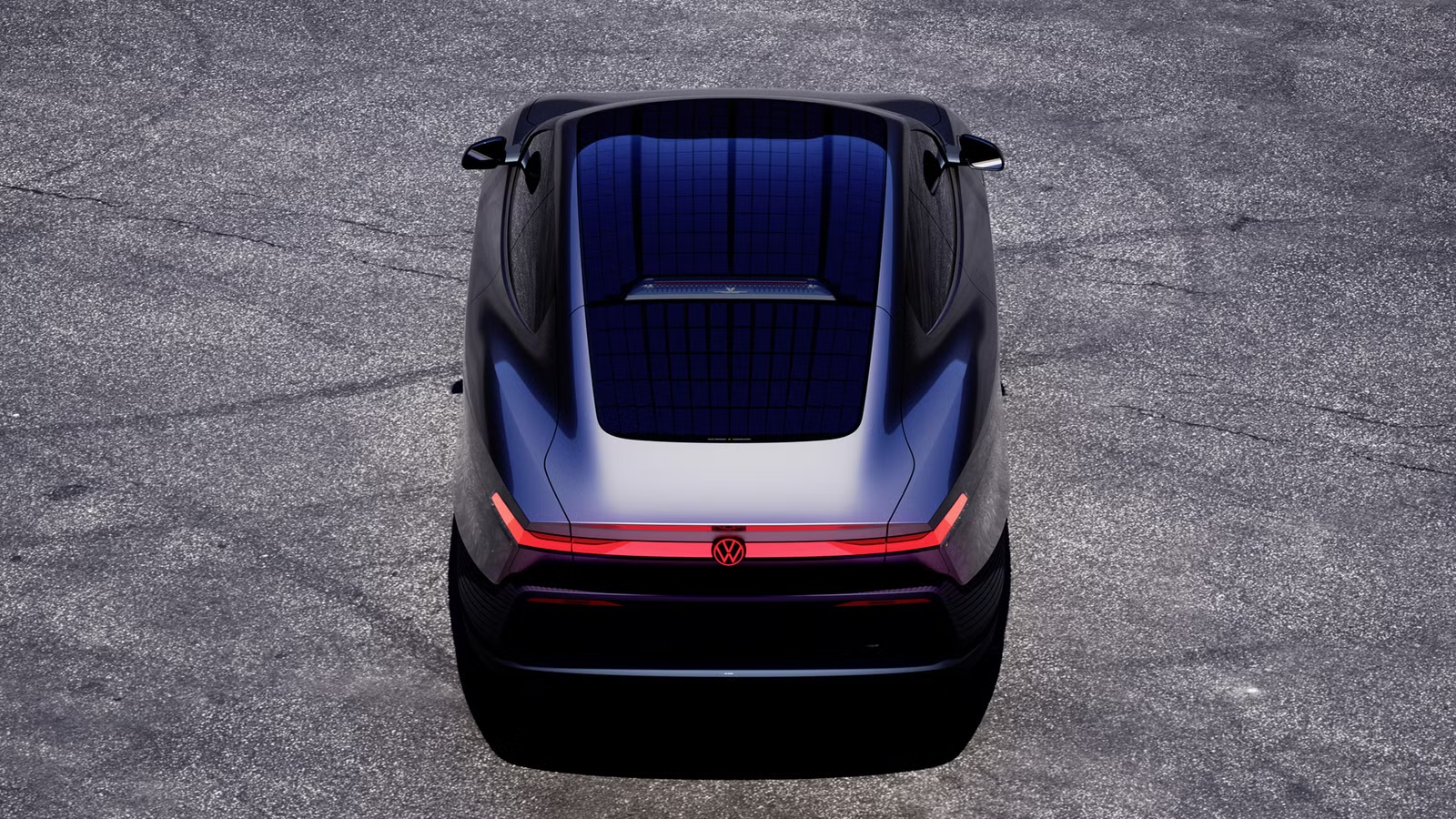
If the 20th century was largely about improving safety and performance in the motor car, the 21st century and the rise of electric vehicles have added efficiency as a third pillar. Volkswagen was an early mover in this area, unveiling its 1-Liter concept in 2002. The tiny, cigar-shaped car used a diesel engine and consumed just a little over one liter of fuel per 100 kilometers, equivalent to roughly 237 mpg.
The XL1 production version arrived a decade later, pairing the diesel with an electric motor and helping usher in the modern hybrid era. Now, VW has returned to the efficiency record-breaking game, this time with the battery-powered Mission Efficiency.
A New Record Breaker Based In Production Reality
Volkswagen Mission EfficiencyVolkswagen
Volkswagen bills the Mission Efficiency as the world’s most efficient electric vehicle, backing up that claim with a coefficient of drag of just 0.158 Cd and an energy consumption rate of 6.48 kilowatt-hours per 100 kilometers. VW calls these records, though they come with an asterisk because the automaker only claims them as records for “near-production” cars. In VW’s mind, the Mission Efficiency is neither a pure concept nor a production car, but something in between.
That doesn’t detract from the achievement at all, as the Mission Efficiency sits much closer to a production model than a typical concept. In fact, it shares the MEB platform found in multiple VW EVs, including the ID. Buzz sold in the US, albeit the updated version known as MEB+ that is being introduced in VW’s latest EVs. It also uses the same low-cost powertrain as the ID. Polo subcompact hatch and ID. Cross subcompact SUV that are about to start sales in Europe, and even has rear seats, enabling up to four occupants to enjoy hyper-miling road trips.
And craziest of all is that it embarasses rivals that have become renowned for insane efficiency.
“Mission Efficiency is the ideal way to demonstrate what distinguishes Volkswagen in the electric age: technology for the masses – not just for the few.”
– Thomas Schäfer, CEO of the Volkswagen brand
How Does It Compare To The World’s Best?
Volkswagen Mission EfficiencyVolkswagen
The 0.158 Cd figure absolutely crushes the Lucid Air’s 0.197 Cd, which currently holds the production-car record. VW has decades of experience chasing slippery aerodynamics, dating back to its 1-Liter and XL1 efforts, and the Mission Efficiency takes that knowledge to another level with a tiny frontal area of around 22 square feet and a flow-optimized teardrop shape. Enclosed rear wheels and a fully clad underbody help keep the air moving cleanly, while frameless windows and concealed door handles further cut drag. The result is especially impressive at higher speeds, with VW claiming the Mission Efficiency at 90 mph needs about the same energy as a subcompact traveling at 60 mph.
Under the skin, there’s a single front-mounted motor producing 133 horsepower and 195 pound-feet of torque. That’s the mid-range powertrain in the ID. Polo, but here it’s paired with the subcompact hatchback’s largest battery, a 54.9-kWh unit mounted in the floor. An electromechanical rear brake system further cuts losses by reducing friction while eliminating some brake lines and brake fluid, saving weight. Roof-mounted solar panels can add a little more energy when the sun is out, while the flat, flow-optimized wheels help keep aerodynamic drag in check. VW says the wheels alone typically account for 25 to 30 percent of a vehicle’s aerodynamic resistance.
Close
Of course, that headline-grabbing 6.48 kWh per 62 miles (100 km) figure comes with some very favorable conditions. VW achieved it at constant speed, without uphill climbs and without energy-sapping creature comforts such as air conditioning. But Mission Efficiency still looks remarkably efficient in the real world. VW says it used just 7.51 kWh per 100 km on a 1,278.36-km (794-mile) journey from its design center in Wolfsburg, Germany, to Vienna, Austria. The average speed was 67.72 kph (42 mph), and the battery reportedly still had 164 km (102 miles) of range left after reaching the Austrian capital.
CarBuzz Insights – Why This Matters
Volkswagen Mission EfficiencyVolkswagen
VW hasn’t indicated whether the Mission Efficiency will enter production like the XL1 did, but that doesn’t make the project any less impressive. The automaker has demonstrated that outstanding efficiency doesn’t require exotic or prohibitively expensive technology. Instead, it can be achieved using relatively affordable components designed for mass production. That knowledge could prove even more valuable when VW applies these lessons to new EVs destined for showrooms.
VW really needs to lift its game when it comes to EVs. The automaker faces increasingly tough competition from Chinese EV makers, helping drive a restructuring that could cost up to 100,000 jobs in Germany alone. VW has already just sold a plant and faces the prospect of closing even more, making projects like the Mission Efficiency more than just an engineering exercise alone.
