
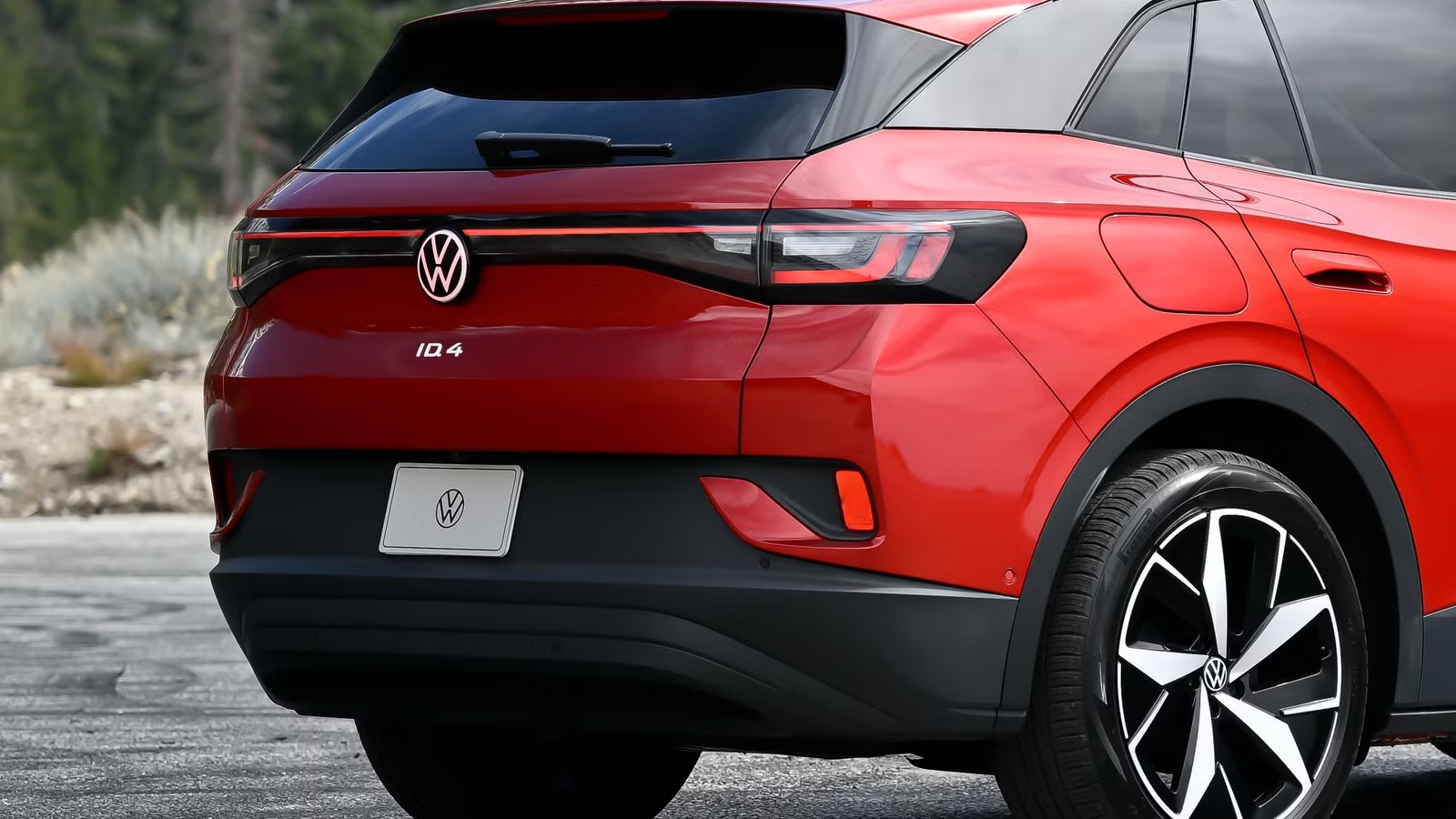
Earlier this month, Volkswagen announced it would recall more than 22,000 examples of its ID.4 electric SUV from the 2023–2026 model years over the risk of a battery fire – the second such issue this year. And although the automaker is working on a more permanent fix, the interim solution may not be very appealing to the folks who commute some distance in their German EVs.
That’s because Volkswagen will automatically issue an over-the-air software update that will limit the charging capacity to 80 percent of the battery’s state of charge unless the vehicle owner specifically opts out of the temporary remedy.
Range Could Become An Inconvenience For Some
VW announced the recall of 22,524 vehicles on October 1, saying that “certain charging profiles combined with a state of charge over 80 percent may trigger thermal propagation within the high-voltage battery.” That’s legalese for fire risk, which apparently increases when giving the car a jolt to 90 or 100 percent. The company hasn’t identified the root cause of the problem, and since it estimates that only 0.1 percent of the recall population is affected, it hasn’t issued a do-not-drive advisory for owners.
However, a participant in the ID.4 community on Reddit posted on October 14 that their myVW mobile app included a pop-up notice requesting owners to limit their charging to 80 percent until Volkswagen identifies a complete repair procedure. The app’s advisory note also says that unless ID.4 drivers specifically opt out by today, the automaker will apply a temporary vehicle setting on October 27 that will end charging sessions once the battery has reached that magic number.
In the case of the entry-level 2023 ID.4, which has a 62-kilowatt-hour battery that’s already a bit range-challenged, an 80 percent charge limit will bring the number to about 162 miles. Even models with the 82-kWh battery may see their numbers fall to between 200 and 240 miles of range.
How Does Charging A Battery Affect Its Performance?
Notably, most automakers already recommend that owners end their charging sessions once the battery has reached an 80 percent charge. Making a habit of going to 90 or 100 percent can reduce the lifespan of the battery due to the heat generated from a full recharge, even on a slower Level I or Level II AC connection. Volkswagen’s reasoning for asking its customers to only go to 80 percent is a bit more sinister, though, given the fire risk.
As part of the interim fix, Volkswagen will also provide owners with stickers that can be affixed around the ID.4 to remind them to limit charging to full whenever possible. We’ve asked the company for some clarification on the recall, including whether owners who volunteer (or are voluntold) for the vehicle setting will be able to force occasional full recharges in the event that they need maximum range. We will update this story if VW responds.
Base Trim Engine
EV
Base Trim Transmission
Automatic
Base Trim Drivetrain
All-Wheel Drive
Base Trim Horsepower
335 HP
Base Trim Torque
536 lb.-ft.
Base Trim Fuel Economy Equivalent (city/highway/combined)
108/96/102 mpge
Base Trim Battery Type
Lithium ion (Li-ion)
Infotainment & Features
8 /10
CarBuzz Insight – Why This Matters:
The ID.4 is Volkswagen’s first long-range EV to be sold in the US, and unfortunately, it’s led a rather inauspicious life. In addition to a very polarizing infotainment system and lackluster range and charging speeds compared to its Hyundai Ioniq 5 rival, the ID.4 has suffered from a few recalls, including one that led to a complete, months-long stop sale because the electric door latches could unexpectedly open when the car was in motion.
The ID.4 will be replaced next year with a heavily facelifted “new” model called the ID. Tiguan. Here’s hoping it has better luck than its cheerfully styled forebear.
Source: Reddit via InsideEVs
