

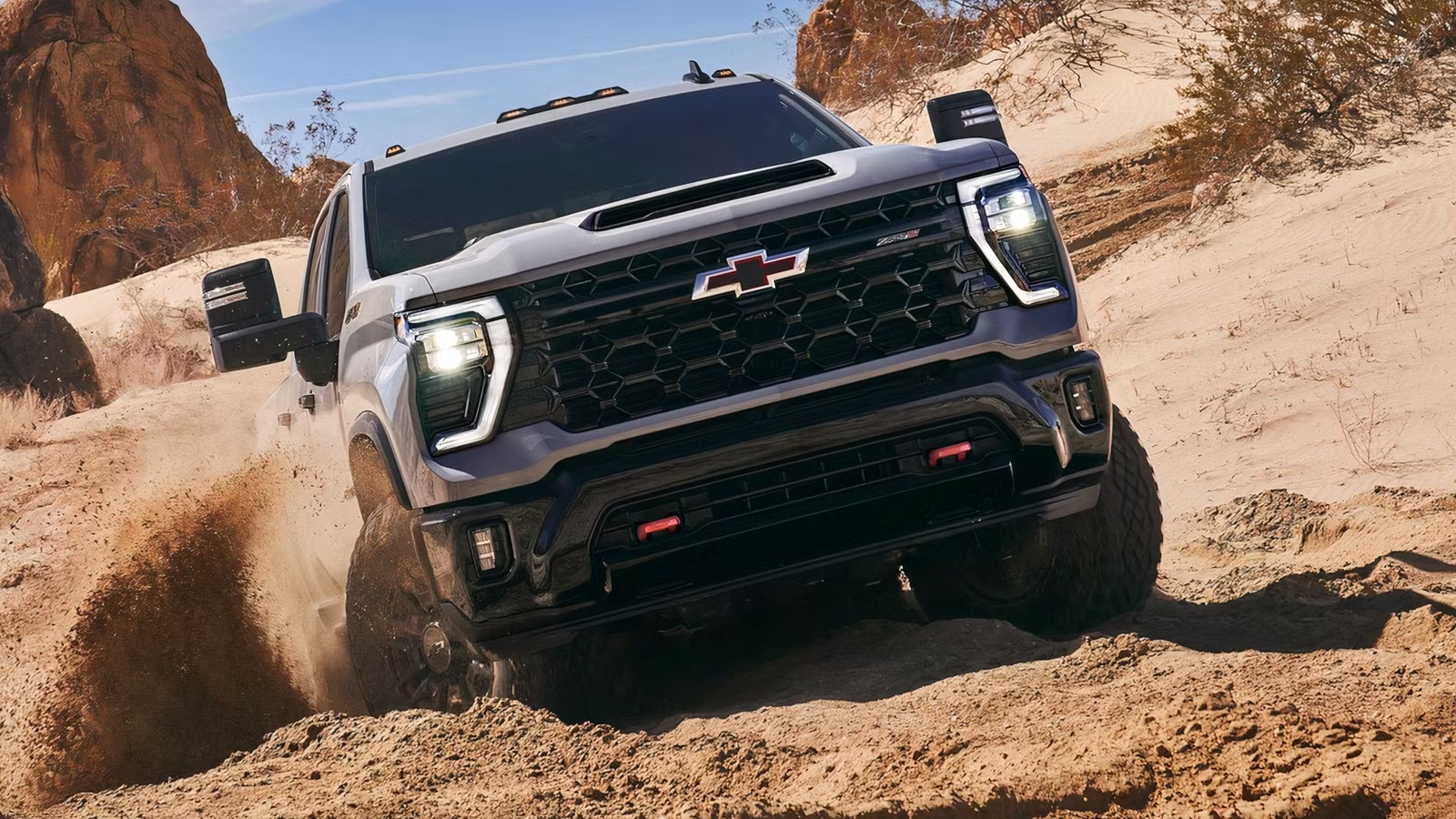
In a heavy-duty pickup truck, the best gasoline V8 may not be the most powerful of the pack. Instead, it’s the one that keeps working. Losing a few pound-feet of torque on paper doesn’t amount to much, but an engine that keeps itself out of the repair shop more than others is much more valuable. After all, for many heavy-duty truck owners, those big V8s are out on the road making money, and an engine that’s down-and-out means it’s not proving useful.
Ford, General Motors, and Ram all produce some form of large-displacement gasoline V8 for their big pickups. Ford’s entrant is the 7.3-liter Godzilla V8, released just a few years ago. On the GM side, there’s the 6.6-liter L8T, and Ram packs the 6.4-liter Hemi V8. In our ranking, we’ll order these three with things like design simplicity, known failure risks, and reliability in mind, leaving peak output on the back burner.
Let’s take a look.
Ram 6.4L Hemi V8
Ranked Last for One Expensive Reason
Power
405 hp
Torque
429 lb-ft
Bore x Stroke
4.09 in x 3.72 in
Compression Ratio
10.0:1
Current-Gen Timeframe
2014—present
First and least trustworthy on our list of three is Ram’s 6.4L Hemi V8. While it’s been around for nearly 13 years without a major mechanical overhaul at this point, it exemplifies the most concerning repair risk of the three engines we’re focusing on today. The mill is found in the current Ram 2500 HD and 3500 HD pickup trucks, and its major Achilles’ heel lies in its use of MDS, or Ram’s Multi-Displacement System.
The MDS acts like any variable displacement tech. When the engine isn’t under heavy load, it can shut down some of its combustion chambers, up to four at a time. Both Ford and General Motors steer clear of the tech, as it exposes an engine to some notable downfalls. For starters, the Ram 6.4L has been known to suffer from lifter and camshaft failures, which have been documented in owner reports and even official service information. Once one of the Hemi’s roller lifters fails, it can quickly damage the camshaft via scoring. Once scored, the cam will release metal debris into the oil supply and the rest of the engine proper.
Ram has issued a technical service bulletin warning of and addressing camshaft-lobe and lifter wear. However, actually fixing the issue can potentially cost owners several thousands of dollars. For context, average estimations put the cost anywhere between $7,000 and $12,000 when completed through a dealer. Not every 6.4L Hemi is a ticking time bomb, but the amount of evidence pointing towards the lifter/cam issue being widespread is hard to ignore, and it can spell disaster for those who rely on their trucks.
GM 6.6L L8T V8
No Cylinder Deactivation, But Direct Injection Brings Its Own Risks
Power
401 hp
Torque
464 lb-ft
Bore x Stroke
4.07 in x 3.86 in
Compression Ratio
10.8:1
Current-Gen Timeframe
2020—present
Slotted into the middle of our list is the GM L8T V8, an engine that joined the fold just a few years ago. It’s a bit simpler in its construction than the previous Ram mill, namely because it foregoes any troublesome variable displacement tech. It sports a cast-iron engine block, a forged steel crankshaft, and a 10-speed automatic transmission.Earlier model years (2020–2023) used a 6-speed automatic.
When the L8T first hit the market in 2020, GM explicitly confirmed that it omitted its Active Fuel Management (AFM) system from the engine’s recipe. Regardless, it still manages to produce over 400 hp and more torque than the Ram’s Hemi, although its pony count does come up short. One of its main concerns is that it makes use of direct fuel injection, which can pose a specific set of issues over time.
Direct injection is great for sustaining engine performance across its power band, but it can cause some serious carbon buildup in an engine over time. Intake-valve carbon deposits can specifically become troublesome, preventing valves from sealing tightly over an extended period of time. Other issues reported with the L8T include things like exhaust manifold leaks and excessive valvetrain noise.
GM’s decision to drop cylinder deactivation was a good one – it alone can make a lot of owners nervous, as these are typically complex systems to begin with. As for its long-term reliability over more than a decade, we simply will have to wait and see what the L8T can manage.
Ford 7.3L Godzilla V8
A Straight-forward Approach But Not Without Its Issues
Power
430 hp
Torque
485 lb-ft
Bore x Stroke
4.22 in x 3.98 in
Compression Ratio
10.5:1
Current-Gen Timeframe
2020—present
Last and most trustworthy on our list is Ford’s 7.3L “Godzilla” V8. The entire engine was designed for heavy-duty use, much like the ones we’ve already discussed. It boasts a cast-iron block, a pushrod-actuated valvetrain, and a wholly straightforward approach to a modern, hard-working gasoline V8 engine. Serviceability reportedly took a front seat in the engine’s design phase, as many folks who run these engines will likely be working on them once the warranty runs out.
It produces the most power and torque of the big three V8s, and it also makes use of port fuel injection. Unlike direct injection – which sees fuel sprayed directly into the chamber – port injection lends itself to a cleaner valvetrain because fuel is sprayed into the combustion chamber via the intake valve’s opening. The direct injection method can lead to some carbon issues down the road. Port injection helps to keep some of that potentially problematic carbon buildup away.
Ford also designed a set of piston-cooling oil jets into the Godzilla’s bottom end, which pay dividends when the engine is asked to perform at, or near, full tilt for long periods of time. Its lubrication system was also set up for success, making use of a variable-displacement oil pump. However, the Godzilla isn’t without its issues. Early models had some reported lifter and camshaft failures, along with spark plug wire problems and oil pump issues.
Godzilla Takes the Crown – But Here’s the Catch
Godzilla 7.3-liter V8 engineFord
When pitted head-to-head-to-head, the Godzilla engine ekes out a win. It’s the simplest, and makes use of the most old-school tech of the three. It also seems to have the shortest list of known issues of the three. But, like the GM L8T, it hasn’t been around long enough to really get a feel for how it will withstand the test of time.
Sources: Ford, GM, Ram, AutoBlog.com, ApexTechNation.com, CarComplaints.com, FordAuthority.com.
