

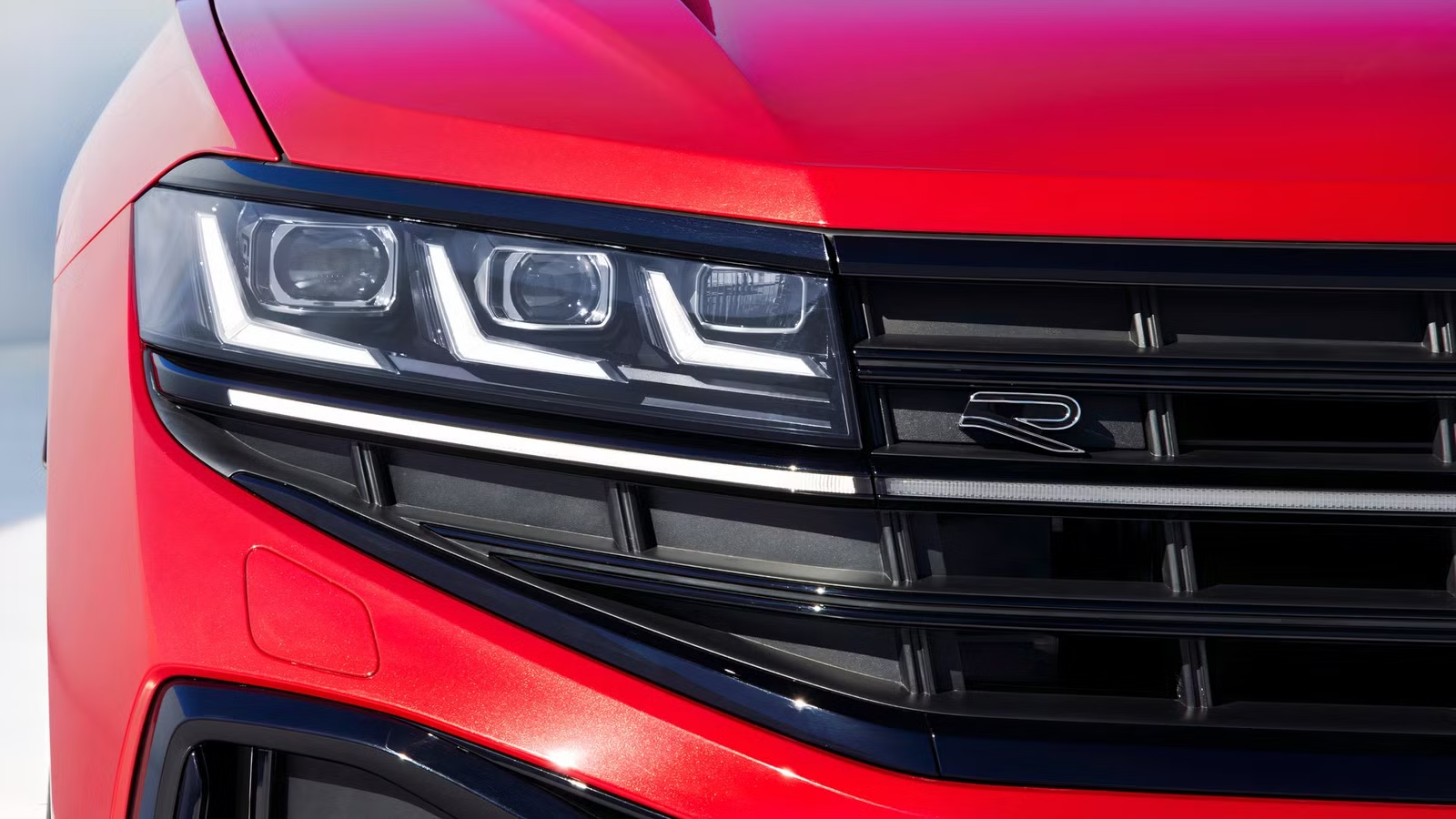
Pour one out, it’s the end of the line for the Volkswagen Touareg. The automaker has confirmed that production of the German SUV ends in 2026, closing an often dramatic and sometimes tumultuous 24‑year run for the only mass-market branded SUV with the bones of a Porsche. After 1.2 million units sold globally, the Touraeg evolved through three generations, became one of the only SUVs ever powered by a V10 engine, pulled a Boeing 747, and put multiple Dakar Rally wins under its belt, all with a lineage tied directly to a premium push by Ferdinand Piëch himself.
Here’s Why You Want A Touareg (And Why You Don’t)
2017 Volkswagen TouaregVolkswagen
The Touareg’s story begins not in Wolfsburg but in Stuttgart, where Piëch forced Volkswagen and Porsche to share a single platform – and the result was one of the most over-engineered budget SUVs ever built.
The US market lost the Touareg after 2017 as the new VW Atlas came online to serve American buyers who wanted a larger, more mainstream three‑row SUV. Globally, Volkswagen continued building the Touareg, but the final generations never returned to the US, instead selling in Europe, China, and other international markets up to and including the series‑finale Final Edition, priced at €75,025 (about $87,500).
That sky‑high MSRP now acts as the upper anchor point from which values will fall as production winds down with no combustion successor in development. With the nameplate expected to return only as an EV, the outgoing Touareg becomes one of the last premium, over‑engineered ICE SUVs of its kind.
The Touareg was a Piëch passion project, co‑developed with Porsche’s first-ever SUV, the Cayenne. The two machines shared platform geometry, suspension setups, and overall engineering intent. Both rode on air suspension systems and used a four‑wheel‑drive layout with low‑range gearing when they launched, though both would switch to a one-speed, permanent AWD system in later generations.
The Cayenne would wear the group’s best features, technologies, and skin, though the Touareg indeed delivered Cayenne bones on a VW budget, and went on to create some powertrain excitement of its own: including a V10 TDI engine that powered a marketing stunt for the history books.
2017 Volkswagen TouaregVolkswagen
That stunt became one of the most buzz-worthy automotive moments of the 2000s: a near‑stock Touareg V10 TDI towing a 155‑ton Boeing 747 for more than 150 meters. The spectacle demonstrated the Touareg V10 TDI’s immense torque output, the durability of its driveline, and the over‑engineering baked into its cooling and chassis systems.
As reported by Pistonheads, the unit was checked after the repeated runs and found to have no adverse wear or damage caused by the extensive demands of this test. The engine temperature remained normal, as did the transmission temperature. Apparently, even the tires showed no signs of wear.
The legend is real – but can a used Touareg actually be lived with day-to-day, or does the maintenance reality kill the dream?
2017 Volkswagen TouaregVolkswagen
The Touareg also played a role in early autonomous‑vehicle development. In 2005, a specially prepared Touareg nicknamed Stanley won the DARPA Grand Challenge, becoming one of the first intelligent vehicles in automotive history. Equipped with laser scanners, stereo cameras, GPS, and specialized control software, Stanley navigated 212 kilometers of Nevada desert without human input, beating 23 competitors and finishing in under seven hours.
That same engineering depth – the hardware built to pull jets and drive itself across deserts – is what makes a used Touareg so compelling today. But it also explains why repair bills can be so steep.
From V10 Diesel To Dieselgate: The Touareg’s Turbulent US Timeline
- 2004: US VW Touareg debut with VR6 and V8 power
- 2004: V10 TDI 5.0L twin-turbo diesel arrives
- 2006: The VW Touareg tows a 747 jet to promote an upcoming facelift
- 2008: mid-cycle refresh brings new looks, features and technology
- 2009: V6 TDI engine launches and becomes the volume seller, V8 engine discontinued
- 2011: Gen 2 Touareg hits the road after shedding 400 lbs and adding an 8-speed automatic
- 2015: Styling and feature content facelift and enhancement adds standard bi-xenon lights, available 360-degree camera
- 2016: Dieselgate halts 3.0L TDI sales; VR6 becomes sole engine option
- 2017: Final US Year Wolfsburg Edition marks Touareg’s US departure
- 2018: New Volkswagen Atlas arrives
- 2018: Gen 3 Touareg goes on sale, but not in the US
- 2026: Global Touareg production ends
Day-To-Day Living Costs
2017 Volkswagen TouaregVolkswagen
Of course, there’s reason to hesitate on that second-hand Touareg. High-end German SUVs are known for many things, and low costs aren’t typically among them. Repairs to air suspension systems can be particularly expensive, though they are relatively predictable and easy to account for. Diesel-powered units out of emissions control warranty coverage can put drivers at additional risk of pricey repairs.
2017 Volkswagen Touareg
Engine
3.6‑liter VR6 FSI
Power
280 hp @ 6,200 rpm
Torque
266 lb‑ft @ 2,500 rpm
Transmission
8‑speed automatic
Drive
4Motion permanent AWD
Max Towing Capacity
7,716 lbs
EPA Fuel Economy (City, Hway, Comb)
17, 23, 19 MPG
EPA Annual Fuel Cost
$3,250
Fuel consumption is on the heavy side, even for diesel models, and the latest infotainment and ADAS suite you’ll find on the used market could be light years behind a more modern alternative.
2017 Volkswagen TouaregVolkswagen
Remember when you’re shopping: in many ways, the Touareg also functioned as Germany’s answer to the Jeep Grand Cherokee. Both are similarly sized, similarly capable unibody SUVs built to strike a balance of luxury, off‑road ability, and long‑distance comfort. Both models offered air suspension, low‑range gearing, V8 power, and high‑spec trims aimed at high-end shoppers. If you’re considering either machine from this pair, be sure to consider the other as well.
Here’s What The Market And The Studies Say Today
2017 Volkswagen TouaregVolkswagen
Today, the cheapest used Touareg models on the second-hand market tend to cost $2,000–$4,000, commonly with around 150,000 miles but sometimes with just half that, depending on configuration. On the higher end of the scale, Touareg second-hand pricing tops out in the mid-twenties, provided you exclude the exotic V10 TDI, which can be $10,000 more. With the V6 TDI engine instead, a spend of around $20k should see you into a unit with under 90,000 miles of use if you shop carefully, and even under 70,000 miles if you’re lucky.
Just remember the added costs. According to RepairPal.com data, budgeting an extra $1,000 annually for routine maintenance and repairs is reasonable. With some big-ticket repair items priced well into the thousands, a contingency fund covering an additional $4,000 worth of repair expense is a good idea too, should your new-to-you Touareg need a new oil pump, oil pan, or diesel injection pump.
The Repair Bills That Make or Break a Used Touareg Purchase
- Oil Pump Replacement — $3,127–$4,280
- Vibration Diagnosis — $182–$268
- Diesel Injection Pump Replacement — $2,023–$2,559
- Spark Plug Replacement — $321–$404
- Camshaft Position Sensor Replacement — $138–$249
- Transmission Mount Replacement — $469–$646
- Airbag Crash Sensor Replacement — $590–$667
- Engine Oil Pan Replacement — $2,233–$2,885
- Parking Brake System Adjustment — $74–$109
- Drive Belt Tensioner Replacement — $332–$411
Will the Touareg satisfy? We can look to JD Power APEAL data for a clue. According to the 2017 study, Volkswagen’s brand-wide score (809) was one point shy of the industry average for the study (810), meaning that owners at the time were reporting roughly average overall satisfaction with their Volkswagens at large.
Today’s SUVs Need To Be Electrification-Ready
2017 Volkswagen TouaregVolkswagen
In a way, the Touareg’s discontinuation is a bit of a “canary in a coal mine” moment for the combustion-dominant SUV in general. As modern market realities mean that SUVs will increasingly need to offer various levels of electrification alongside ICE power, the industry is starting to say goodbye to its remaining ICE-only and ICE-dominant models, paving the way for future platforms that can accommodate evolving demands for electrification.
That’s what makes the Touareg’s exit so meaningful. Though earlier-generation hybrid power was available for a few years in the US, the Touareg isn’t switching to a new platform designed primarily to accommodate future downsized and electrified powertrains with larger batteries and more powerful electric motors. Toyota, for instance, moved numerous SUV models to their next-generation hybrid-ready TNGA platforms, with some offering hybrid power, and others ready for it when the time comes.
2017 Volkswagen TouaregVolkswagen
Remember, the Lexus LX is tied to Toyota’s carbon‑neutrality roadmap and will eventually need to incorporate electrification, but its latest platform is ready. Ditto the Lexus GX, which bought time by making the TNGA switch to a hybrid-ready setup. Another example comes from the Genesis GV80, nestled snugly within an aggressive Genesis-wide EV strategy, with ICE-only variations currently available to bridge the gap.
Conversely, the Touareg was engineered to carry legendary combustion engines, not to accommodate an increasingly electrified future. VW’s press release specifies the end of the “combustion engine model,” heavily hinting that the Touareg nameplate will return as an EV, potentially on the upcoming SSP architecture.
Sources: Volkswagen, TopGear, Carscoops, drivencarguide.co.nz, Slashgear, RepairPal, Pistonheads
