

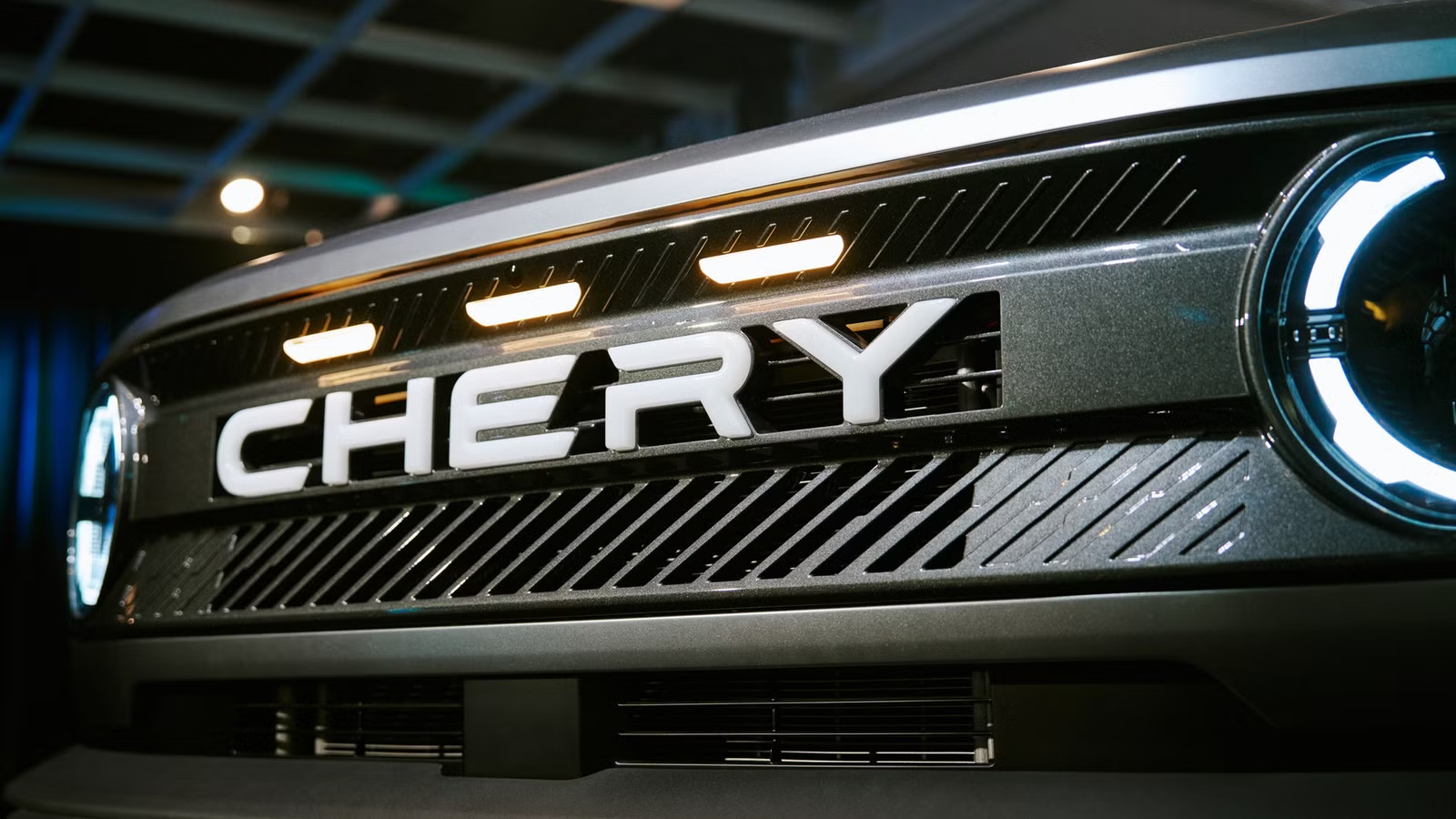
Thirty years ago, as the nascent Chinese auto industry was gaining steam, a lot of analysts could see that explosive growth was in the future. And sure enough, it became like the Wild West in the 2000s, where anything goes and intellectual-property violations were common as automakers and suppliers from around the globe arrived as joint venture partners to help Chinese automakers learn the business – and grow sales at a breakneck pace.
2026 BYD Atto 3 front quarterBYD
Today, all signs from China suggest the market remains an automotive hotbed, where annual car sales ballooned from 26 million in 2021 to more than 34 million last year – way ahead of the 16.3 million vehicles sold in the No.2 US market. Finally this year, a correction in the China market has pushed first-half sales down 20%, despite declining domestic vehicle sales this year amid intense price wars and cooling demand.
A Staggering Pace, By Any Measure
So this means the red-hot China market has cooled off, and that automakers are slow-rolling new products because they just aren’t needed, right? Hah! Despite the slowdown, Bloomberg reports that China has already been flooded this year with 650 new or refreshed models – a rate of almost four a day – according to data compiled by automotive platform Dongchedi. The number is staggering, even if it includes minor facelifts, configuration tweaks, new body colors, and other subtle changes.
Buick Electra Orbit ConceptSAIC-GM
Beyond the minor tweaks, automotive analyst Sam Fiorani tells CarBuzz via email that production of no fewer than 20 new nameplates or major updates were reported in January alone across a dozen vehicle manufacturers in China. This flood of new models might suggest that some automakers believed their products to be outdated, but Fiorani, vice president at AutoForecast Solutions, said this latest trend is just a sign of the extreme nature of competition in China.
“Every brand wants to fill out every niche in their lineup.”
–Auto Analyst Sam Fiorani
2027 Ford Expedition 30th Anniversary Package from the rear three-quarter angleFord
Automakers in China can develop a new vehicle much more quickly than legacy automakers, and Fiorani says that’s putting the squeeze on both domestic brands and foreign brands inside of China.
Compared to China, the US auto industry has been sitting on its hands. Auto analyst Sam Abuelsamid points to Ford, whose last new models were the 2024 Ranger and Mustang and 2025 Expedition and Lincoln Navigator, while the last new nameplate was the Maverick pickup, in 2022.
“The Explorer is now seven years old and is probably at least three years from a full redo.”
–Auto Analyst Sam Abuelsamid
In truth, the US market is shrinking in terms of product, with Ford having dropped the Edge, Escape, F-150 Lightning, and Lincoln Corsair, notes Abuelsamid, vice president of Telemetry Insights. “Other automakers have certainly had more product but compared to China, the numbers are miniscule,” he tells CarBuzz via email.
All this new product in China isn’t entirely for the domestic market, as exports from the mainland are gaining share in numerous markets, including Latin America, Southeast Asia, Africa, and Europe.
China In A Downward Spiral
2025 Lincoln Corsair Front Angle View in whiteLincoln
But growth in exports from China are merely masking a home market in deep trouble, as analyst John McElroy sees it. “The CEO of NIO predicts that most automakers will cease to exist by 2030,” McElroy, well-known for the Autoline automotive webcasts, tells CarBuzz via email.
He sees the Chinese car market in a downward spiral, with no signs of turning around. Most automakers are not profitable, and many dealers are going out of business, he says.
“But I point out that the survivors will be even more formidable competitors.”
–Auto Analyst John McElroy
CarBuzz Insight – Why This Matters:
How long can the Chinese auto industry keep pumping out new vehicles, especially while the overheated market has twice as much capacity to build vehicles than the domestic market needs? It seems obvious that activity this brisk cannot be sustained and will result in many one-generation models in China and the likely closure of plants (and yes, automakers) over the next few years.
If sales of new vehicles continue falling in China, the pressure will be even more intense on Chinese automakers needing to unload vehicles in Europe and the US, if that door should ever open.
Source: Bloomberg
