

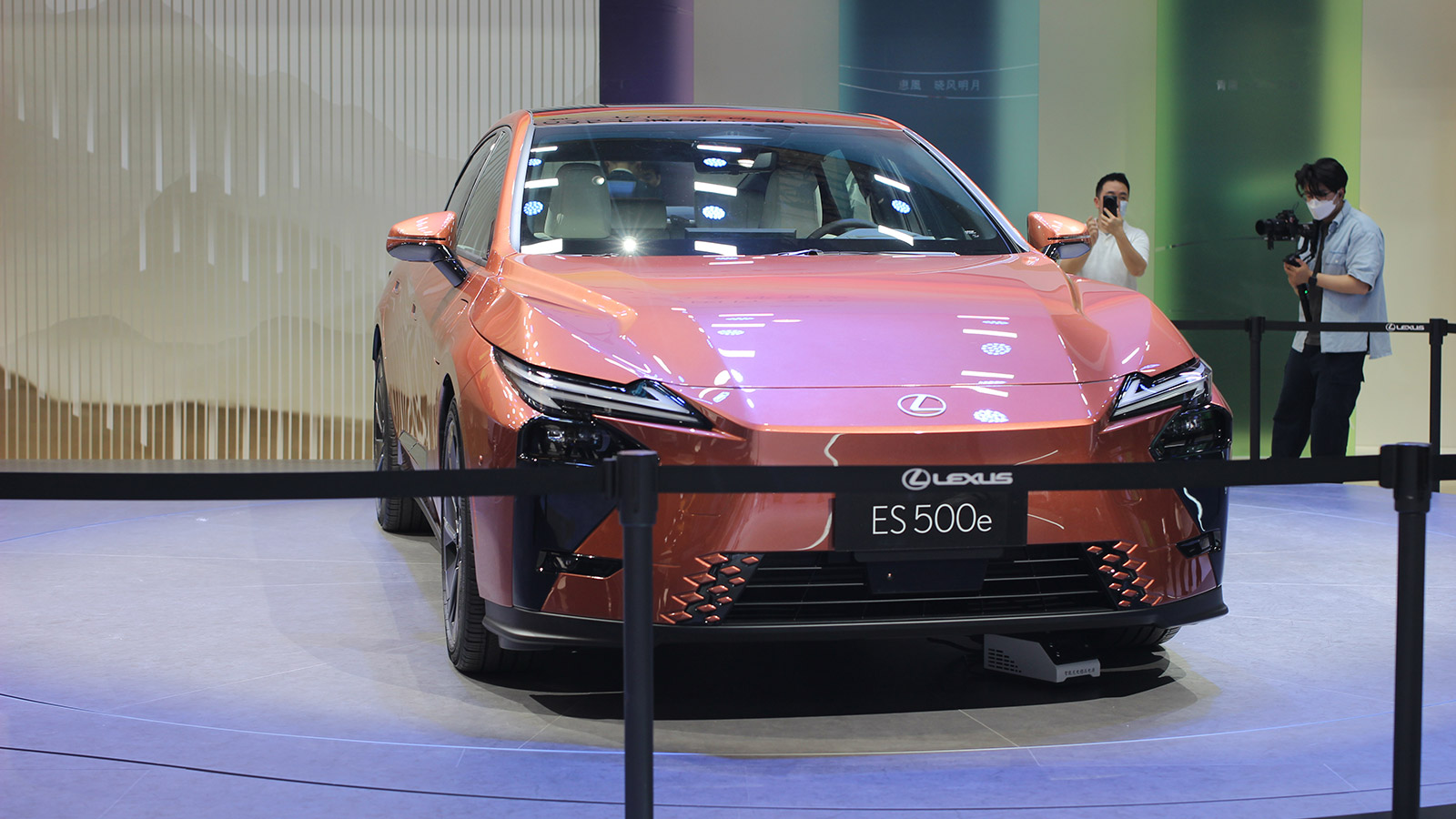
A Lexus ES 500e on display at the Shanghai Auto Show in April 2025. Credit: CnEVPost.
- The new model will be assembled at a wholly owned plant in Shanghai, with annual output planned to rise to tens of thousands of units from 2028.
- The vehicle will use Gigacast integrated die-casting technology, underscoring Toyota’s shift of its latest EV development and production toward China.
Japanese auto giant Toyota reportedly plans to produce a Lexus electric SUV (sport utility vehicle) in Shanghai in the second half of 2027, with initial monthly output of about 1,000 units.
The move would mark a rare decision by Toyota to produce its latest-generation electric vehicle (EV) first outside Japan, highlighting China’s growing importance in the global EV race.
The next-generation EV will be assembled at Lexus’ new Shanghai plant from the fall of 2027, with output of about 1,000 units a month in its first year, Nikkei reported Friday.
Toyota plans to raise the model’s annual output to tens of thousands of units from 2028, the report said. It did not disclose a specific production target.
At 1,000 units a month, the model’s initial annualized output would be about 12,000 units, equivalent to just 12% of the Shanghai plant’s planned annual capacity of 100,000 units, suggesting Toyota will adopt a cautious production ramp-up.
The vehicle will use cutting-edge body components and Gigacast integrated die-casting technology, which forms multiple aluminum body parts in a single casting to reduce the number of components and assembly processes, the report noted.
The technology could reduce the weight of some body structures by as much as 20% and increase driving range on a single charge by several percentage points, while also improving body rigidity and production speed.
Toyota had been developing a lower-slung, more streamlined next-generation EV coupe in Japan but halted the project in spring 2026, according to Nikkei.
The company subsequently shifted its next-generation EV focus toward SUVs, which are in stronger demand in China, reflecting the growing influence of local consumer preferences on its product planning.
Lexus’ Shanghai plant is located in Jinshan district in the southwestern part of the city and broke ground in June 2025. At the time, the project was expected to be completed in August 2026 and begin production in 2027.
Toyota announced in February 2025 that it would establish a wholly owned company in Shanghai to develop and produce Lexus battery electric vehicle (BEV) models and batteries.
That would make Lexus the second foreign auto brand after Tesla (NASDAQ: TSLA) to have a wholly owned vehicle plant in China.
Toyota is the world’s largest automaker by sales, and China is its third-largest market after the US and Japan. The company, however, has faced sustained pressure from local brands in China in recent years.
Toyota’s global sales fell 5.3% year-on-year to 912,683 vehicles in July, while its sales in China dropped 24.3% to 114,747 vehicles, according to data it released Friday.
In the first 7 months, Toyota sold 809,417 vehicles in China, down 18.2% year-on-year.
The 2027 bZ5 starts at a limited-time price of 109,800 yuan ($16,170), with its driver-assistance system upgraded to Momenta 6.0.
