

Whiplash. It’s not just a movie about drummers shouting at each other and throwing cymbals around the room; it’s also one of the most worrying and common potential outcomes of even the lowest of low-speed automotive accidents, and, according to the IIHS, an area where current crash testing methods could use some improvements. If we look at the research, rear-end collisions account for 42% of all vehicle-in-motion accidents, which is why we’re calling this the most important safety test.
The Insurance Institute is currently in the process of rolling out a new testing system targeting neck injuries stemming from rear-end collisions, and, so far, only four models have aced the new test. That’s to be expected, of course, as this test didn’t even exist when the latest Ford Bronco Sport was in the design stage, but it shows how far the industry has to go regarding addressing the problem.
How Does This New Test Work?
Whiplash testIIHS.org
The head restraint evaluation involves a new rear impact test that is “less destructive than a crash test.” That is, the IIHS isn’t looking to find out whether the car can withstand the impact, but rather, the effects of low-speed collisions on the occupants.
The test features a midsize male dummy with an articulated spine, seated in the driver’s seat, which is removed from the vehicle and seated in a sled. That is, the car itself is left out of these tests, as it will be the seating that determines the safety of the occupants. The sled doesn’t even need to be subjected to any vehicle-to-vehicle impact, it’s simply jolted with a “sudden pulse of acceleration” to simulate a rear-end collision.
Related
2024 And Newer Jeep Wrangler IIHS Safety Scores Improve
The updated 2024 and 2025 JL Jeep Wrangler has improved some of its IIHS scores, though there’s still a lot of room for improvement.
Of course, this is how the IIHS has conducted these tests for years. So, what’s changed? The old test used a single pulse, simulating a 20 mph collision, by a vehicle of the same weight. With the new test, the IIHS is testing at 20 mph and at 30 mph, and the new testing system has been expanded to include all the following metrics.
- Head contact time (how long it takes the head restraint to touch the dummy’s head)
- T1 vertebra acceleration (the last vertebra on the upper spine, where it joins the neck)
- Pelvis displacement (the ability to sink into the seat to prevent forward head movement)
- Tilting force of the head relative to the neck
- Bending force of the head relative to the neck
Data is collected through the dummy’s sophisticated sensor systems, as well as on video. You know those slow-motion crash shots of dummies getting thrown into brick walls? They don’t just make the dummies look like badass action heroes, the IIHS actually needs them for visual observation, as there are a lot of metrics that need to be measured with the assistance of human eyeballs.
Cars Can Get To Be A Little Too Safe For The IIIHS’ Liking
The old whiplash test did a lot of good in encouraging safer car design, but it was retired in 2022 because almost every single vehicle was coming out of the test with a perfect score. This is one of the main reasons why the IIHS needs to keep these tests constantly evolving. It’s not just that our testing technology is getting better and better, it’s also about giving automotive designers something to shoot for (and something to brag about when they get it right).
Related
Six More Models Now Among America’s Safest Cars
The Insurance Institute for Highway Safety has announced six new Top Safety Pick+ award-winning models for 2025.
The IIHS determined that there was room for improvement based in part on the fact that cars with the exact same whiplash rating were seeing completely different results in real-life scenarios, according to insurance claim rates. That is, a car could score a Good rating, meaning that it had cleared the hurdles the IIHS put ahead of it, but drivers were still suffering neck injuries at a higher rate than in other Good-rated vehicles.
13 Models Scored “Acceptable” Or Better
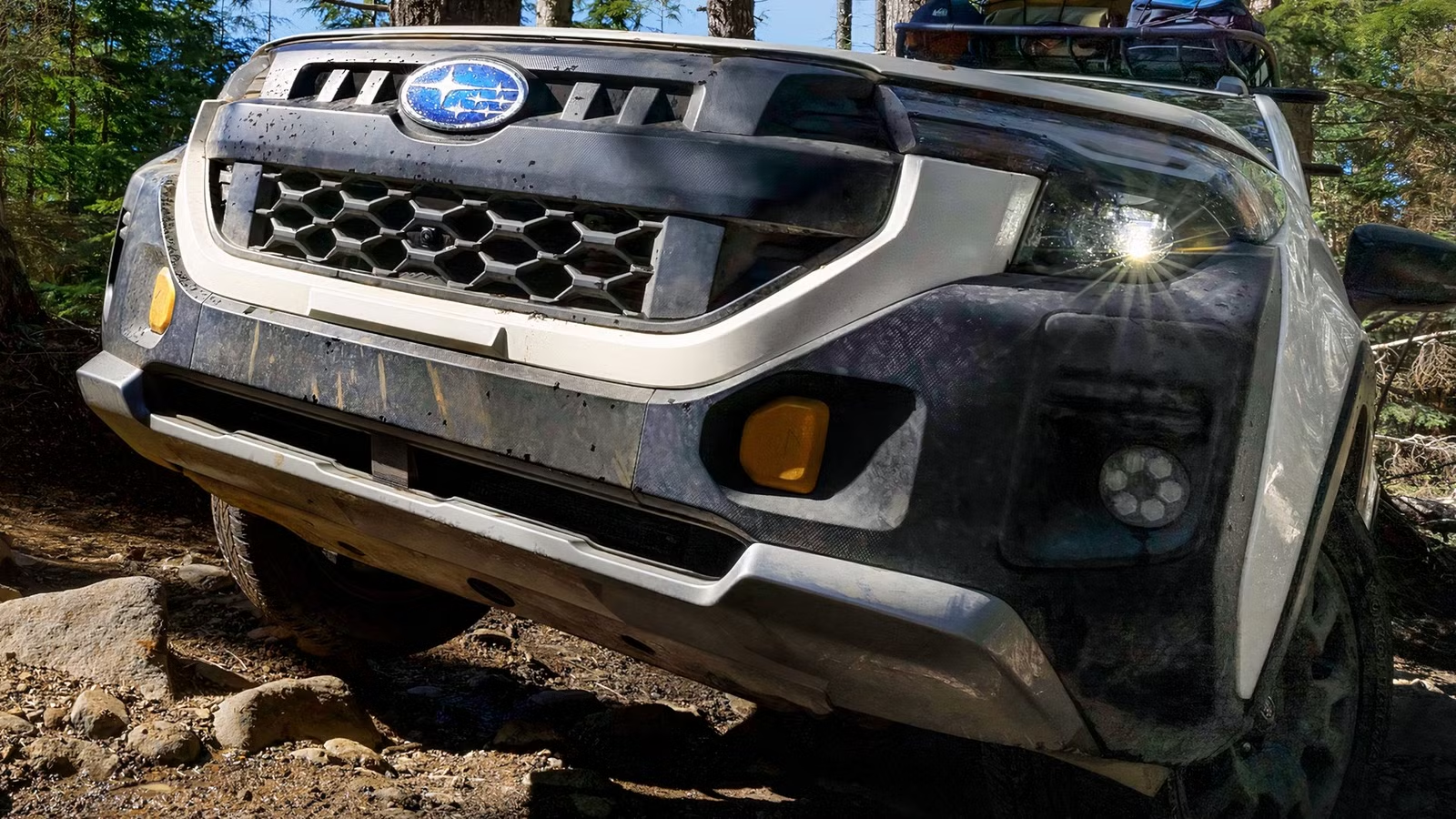
2025 Subaru Forester Adventure Style Front Angled ViewSubaru
With the new test, only four models scored a Good rating (the IIHS’ best rating). These include the 2025 Audi Q3, the 2025-2026 Hyundai Ioniq 5, the 2025-2026 Subaru Forester, and the 2025 Toyota RAV4. Here’s what their IIHS report cards look like now.
Audi Q3
Hyundai Ioniq 5
Subaru Forester
Toyota RAV4
Small Overlap Front
Good
Good
Good
Good
Moderate Overlap Front
Marginal
Good
Acceptable
Marginal
Side: Updated Test
Acceptable
Good
Good
Acceptable
Headlights
Good
Good/Acceptable
Good
Good
Front Crash Prevention
Marginal
Acceptable
Good
Acceptable/Good
Whiplash
Good
Good
Good
Good
If you’re looking for a car that holds as close to a perfect score as possible, given this new test, the Top Safety Pick-winning Forester is the easy choice.
Base Trim Engine
2.5L H4 ICE
Base Trim Transmission
8-speed Lineartronic CVT
Base Trim Drivetrain
All-Wheel Drive
Base Trim Horsepower
180 HP @5800 RPM
Base Trim Torque
178 lb.-ft. @ 3700 RPM
Base Trim Fuel Economy (city/highway/combined)
26/33/29 MPG
Infotainment & Features
8 /10
Find 2026 Subaru Forester and more cars for sale on our Marketplace
Shop Now
In addition to these safety leaders, the following models scored a rating of Acceptable, which is the Insurance Institute’s second-best score.
Acceptable doesn’t mean bad, it just means not-quite-perfect. Think of it like a B+, or a four-out-of-five-star rating. Again, the whole point of revising IIHS crash tests is to improve safety systems that were already up to par.
Five Models Are Lagging Behind
2025 Ford Bronco SportFord
If there was a gang of cars at the back of the class during this test, shooting spitballs and doodling on their exam papers, they would be comprised of the following models.
Whiplash Rating
2025 BMW X1
Marginal
2025-2026 Nissan Rogue
Marginal
2025-2026 Ford Bronco Sport
Poor
2025-2026 Hyundai Tucson
Poor
2025-2026 Mazda CX-50
Poor
A Marginal rating is nothing that any automaker is going to brag about, but a Poor rating is the only score where you can say that the vehicle flunked the test.
Find 2025 Mazda CX-50 and more cars for sale on our Marketplace
Shop Now
These Ratings Are Nothing To Worry About At The Moment
Note that these ratings don’t mean that any of these models are unsafe, necessarily, only that these brands will want to think about redesigning the seats sometime in the near future. The Mazda CX-50, for instance, is actually a Top Safety Pick+ winner with a Good rating in almost every category, and the BMW X1 holds a Top Safety Pick award. There’s just no way to study for a test that the IIHS only recently invented.
A poor IIHS rating in a given test should only be worrying after an automaker has had plenty of time to address the Institute’s safety concerns. Moving the goalposts may be bad form in a debate, but pushing the target back another yard or two every few years is the only way the IIHS can ensure a standardized means of gradually improving safety with every model year.
Related
Tesla Model Y Is An IIHS Top Safety Pick+ Winner For Fifth-Straight Year
Amid challenges, the Tesla Model Y secures another top award.
There have been spikes and valleys in traffic fatalities and injuries over the years, but the general trend has been towards fewer incidents per capita, year after year. In 1959, the year the IIHS was founded, the US saw 20.37 fatalities per 100,000 people. In 2022, that number was down to 12.75 per 100,000 people.
Safety organizations like the IIHS aren’t the only factor in making our roads safer. Roads are generally safer than they were 60 or 70 years ago. We’ve adapted to motor vehicles as a society over the years. But the Insurance Institute clearly plays a part in getting us all home in one piece, and, hopefully, without a neck injury that’s going to take a lifetime of therapy and medication. To a large extent, that owes to the non-profit’s pattern of setting a lofty goal, and setting an even loftier one when the industry meets it.
Sources: IIHS.
