

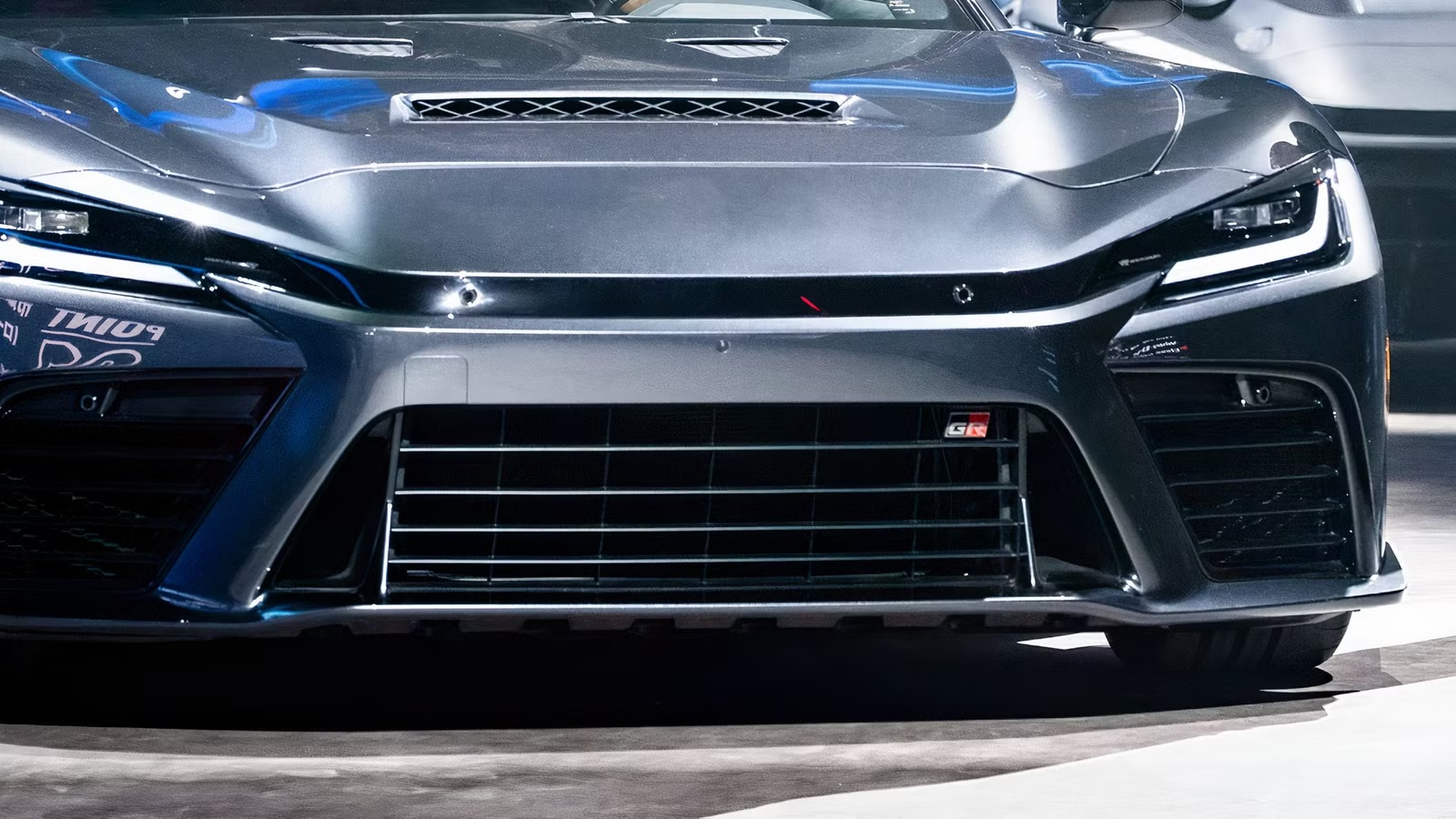
From the moment that Toyota revealed its GR GT sports car, the company made it clear that it exists, effectively, to give Toyota a top-tier GT3 race car. This goal has dictated the type and design of the engine, its shape, and even how weight is distributed. Most of these changes should make the road car amazing to drive, but one bizarre little detail is almost completely irrelevant on the road, but critical for the race car.
2027 Toyota GR GTToyota
What Are Those For?
If you look at the back of the Toyota GR GT, you’ll probably first notice its huge exhaust tips, prominent rear diffuser, and huge air vents. If you stare long enough, though, you may notice that there are two little tabs that sit above the license plate location. These tabs do hold the lights to illuminate the license plate, which is a requirement to be road legal. However, automakers usually go to some effort to better integrate their lights so that they aren’t just sticking out in the wind.
As Road & Track discovered during a press briefing with Toyota, there’s a secondary reason for the design of these lighting tabs. Apparently, they’re there to extend the car’s permanent bodywork farther backward. Why is that important? It isn’t for the road car, but it makes all the difference for the race car. GT3-class rules for cars say that the location of the wing is dependent on the rearmost edge of the car’s bodywork. By adding those tabs, Toyota is allowed to mount the GR GT3’s rear wing farther back, which effectively gets them more downforce without changing the shape and size of the wing.
Toyota’s given us a first proper look at its upcoming GR GT and GT3… and if you drive a Porsche 911, best keep an eye on that rearview mirror.Toyota
Toyota Has Exploited Rules Before
Whenever a race car class is based closely on cars that have to be built and sold to the public, whether in miniscule or monumental numbers, automakers will look for exploits like this. Toyota has certainly done as much in the past. One of its more famous instances was with its GT-One supercar and its respective racing variant.
1998 Toyota GT-ONE Road Car finished in red with tan interiorYT: StyleNL
At the end of the 1990s, automakers were building extremely limited-production vehicles that were effectively race cars in order to get the racing versions into Le Mans. The GT-One was among them, and Toyota built just two examples, building as few as it possibly could to be able to say the race car was based on a production road car. Another loophole was even more wild. Toyota convinced the sanctioning body that the empty fuel tank qualified as the required cargo area, since that rule wasn’t any clearer than saying it needed an empty space that could hold things. As a result, Toyota managed to avoid having to compromise the car just to have empty space inside.
Also in the 1990s, Toyota was having success in the World Rally Championship with its Celica GT-Four-based car. Toyota sold loads of GT-Four cars, and it was a genuinely usable road car. It also had some extra equipment that was really designed just for the race car. Toyota fitted the road cars with some of the hardware necessary to operate the race car’s anti-lag system. It was non-trivial to hook it up on the road, but it added some convenience for the race car.
Toyota Celica GT-Four WRCToyota
CarBuzz Insight – Why This Matters:
We knew Toyota was serious about the GR GT being a race car based on details about the powertrain and the chassis. Learning about details such as these license plate light tabs make it clear that making the GR GT a strong-selling road car was completely secondary to building a race car. That’s also supported by the fact that only a couple hundred will be in the US. Rather than volume, this car exists to be competitive in racing, and also to be able to sell said competitive GT3 car to private teams.
Genesis Magma GT Concept Updated VersionGenesis
The latter part must be a lucrative path, because Genesis is also planning its own sports car and subsequent GT3 car with the Magma GT. However, Genesis seems to want its road car to be a higher-volume model, and to spawn a wide range of variants. The concept car also looks to have prioritized aesthetics a bit more than the GR GT, too.
Source: Road & Track
