

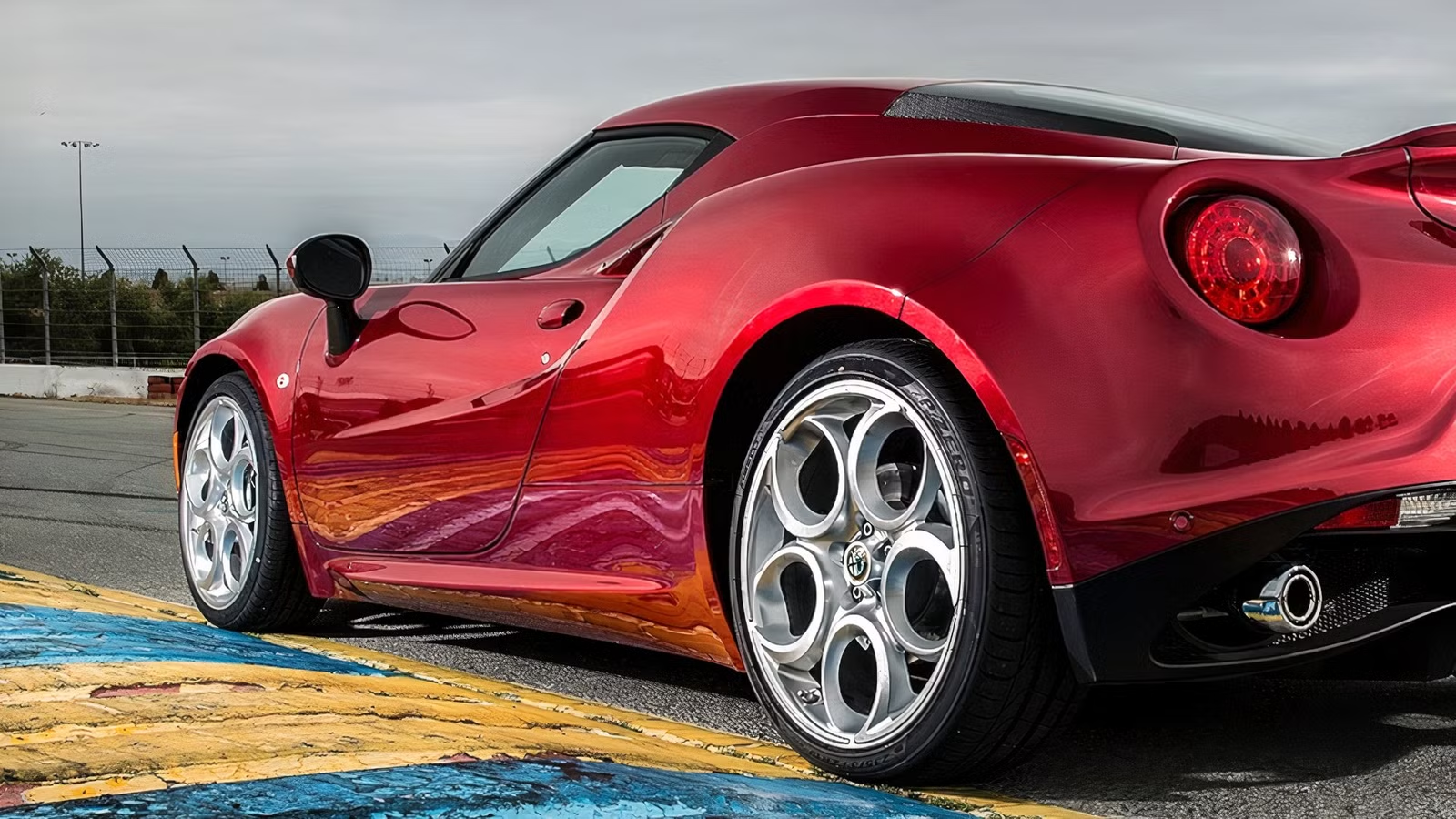
The aim of sports cars generally goes in one direction or the other. Most automakers give us accessible creations designed for mainstream enjoyment, like the ever-affordable Mazda Miata and Toyota GR86. Cars like these are great for providing driver-focused enjoyment at prices most can stretch to. At the other end of the scale, there are limited high-performance creations like McLarens, Aston Martins, and Ferraris, which boast impressive motorsport-derived tech but are completely unaffordable for most people.
Rarely does one car walk so confidently into both camps as the Alfa Romeo 4C. It was a sports car designed to deliver all the accessibility and affordability of an entry-level sports car, but with the seldom-seen high-end tech usually reserved for the most exclusive of sports and supercars. Here’s how Alfa managed it.
Alfa Romeo Packed The Little 4C With Supercar Technologies
Alfa Romeo is an automaker associated with some of the best driving cars ever produced, but it’s safe to say the firm lost its way a little in the 2000s. The halo 8C supercar was a high point, but the more mainstream offerings were relatively dull in comparison to Alfas of old. With the Spider gone from the lineup, there was no dedicated sports car to keep fans enthused.
That all changed in 2013, when Alfa Romeo revealed the 4C. It was a proper little two-seater designed for thrills above all else. However, unlike the more accessible GTV and Spider models that preceded it, the 4C was far more driver-focused, sporting technologies and design features more commonly associated with supercars.
The 4C is mid-engined, sporting an all-aluminum 1.75-liter turbocharged inline-four, good for 237 horsepower and 258 pound-feet of torque. Those outputs aren’t exactly supercar-level, but the grunt is more than ample for a nimble two-seater , especially when coupled with the 4C’s remarkably low 2,465-pound curb weight. Hooked up to the boosted four-cylinder, there’s a six-speed dual-clutch transmission, which sends power exclusively to the rear wheels.
Other features that help deliver a supercar feel include:
- A DNA driving mode selector, with the option for Race Mode
- Aluminum front and rear subframes to keep weight down
- Composite body panels instead of steel panels
- Rear-mounted intercoolers fed by sculpted side intakes
- Launch control
All very impressive, but the really impressive aspect of the 4C was its one-piece pre-impregnated monocoque carbon fiber chassis.
A Carbon Fiber Tub Was The Star Of The Show
2015 Alfa Romeo 4C chassisStellantis
That’s right, this is no cheap imitation, but a fully carbon fiber passenger cell – just like what buyers would expect to find on a Koenigsegg, high-end Ferrari, or McLaren. Whereas less-committed cars might opt for an aluminum spaceframe or bonded composite tub, the 4C went all in, the result being a pre-impregnated (or pre-preg) chassis which tipped the scales at just 143 lbs.
That pre-preg part is important. It refers to the type of carbon fiber used, with the cheaper option being wet lay. Unlike the latter, pre-preg carbon fiber already contains a layer of epoxy resin within each sheet, eliminating excess weight and prioritizing stiffness. Once the carbon sheets had been laid into molds, autoclave curing finishes the whole process. This involves vacuum bagging the material, then curing it within an autoclave, where heat and pressure are applied to form a complete, structural, single piece.
How Alfa Romeo Managed To Deliver Supercar-Tech For Sports Car Money
2015 Alfa Romeo 4C seats and chassis designStellantis
Here’s the truly impressive part. Alfa Romeo managed to deliver all of this carbon-clad magic for just $53,900. At the time, that was just $5,200 more than an Audi TTS, or $4,950 more than an entry-level BMW Z4. Both are fine cars, but neither even get close to approaching the world of supercars, whereas the 4C truly is a baby of the sector.
2015 Alfa Romeo 4C SpiderStellantis
Alfa Romeo managed this incredible price point by partnering with Italian composites specialist Adler Plastic. The Italian firm took what was typically a minuscule production practice, the development of carbon tubs, and set itself up with the capacity to do it on a far larger scale. Adler could churn out 1,000 a year, which is still tiny on a production-car scale but significant for carbon-tub cars, and this “mass-production” approach is what enabled costs to be cut right down for Alfa Romeo.
Crucially, Alfa Romeo avoided the temptation of going overboard with the 4C. It would have been easy to commit to all-carbon body panels, a more powerful engine, and an endless array of expensive add-ons like carbon-ceramic brakes and carbon bucket seats. Still, the Italian automaker knew when to stop. The 4C could have been another rich gearhead’s six-figure toy, but the 4C that resulted from Alfa Romeo’s restraint was just as fun and yet still attainable, and all the better for it too.
The End Result Was Truly Impressive
Alfa Romeo’s work did not go unrecognized. The storied automaker had created an all-time great. It was a two-seater that truly ascended the world of sports cars and somehow found itself in the baby-supercar camp, despite boasting just four cylinders, 237 hp, and a starting price more typically associated with a smart sedan.
To the untrained eye, the 4C may look like another Porsche 718 Boxster or Lotus Evora rival, but the truth is that nothing this side of $100,000 even gets close to offering what the Alfa Romeo does. Those cars and other competitors might be just as quick or quicker around a track, able to match or beat it to 60 mph, and just as exclusive. The carbon-tubbed baby supercar is truly one of a kind thanks to the engineering embedded within its DNA. For reference, the Evora – from champions of lightness Lotus – boasted a curb weight between 500 pounds and 600 pounds heavier than the 4C.
Enthusiasts appreciate that too, which is why the 4C has managed to pull off the most un-Alfa Romeo of feats, in totally avoiding depreciation.
Buying One Today
2015 Alfa Romeo 4C SpiderStellantis
To refresh your memory, the 4C Coupe debuted just over a decade ago, initially with an MSRP just south of $54,000, although that did swell by a couple thousand dollars by the time production ended in 2018. Shelling out for an open-roof 4C Spider commanded a significant amount more, with prices kicking off at $63,900 for the 2015 model year, and winding up at $67,150 in 2020.
Now, according to CarEdge, Alfa Romeo models depreciate by 66% over the first five years of ownership on average. Applying that logic to a final model-year 4C Spider, that car should now cost around $22,800, but the reality is that estimate could not be further from the truth. A quick look online brings up the following listings and recently sold examples:
- A 54k-mile 2017 Coupe for sale at $39,486
- An 18k-mile 2015 Spider for sale at $65,490
- A 40k-mile 2015 Launch Edition Coupe for sale at $48,695
- A recently sold 2016 Spider with 8k miles achieved $56,000
- A recently sold 2018 Coupe with 8k miles achieved $48,250
In other words, prices haven’t really budged since the cars were new, not by a huge amount anyway, considering over a decade has passed. The cheapest cars are available for around $10,000 miles below MSRP, but these tend to be quite leggy, whereas most examples of the marque have covered minimal miles, and trade for between $45,000 and $60,000.
The 4C actually looks like quite a wise investment. There’s potential to buy one, enjoy it on road trips and backroads for a summer or two, and then move it on for virtually what was paid; certainly seems like a possibility. And unlike many other European sports and performance cars, the 4C should prove fairly cheap to run and maintain, thanks to its championing of lightness and sensible powertrain. Just don’t run out of talent, as any dreams of affordable sports car ownership would soon be shattered if that tub gets even so much as a hint of damage.
Sources: Alfa Romeo
