

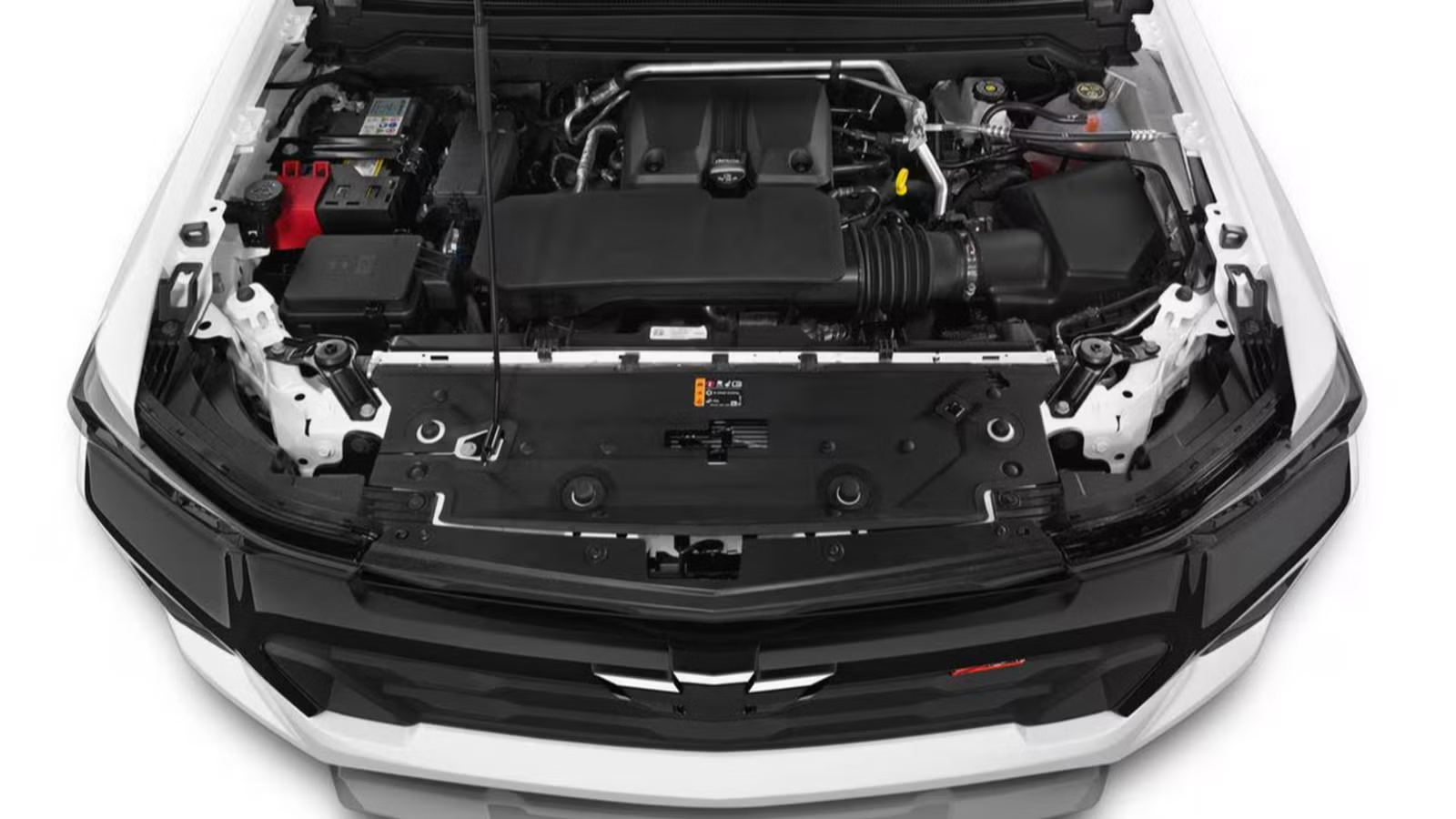
Just 20 years ago, it was still relatively uncommon for a luxury car to use a four-cylinder engine. How things have changed! For most of automotive history, four‑cylinder engines were meant for thrift, not thrust. The idea of a four-cylinder engine in a truck like the Chevrolet Silverado would have sounded like a pretty tough sell a couple of decades ago because a four-cylinder had never been designed to handle the towing demands and torque output required by modern full-size pickup drivers.
General Motors took things in a different direction. Instead of chasing horsepower per liter, the TurboMax engine was engineered for usable torque, low‑RPM response, and truck‑grade durability. Its long stroke, advanced cooling system, and unique turbo design weren’t meant for Nürburgring lap times. Instead, these attributes helped with towing, hauling, and surviving long periods of incredible cylinder pressures.
Broadly, the GM TurboMax represents the moment when a four‑cylinder becomes a legitimate alternative to a V8 in one of the industry’s most demanding segments. Along the way, an accidental battle would play out between GM and Mercedes-AMG for the four-cylinder torque output crown.
Meet The Four-Cylinder Gas Engine With The Most Torque
2022 – 2026 Chevrolet Silverado 1500 4th Gen (GMTT1XX) Facelift PickupChevrolet
Selected Specifications For The 2025 Silverado
GM TurboMax
GM Duramax
GM 5.3-liter V8
GM 6.2-liter V8
Engine
2.7-liter inline four-cylinder gas turbo
3.0-liter inline six-cylinder turbodiesel
5.3-liter V8 gas NA
6.2-liter V8 gas NA
Power
310 hp
305 hp
355 hp
420 hp
Torque
430 lb-ft
495 lb-ft
383 lb-ft
460 lb-ft
Fuel Type
Regular Unleaded
Diesel
Regular Unleaded
Premium Unleaded
Annual Fuel Cost (4×4)
$2,450
$2,300
$2,600
$3,450
In 2019, there were six engine-transmission combinations available in the Silverado. Specifically, shoppers could choose a 4.3-liter V6 with a six-speed automatic transmission as the base engine, or the long-running small-block 5.3L V8 with a six or eight-speed automatic transmission (depending on trim level). The 6.2-liter V8 with a 10-speed automatic was on the options roster, and there were two newcomers. Buyers could get a 3.0-liter turbodiesel inline-six with a 10-speed automatic, or the 2.7-liter TurboMax four-cylinder with an 8-speed automatic.
Note that all engines other than the diesel came with built-in fuel-saving cylinder deactivation technology. Both the 5.3- and 6.2-liter gas V8’s ran the latest Dynamic Fuel Management system (DFM), while the 4.3-liter V6 and 2.7-liter turbo four used the earlier Active Fuel Management (AFM) system.
For its 2019 launch, the TurboMax engine delivered 310 horsepower and 348 pound-feet of torque. For the 2022 model year update, the engine received a more rigid cylinder block casting and a stiffer crankshaft, in addition to its existing fully forged bottom end. With internal strength already up, everything was thrown at increasing torque output. The result was the same 310 hp as the earlier engine, but torque spiked to a whopping 430 lb-ft – a 24% increase. Further, peak torque is available from just 1,500 RPM, giving the updated TurboMax diesel-like torque delivery.
Related
The Most Powerful Four-Cylinder Engine You Can Buy In 2026
This engine rocks half the cylinder count of a V8, but somehow Mercedes-Benz squeezed the power of a Ford Mustang GT out of it.
This Isn’t A Car Engine In A Truck
2019 Chevrolet Silverado 1500 finished in silver with black interiorChevrolet
The TurboMax engine is not for sports-car duty. The truck-specific powerplant even incorporates lessons from diesel engine design to help manage combustion chamber temperatures, cylinder head temperatures, and durability during long bouts of running 27 PSI of boost while towing.
With a maximum boost of 27 PSI, managing thermal stress was a priority. Supplier BorgWarner worked to develop a new Dual Volute-style turbocharger for this application. It features a unique internal design that keeps exhaust pulses separate until they reach the turbine wheel. The technology has its roots in commercial diesel engines and is designed to allow the turbocharger to spin up as quickly as possible.
Further, a computer-controlled cooling system can run coolant through targeted thermal circuits, even when the engine is shut off, to direct extra cooling power where it’s needed most. The system can actively cool the turbocharger after engine shutdown and even redirect a high-flow stream of coolant to the integrated exhaust manifold cast into the cylinder head to help lower exhaust gas temperatures before they reach the turbocharger.
The TurboMax engine, especially after its latest update, is built to withstand immense internal forces and pressure. For maximum leverage and torque, the engine uses an aggressively under-square design, meaning that its pistons travel a particularly long distance from top to bottom compared to most engines. This creates significant mechanical leverage vital for high torque output, but makes life particularly challenging for the cylinder walls, which need to resist side-loading forces. The solution was to offset the crankshaft axis slightly, shifting the crank away from the cylinder centerline. This ensures the connecting rod angle is as straight as possible during the highest-pressure moments of the combustion stroke, reducing friction, heat, and stress on the internals.
GM and Mercedes Accidentally Battled For The Top Torque Title
Turbocharged 2.7-liter TurboMax four-cylinder engine in a Silverado engine bayChevrolet
High-powered turbo four-cylinder engines are nothing new, and many high-performance cars have offered them for decades. The Mitsubishi Evo X with 303 lb‑ft was a noteworthy milestone. Volkswagen, Honda, and Hyundai followed with 280-300 lb‑ft engines of their own, making each brand’s compact performance models more muscular than ever. Mercedes‑AMG escalated the race with the M133 and later the M139 engines, which pushed the boundaries of specific output and thermal management.
The M133 was a compact, high-performing 2.0-liter four-cylinder capable of making as much as 375 hp and 350 lb-ft of torque. It was the world’s most powerful factory four-cylinder at the time. When the GM TurboMax engine arrived in 2019, its 348 lb-ft of torque nearly topped the smaller Mercedes’ output.
However, only the most obsessive auto-engineering fans took notice, because the models with the Mercedes M133 and the GM TurboMax were competing for completely different customers. The Germans built a performance powerplant, and the Americans had a heavy hauler.
The M139 engine is hand-built by a master technician. When it is completed, the builder adds his or her name to the engine with a special placard.Mercedes-AMG
In 2020, the new Mercedes-AMG M139 engine arrived, and the brand’s latest take on the 2.0-liter turbocharged four was particularly impressive. It now made 416 hp and 369 lb-ft of torque on pump gas with warranty coverage. But the TurboMax engine family took the torque crown in 2022, when the updated 2.7-liter truck engine arrived, producing 430 lb-ft of torque.
Meanwhile, Mercedes added hybrid assistance and an electrically driven turbocharger to the M139, resulting in a total output of 671 hp and 752 lb-ft for the Mercedes-AMG C63. Owners can’t use this muscle to tow a boat, though.
The M139 is designed to spin at high revs while attacking a road course, where drivers expect a big flow of power at higher revs. The TurboMax takes an alternative approach. It is designed for torque rather than revs. It hits its torque peak at 1,500 RPM, whereas the M139 needs more than triple that. In a heavy truck, that low-end torque availability helps keep the transmission from constantly hunting for gears.
Related
Chevy TurboMax Engine: Specs, Uses, And Common Problems
Here’s everything you need to know about Chevrolet’s punchy inline-four, including what goes wrong, and where to find it.
Why Not Just Get The V8 Instead?
2019 Chevrolet Silverado 1500 finished in silver with black interiorChevrolet
Selected Specifications
2026 Silverado TurboMax
2025 F-150 2.7L EcoBoost
2025 RAM 1500 3.6L (eTorque)
Transmission
8-speed automatic
10-speed automatic
8-speed automatic
Power
310 hp
325 hp
305 hp
Torque
430 lb-ft
400 lb-ft
271 lb-ft
Annual Fuel Cost (4×4)
$2,450
$2,200
$2,100
So, why not pick the V8 instead? First, the TurboMax is cheaper to buy and slightly cheaper to feed. According to EPA data, it uses $150 less fuel per year than the 5.3-liter V8, despite delivering 47 more lb-ft of torque. That’s 6% less of your fuel dollars and a 10% advantage in torque versus the eight-cylinder.
Further, the TurboMax puts much more torque into the low end of the rev range. From the driver’s seat, that’s less throttle and revs required for a stronger reaction from the vehicle, as well as smoother and quieter acceleration in stop-and-go traffic.
Some people are open to the idea of a four-cylinder engine in a full-sized pickup truck; others aren’t. The nice thing about pickup trucks is that if you don’t like the idea of a four-cylinder engine in yours, you’ve got plenty of other options to choose from. Today, the TurboMax remains available as a cost-conscious alternative to small-block V8 power.
Sources: GM, Mercedes-Benz, EPA
