

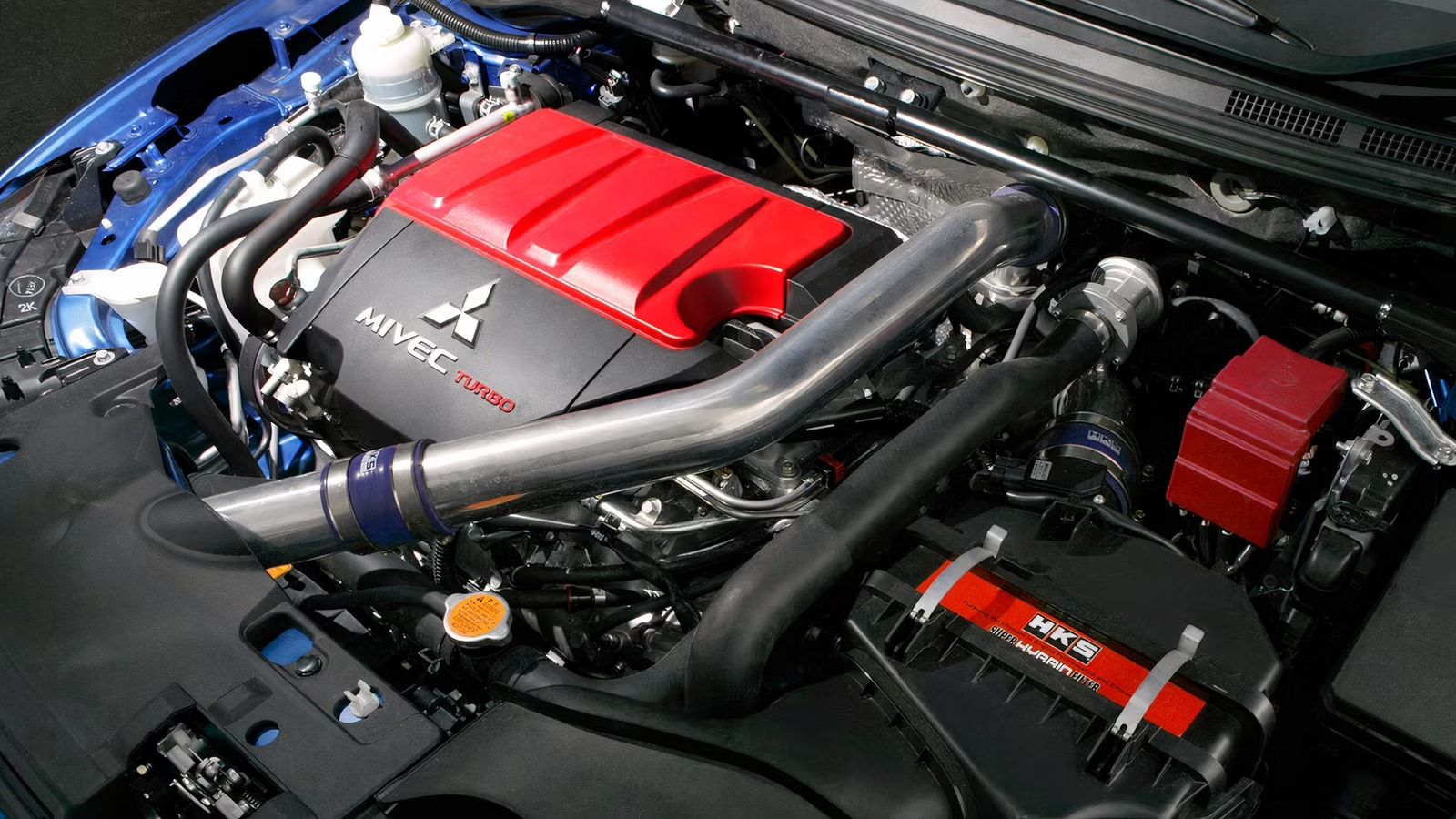
When talking about outright vehicle performance, few people refer to the ratio of horsepower to an engine’s displacement. But that metric can often be worth looking at, especially in the case of the 2004 Mitsubishi Lancer Evolution VIII.
This British-market model was a sporty four-door sedan that had a 2.0-liter inline-four engine with a cast-iron block, but it was surely a wolf in sheep’s clothing. Its output ratio was quite astonishing, able to beat comparative figures from several supercar engines. And due to some very bold engineering, Mitsubishi aimed to squeeze every last bit of power from every liter of its engine displacement.
2004 Mitsubishi Lancer Evolution VIII nearside front quarterMitsubishi
The 2004 Lancer Evolution VIII FQ-400 produced 405 hp and, based on its 1,997-cc displacement, turned out no less than 202.8 hp per liter. Clearly, that didn’t make the engine more powerful than a modern supercar, and a Corvette ZR1 or McLaren 750S would still disappear quickly down the road. However, Mitsubishi was still able to extract more power from each liter of displacement than many modern-day supercars, and this came down to some very aggressive development work over at Mitsubishi Motors in the UK.
The FQ-400 sat at the top of Mitsubishi’s locally developed Evolution range, above the FQ-300, FQ-320, and FQ-340. Mitsubishi started out with the Evo VIII MR FQ-320 when developing the FQ-400, but to reach 405 hp, it needed some serious mechanical help. So, to achieve its goals, Mitsubishi Motors UK worked with several third-party organizations like Rampage, Owen Developments, and Flow Race Engines.
This collaboration introduced forged pistons and connecting rods, an upgraded fuel system, a specially selected turbocharger, a stainless-steel exhaust manifold, a high-flow catalytic converter, and a MoTeC engine management system. It fell to Flow Race Engines to build the engines themselves while Rampage dealt with much of the vehicle’s assembly.
The end result was an engine that delivered peak torque of 355 lb-ft at 5,500 rpm, and maximum power came in at 6,400 rpm. This wasn’t a modern turbo engine that was able to deliver a significant amount of torque just above idle, but when everything did come together, the FQ-400 turned out to be brutally fast. It could get to 60 mph in 3.5 seconds, according to Mitsubishi, with a top speed above 175 mph. This was significant performance back in 2004, for what was essentially a four-door sedan.
The FQ-400 Still Beats Several Modern Supercar Engines
Mclaren 750SMcLaren
If you put the Mitsubishi alongside something like the McLaren 750S in a drag race, it would disappear quickly into that supercar’s rearview mirror. But while the dominant 750S produces around 740 hp in US trim from its 4.0-liter twin-turbo V8, it records a figure well below the Mitsubishi’s in the horsepower-per-liter stakes.
The 750S records 185.0 versus the Mitsubishi’s 202.8, and the same general result appears when you compare the Mitsubishi to Lamborghini’s Temerario. This Italian supercar has a 4.0-liter twin-turbo V8 that can rev to 10,000 rpm and produces about 789 hp without taking into account its electric motors. That generates a headline figure of 198 hp per liter, and while it’s one of the most advanced turbo V8s in production, the Mitsubishi edges it on this specific measurement.
Moving over to the Chevrolet Corvette ZR1 reveals a staggering 1,064 hp out of its 5.5-liter twin-turbo V8. That works out at 193 hp per liter, with the Mitsubishi again winning the fight. Meanwhile, the Porsche 911 GT3 RS sits significantly behind the Mitsubishi because its 4.0-liter flat-six is naturally aspirated and can only return a figure of 130 hp per liter from its approximately 518 hp output.
Ferrari, Koenigsegg, And One Surprising Sedan Outclass The Mitsubishi – But Only Just
2026 Ferrari 296 GTB. Wheel. Alloy. Front, three-quartersFerrari
The Mitsubishi’s figures may be exceptional, but they’re not unbeatable, as shown by the Ferrari 296 GTB. This uses a 2.992-liter twin-turbo V6, generating roughly 654 hp before taking into account the hybrid motor, and that gives it about 219 hp per liter. Maserati’s MC20 gets past the FQ-400 as well, with its 3.0-liter V6 producing roughly 621 hp, or about 207 hp per liter.
Of course, there are some truly extreme machines to consider when painting a complete picture. For example, the McLaren W1 returns 230 hp per liter with its 4.0-liter V8 producing roughly 915 hp by itself. TheKoenigsegg Jeskomakes 1,280 hp from 5.0 liters on gasoline, which is roughly 256 hp per liter.
The real surprise isn’t that exotic hypercars beat a 20-year-old Mitsubishi — it’s that a modern family performance sedan came even closer than any of them.
A Mercedes Four-Cylinder Actually Went Further
2024 Mercedes-AMG C63 S E PerformanceMercedes
Mercedes-AMG may want some input into this conversation, as one of its modern engines most directly challenges the Mitsubishi without any supercar foundation. Here, the Mercedes-AMG 2.0-liter M139l four-cylinder generates roughly 469 hp within the C63 S E Performance and that works out to around 236 hp per liter.
However, this system uses both direct and port fuel injection, has a twin-scroll turbo, and incorporates a small electric motor that engineers mount directly on the turbocharger shaft for better response. That’s a far more sophisticated solution than that of the older FQ-400, and Mercedes certainly designed this system for larger-scale production as well as integration into a plug-in hybrid system.
It’s still worth pointing out that Mercedes-AMG is moving away from the four-cylinder C 63 and GLC 63 formula. In doing so, it’s pointing to weak customer enthusiasm for a four-cylinder hybrid versus a traditional V8, and the company is also acknowledging challenges around tougher Euro 7 emissions requirements.
Mitsubishi Built An Even Wilder Engine
2015 Mitsubishi Evo X Final Edition I4 engine topMitsubishi
As it turns out, the FQ-400 still wasn’t the highest-output Mitsubishi four-cylinder to come out of its British operation. In 2014, Mitsubishi revealed theEvo X FQ-440 MR as part of its 40-year celebration. It would only offer 40 cars to consumers, and all of them were painted Frost White with a price tag of £50,000, or around $82,000 at the time. It had a 2.0-liter turbo engine producing 440 hp, along with an HKS turbocharger, a Janspeed exhaust system, bigger fuel injectors, and upgraded intake hardware. That equates to roughly 220 hp per liter, actually edging the Ferrari 296 GTB’s combustion engine for specific output.
Ferrari may still claim a production car record as the 296 was, after all, a globally sold series production vehicle. By comparison, the FQ-440 was a very limited special that needed extensive expert engineering as well as a lot of aftermarket-derived hardware.
Peak Power Came With A Price
2014 Mitsubishi Lancer Evolution X FQ-400 2.0L Turbo 4B11T I4 EngineMitsubishi
While the FQ-400 numbers may have been spectacular, not everyone was enthusiastic about the performance on the road. Some felt that this particular Evo VIII was not the best option and that the FQ-400 engine’s delivery was difficult to exploit on normal roads. Some felt that an FQ-340 or even an FQ-320 was a better all-around performer, as they were able to deliver their power earlier and across a broader part of the rev range.
This may point to the difficulties of managing huge horsepower-per-liter numbers. Those numbers may often come with a narrower power band or turbo lag, making a car feel extraordinary only if its engine is working at full boost.
In fairness to modern supercar engines, it’s also important to understand what their manufacturers have to face. Modern supercar engine builders must deal with requirements that their FQ-400 counterparts never faced on the same scale. Those modern engines must pass current emissions rules, support advanced diagnostics, work in multiple climates, and cope with much larger production runs. And all of that really matters, even though this particular Mitsubishi was an official company model that had to go through reliability testing, and it did come with a three-year, 36,000-mile manufacturer warranty.
While some supercar manufacturers have produced engines that beat the 2004 Mitsubishi Lancer Evolution VIII MR FQ-400 in the romantic horsepower-per-liter stakes, a number of others were not able to. This means that after more than two decades, a limited-production Mitsubishi sedan is still contributing to that intriguing conversation.
Sources: Mitsubishi, McLaren, Mercedes-AMG, Porsche, Lamborghini.
