

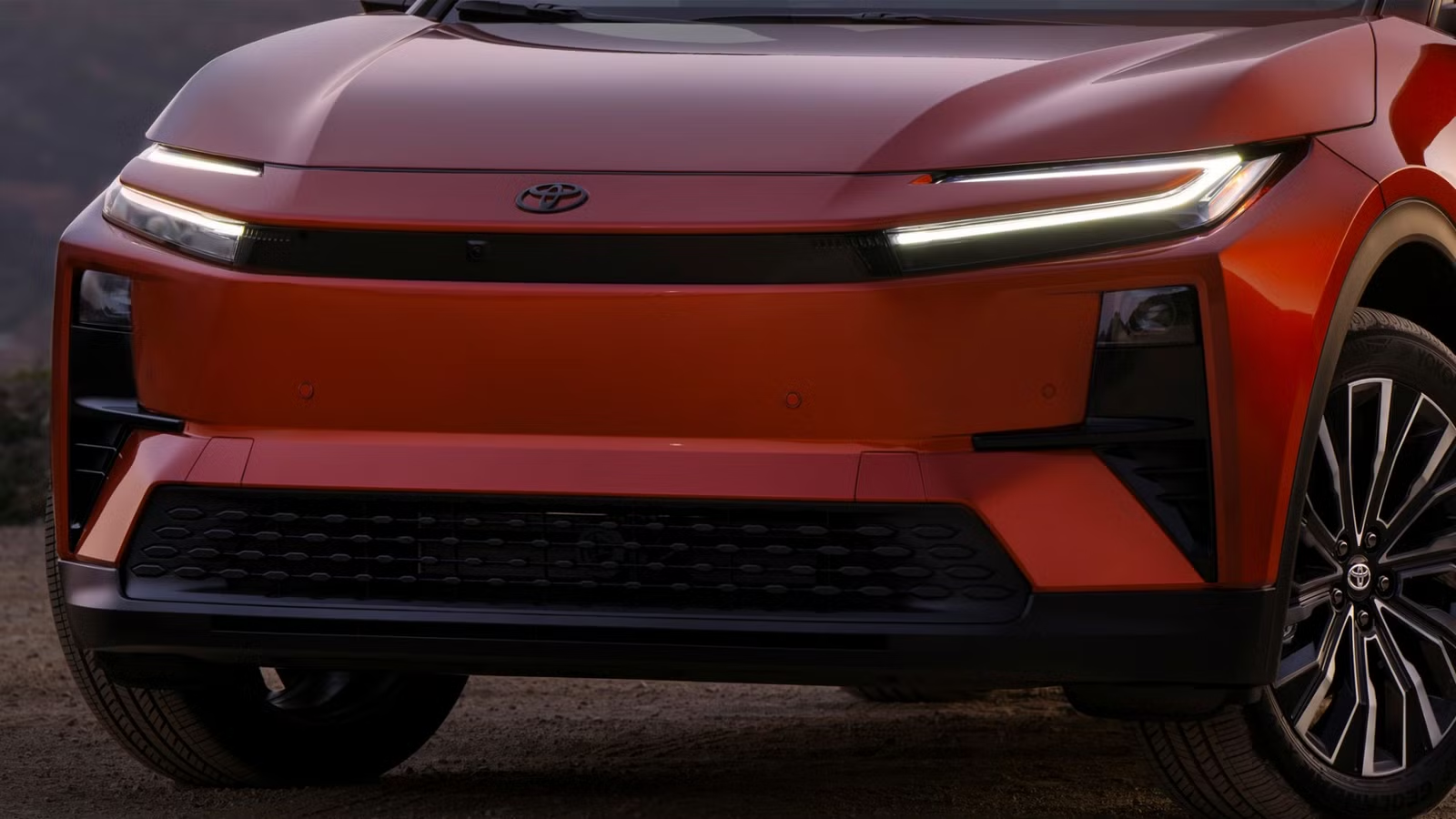
Toyota has issued a recall on its 2026 C-HR, the first in fact for the redesigned subcompact SUV. It’s for a serious problem, one that could lead to the loss of drive power, but the way Toyota discovered it is a little odd. That’s because the discovery didn’t happen on current models, but something still to come.
The recall was published by the NHTSA on September 2 and affects 8,521 C-HRs, though the exact number affected in the US wasn’t stated.
Problem Discovered While Testing Future EV
2026 Toyota C-HR ExteriorToyota
The latest C-HR is sold exclusively as an EV in the US, and according to the recall notice (campaign number 26V570000), a software problem could cause the vehicle’s battery to become overcharged under certain driving conditions. The recall mentions driving in particularly low temperatures with the battery at a high state of charge and the regenerative mode used over a long distance, like coasting down a hill.
The problematic software has guardrails designed to limit how much the battery is charged, and as a result could cause the powertrain to shut down if the battery gets to an overcharged state. A loss of power while on the move is downright dangerous, particularly when it happens without warning.
Toyota said it first became aware of the issue in April while testing an upcoming battery-powered model, the identity of which wasn’t detailed in the recall notice. After discovering the issue, it identified the same problematic software in specific versions of the 2026 C-HR. The vehicles have production dates spanning February 6, 2026, to July 10, 2026.
As for what that upcoming battery-powered model could be, that’s a complete mystery. It could be something as obvious as the Highlander EV, a vehicle that’s debuted but is technically still an upcoming model since it’s yet to go on sale. Or, we could be talking about something still in the pipeline, even something from the company’s Lexus division.
How Is Toyota Fixing This?
2026 Toyota C-HR ExteriorToyota
Affected owners will be asked to bring their vehicle to a dealer, who will update the vehicle’s software. Toyota plans to notify owners by mail starting Oct. 18, and at present the automaker hasn’t warned that driving the vehicles is unsafe.
Toyota has confirmed that no other Toyota or Lexus vehicles sold in the US suffer from the same issue, and that, to the best of its knowledge, there aren’t any instances of C-HR drivers experiencing it. Anyone looking for more information can contact the automaker’s customer service department at 1-800-331-4331 or visit the automaker’s recall page linked below.
CarBuzz Insights – Why This Matters
2026 Toyota C-HR ExteriorToyota
A loss of drive power is a very dangerous problem, regardless of what powers the vehicle. While it can happen to internal-combustion vehicles too, Toyota will want to avoid buyers who are still largely wary of electrification associating this kind of failure with electric vehicles and the issue potentially flaring up into a Toyota-specific problem. The automaker will definitely not want a repeat of the unintended-acceleration debacle it suffered less than two decades ago.
Fortunately, the problem appears to be isolated to a small batch of C-HRs, and Toyota looks to have identified it early.
Sources: NHTSA, Toyota
