

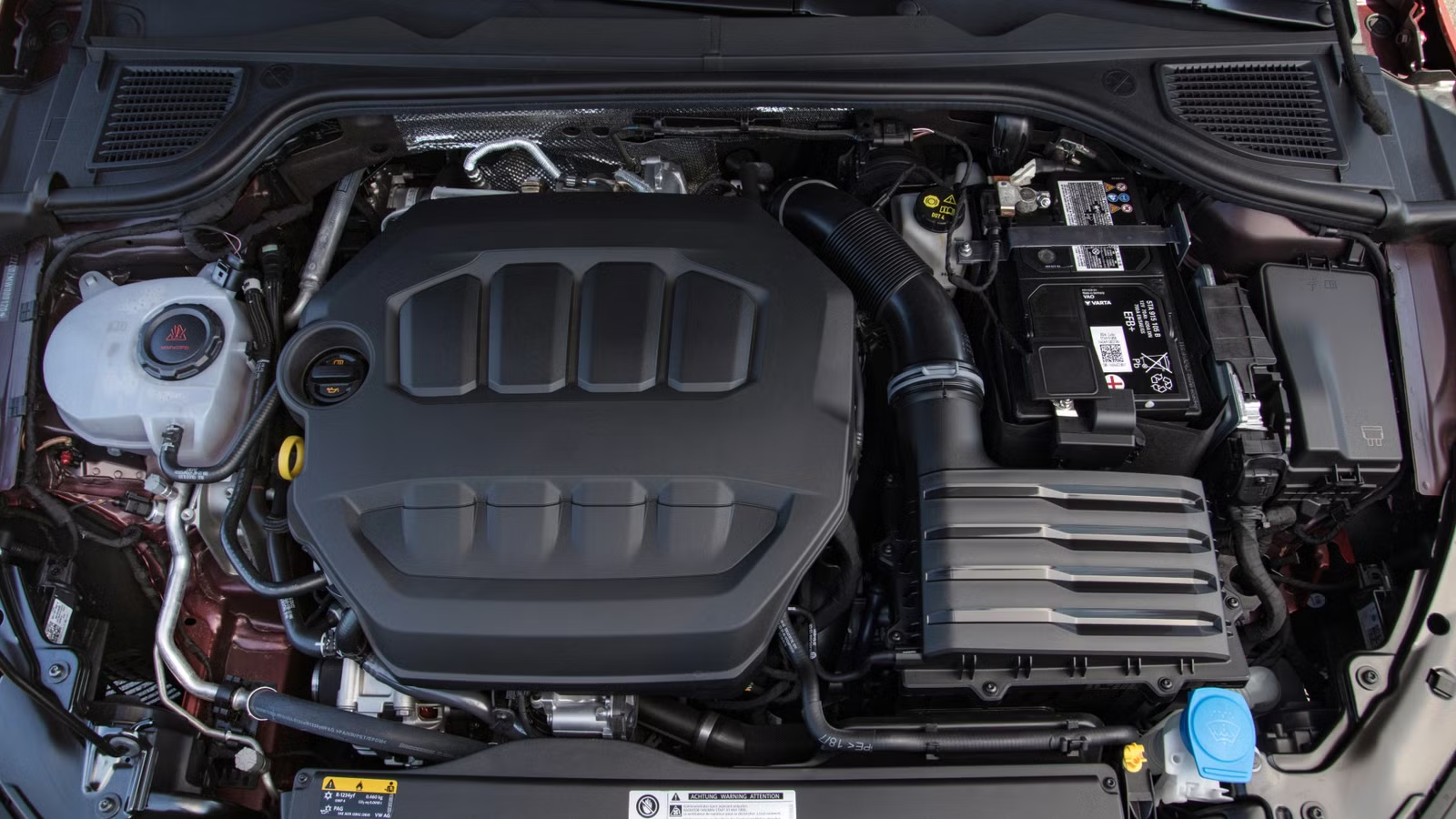
Drivers who purchase compact turbocharged sedans and hatchbacks for fuel efficiency often accelerate engine wear without realizing it. The sub-15-minute cold‑climate commute that many Americans face during colder seasons creates a silent mechanical flaw. Modern downsized engines use exhaust gas to spin turbines past 100,000 RPM, relying on steady oil pressure for survival.
Short trips never allow these engines to reach proper operating temperatures, creating an ideal environment for oil degradation and component fatigue. A naturally aspirated, port‑injected engine operates without these forced‑induction stress points. In contrast, a modern forced-induction powertrain exposes specific weaknesses when subjected to short-distance, cold-weather driving.
Downsized Turbocharging Reshaped Commuter Cars
Audi
Automakers now employ downsized turbocharged engines to meet strict global emissions regulations and fuel economy standards. A turbocharger forces compressed air into the combustion chamber. This extra air allows a low-displacement engine to burn fuel efficiently and generate power equal to a larger naturally aspirated engine.
Smaller engine blocks weigh less and reduce internal friction during light driving. The turbocharger produces peak torque at low engine speeds, which improves acceleration in city traffic. Commuters obtain strong responsiveness during driving while maintaining low fuel consumption. This advanced technology has its benefits, but there are some significant long-term reliability drawbacks associated with these powertrains.
The Downside Of Downsized Engines
Front 3/4 view of red 2021 Volkswagen Golf GTI driving. Volkswagen
Commuters who use turbocharged cars for quick errands, such as the EA888 applied to a multitude of VW products, such as the Golf GTI, generate specific failure modes that rarely afflict simpler engine designs. Cold winter temperatures increase motor oil viscosity. Thickened oil moves slowly through the narrow oil passages that feed critical turbocharger bearings during a cold start. The rotating assembly in a turbocharger spins instantly upon ignition, but the oil supply lags behind.
This delay creates brief moments of metal-on-metal friction before adequate pressure arrives. Gravity feeds the oil return lines that carry lubricant from the turbocharger housing back to the oil pan. Thickened oil drains slowly, pooling inside the turbocharger housing. Internal back pressure then forces the oil past dynamic shaft seals. This continuous startup stress causes bearing play, shaft instability, and premature turbo housing failure over time.
How Engine Temperature Improves Turbocharger Reliability
VW EA888VW
An engine operating on short trips never maintains peak operating temperature long enough to burn off internal moisture. Cold engine blocks encourage moisture in the air to condense inside the crankcase. At the same time, cold-start enrichment sprays excess fuel to keep the engine running smoothly. Unburned fuel washes past cold piston rings and enters the oil pan.
In a fully warmed engine, fuel and water are drawn out through the crankcase ventilation system. On short trips, these contaminants remain in the oil pan. Fuel dilution reduces oil viscosity and breaks down its protective film. Water mixes with degraded oil to form acidic sludge. This thin, contaminated mixture loses its ability to protect high-load components, accelerating bearing wear across the entire engine.
VW’s Critical Flaw In The EA888
2025 Audi S3 Prestige 2.0 TFSI Quattro EngineLyndon Conrad Bell | TopSpeed
The early VW and Audi 2.0-liter TFSI EA888 enginedemonstrates the extreme mechanical demands of forced induction and direct injection. Direct injection requires a High-Pressure Fuel Pump that operates at pressures between 1,800 and 2,000+ PSI. A mechanical lobe on the intake camshaft directly drives this pump, while a small, bucket-style cam follower sits between the camshaft lobe and the HPFP piston. This follower relies completely on steady, clean engine oil for lubrication. Diluted or oil-starved engines rapidly wear down the sacrificial black coating on the follower. Once that friction barrier fails, the pump piston grinds directly into the camshaft.
Left unchecked, the pump bores through the metal follower, destroying the intake camshaft and spraying metal shavings throughout the cylinder head. Volkswagen Group eventually extended warranty coverage for the HPFP, camshaft, and follower to 120,000 miles to address this systemic issue. Proactive owners manually pull and inspect this cam follower every 10,000 to 20,000 miles to prevent catastrophic engine failure.
What Happens During A Short Drive In Cold Temperatures
Rear 3/4 shot of 2018 Audi A4 in silver parked next to roadAudi
Short commutes compound the structural limitations of direct-injection intake systems. Traditional port fuel injection sprays gasoline onto the back of the intake valves, continuously cleaning away oil residues. Direct injection sprays fuel straight into the combustion chamber. The engine’s Positive Crankcase Ventilation system routes crankcase vapors back into the intake tract to reburn oil mist.
Short trips increase crankcase moisture and blow-by gases. Without gasoline to wash the intake valves, these oil vapors bake directly onto the hot metal valve stems. Over time, heavy carbon deposits choke engine airflow, causing misfires, rough idling, and lost performance, requiring manual walnut‑blasting to remove deposits.
Volkswagen Jetta GLI EngineLyndon Conrad Bell | TopSpeed
Forced induction introduces auxiliary components that naturally fail under heat and pressure. The EA888 uses an electronic diverter valve to recirculate excess boost pressure when the driver closes the throttle plate. Early iterations used a delicate rubber diaphragm inside the valve housing.
Repeated exposure to hot boost charges, oil vapor, and pressure spikes causes the rubber diaphragm to tear. A torn diverter valve creates a persistent boost leak. The turbocharger must spin significantly faster and hotter to compensate for lost pressure, accelerating wear on an already stressed rotating assembly. Volkswagen eventually replaced the rubber diaphragm with a piston-style valve to survive these harsh operational cycles.
How To Keep The EA888 In Prime Condition
Volkswagen
The Volkswagen Group EA888 engine family spanning generations Gen 1 through Gen 4 requires strict service adherence to avoid severe mechanical failures. Routine engine oil and filter changes must occur every 5,000 to 10,000 miles or 12 months using VW-certified full-synthetic oil, costing between $80 and $150 for self-service or $150 to $250 at a dealership. Spark plug replacement occurs every 30,000 to 40,000 miles on stock engines, though tuned variants reduce this interval to every 10,000 to 15,000 miles, with service costs ranging from $60 to $350 depending on whether an owner performs the work or visits a dealer.
Ignition coils typically require replacement every 40,000 to 60,000 miles or at the first sign of misfires, carrying a $120 to $200 parts cost for a set of four, while cabin and engine air filters need fresh units every 20,000 to 30,000 miles for $40 to $80. Drivetrain components demand equal vigilance, as models equipped with the DSG transmission require fresh fluid and filters every 40,000 miles at a cost of $300 to $800, and Haldex all-wheel-drive systems require fluid changes and pump strainer screen cleanings every 30,000 miles for $150 to $300.
Finally, the serpentine belt requires inspection at 40,000 miles and replacement between 60,000 and 80,000 miles for $150 to $300, while direct-injection carbon accumulation demands a manual walnut-blasting service every 50,000 to 80,000 miles, costing $400 to $800 at independent specialist shops.
Recalls That Have Affected EA888-Driven Volkswagens
Bring A Trailer
A history of prominent factory recalls, technical service bulletins, and class-action settlements highlights the structural vulnerabilities of the EA888 architecture across its production run. Early Gen 1 and Gen 2 engines suffered from failing mechanical timing chain tensioners that lost tension or snapped, causing the timing chain to jump and destroying the engine, which ultimately resulted in a massive class‑action settlement that provided extended warranties and repairs for affected 2008 through 2013 vehicles.
Gen 3 variants frequently experience premature coolant leaks from plastic thermostat housings and water pump assemblies that crack or warp under heat, prompting a separate class-action settlement that extended warranty coverage up to 10 years or 100,000 miles on many 2014 to 2021 models. Additionally, select Gen 3 and Gen 4 engines faced official NHTSA safety recalls due to improperly torqued fuel rail bolts or high-pressure fuel pump defects that caused fuel leaks and posed fire hazards.
Secondary mechanical components present further ownership burdens, as early Gen 3 turbocharger wastegate linkages frequently corrode and bind, causing boost faults that require full turbocharger replacement, while earlier iterations suffered from leaking camshaft adjustment solenoids that wicked oil into engine wiring harnesses and damaged control units.
The VR6’s Older Design Gets Temperature Regulation Right
The Volkswagen VR6 engine offers a direct counterpoint to turbocharger complexity. By utilizing a narrow-angle V6 design underneath a single cylinder head, the naturally aspirated unit delivers smooth power without high-stress forced-induction add-ons. The following key designs allow it to manage heat better than modern turbocharger options:
- Port Fuel Injection: Fuel washes over the intake valves continuously, stopping carbon accumulation before it forms.
- Lower Operating Pressures: Fuel runs at standard line pressure rather than 2,000 PSI, removing cam follower friction points entirely.
- Thermal Management: The engine lacks a red-hot exhaust turbine, lowering overall engine bay temperatures and preserving vacuum lines, plastics, and synthetic seals.
- Cold-Start Resilience: The VR6 uses simple, robust oil passages that lubricate main bearings instantly without waiting for a turbo feed line to clear thick oil.
A VR6 engine easily reaches 200,000 miles on basic maintenance schedules. Short-distance commuters in a VR6 face minor oil dilution risks, but they avoid total turbo bearing collapse, HPFP destruction, and intake clogging.
Turbochargers Will Always Need Optimal Temperatures
2024 Chevelle 70/SS turbochargerTrans Am Worldwide
Turbocharged engines offer excellent power and fuel efficiency on long highway runs where the oil stays warm and burns off moisture. However, applying that same turbocharged car to a sub-15-minute cold-weather commute forces the engine to run in its most damaging operational zone.
Those seeking long-term ownership on short urban routes benefit far more from naturally aspirated engines like the VR6, but this comes at the cost of fuel efficiency. Simple mechanical designs remain superior for surviving repetitive cold starts, severe oil dilution, and low-mileage usage patterns. Matching your driving profile to the correct engine design prevents costly premature mechanical failures.
How To Spot The Right EA888 In The Used Market
Front 3/4 shot of a 2010 Volkswagen Golf GTIVolkswagen
When shopping for a deal in the used market, buyers often mistakenly equate low odometer mileage with low mechanical wear. A short-trip forced-induction operation reverses this logic. A high-mileage turbocharged car that spends its life cruising on highways at steady operating temperatures often displays pristine internal components, free from fuel dilution, carbon crusting, or heat-soak degradation.
Conversely, a low-mileage commuter car subject to constant cold cycles, frequent stop-and-go restarts, and unevaporated crankcase moisture experiences several lifetimes of thermal stress within a fraction of the distance. Evaluating a modern forced-induction vehicle requires shifting focus from the odometer reading to the operational history of the engine. Buyers who prioritize long-term durability on short urban routes must recognize that low mileage logged under severe cold-start conditions represents far more threat to engine longevity than high mileage accumulated under ideal thermal conditions.
Available Models
Select Available Models
Volkswagen
Founded
28 May 1937
Founder
German Labour Front
Headquarters
Wolfsburg, Germany
Owned By
Volkswagen Group
Current CEO
Thomas Schaefer
Sources: MotorReviewer, KBB, RepairPal, and the NHTSA.
