

The midsize SUV segment is the most fiercely contested battleground in America’s automotive industry. As a result, choosing the best one is a near-impossible decision, because you must consider so many variables. Thankfully, we evaluated these modern contenders to determine the best one; which should help make your decision-making process just a bit easier.
This list comprises all models in the mid-size SUV segment as tested by CarBuzz in 2026; we rank them from least impressive to most, with reasons provided.
Best Mid-Size SUVs We’ve Tested
2026 Subaru Outback
The 2026 Subaru Outback occupies a unique space within this segment. While traditionalists might argue that its elevated station wagon silhouette disqualifies it from true utility vehicle status, its measurable ground clearance and standard symmetrical all-wheel drive system aim to prove otherwise. In establishing our midsize SUV rankings, the Outback consistently demonstrated a mechanical competence and traction retention that outpaces many conventional rivals, and the 2026 model year refines the existing platform architecture rather than rewriting it.
Subaru engineers focused their efforts on suspension damping metrics and chassis torsional rigidity, with the result being a subframe that absorbs washboard ruts with a much-improved composure. The powertrain options remain practical. The naturally aspirated 2.5-liter boxer engine provides adequate propulsion with 180 horsepower and 178 lb-ft of torque, but the 2.4L turbocharged variant (260 hp / 277 lb-ft) is the one to choose if you regularly seek higher elevations. Both engines are mated to a continuously variable transmission (CVT).
“The Subaru Outback has achieved its “beloved” status by being a friendly, comfortable wagon with enough rugged performance to get its occupants over and through moderately slippery and generally difficult terrain.”
– Ian Wright, Senior Road Tester, CarBuzz
The dual-function X-Mode system manipulates the CVT’s torque mapping during slip events, routing power to the wheels with the highest friction coefficient faster than purely mechanical limited-slip differentials.
Inside, the layout leans into functionality and practicality. The central infotainment interface responds with reduced latency, and the material quality in the high-wear zones indicates a vehicle that’s been engineered for daily use. Notably, the steering rack has also been re-weighted, offering a better on-center feel at highway speeds.
2027 Kia Telluride
Kia’s impact on the three-row space has been largely undisputed since the Telluride’s inception. When evaluating the best midsize SUV 2026 has to offer, significant mechanical evolution is required; this 2027 iteration represents that critical pivot. The most significant structural departure from its predecessor lies beneath the hood. The aging naturally aspirated V6 that previously defined its power delivery has been retired and replaced by a highly efficient, torque-dense turbocharged engine. This forced-induction 2.5L powertrain alters the Telluride’s dynamic performance profile with its 274 hp and 311 lb-ft (there’s also a hybrid variant).
This powertrain transition is mated to a new 8-speed automatic transmission equipped with better thermal management systems. During our time with the Telluride, we noticed the turbocharged setup not only shaved tenths off the 0-60 mph sprint but also returned consistent power delivery across fluctuating altitudes. As for the chassis tuning, Kia stiffened the rear multi-link suspension geometries and subframe mounting points. This makes the Telluride feel decidedly more planted. The active all-wheel drive system now features enhanced torque vectoring across the rear axle in a bid to neutralize understeer.
“You might not fall in love with this Telluride at first sight – I didn’t. But live with it for a month, point it at a snowy road with your kids in the back, or pack it for a road trip, and the logic becomes hard to argue with.”
– Seyth Miersma, Road Tester, CarBuzz
Cabin isolation is another strong point. The use of acoustic laminated front glass and high-density sound deadening in the firewall has significantly reduced wind shear and powertrain noise intrusion. The third row remains habitable for full-sized adults, and the cargo volume behind it continues to impress when it comes to spatial packaging efficiency. The Telluride is a winner because it actually feels like it’s been engineered for the American family’s specific needs.
Standard features on the 2027 Telluride:
- Highway driving assist
- Lane keep assist
- Forward collision avoidance
- Safe exit warning
- Driver attention warning
- Blind spot monitoring / blind spot collision warning
- Rear occupant alert
- 10 airbags
The Best Mid-Size SUV Of 2026 Is…
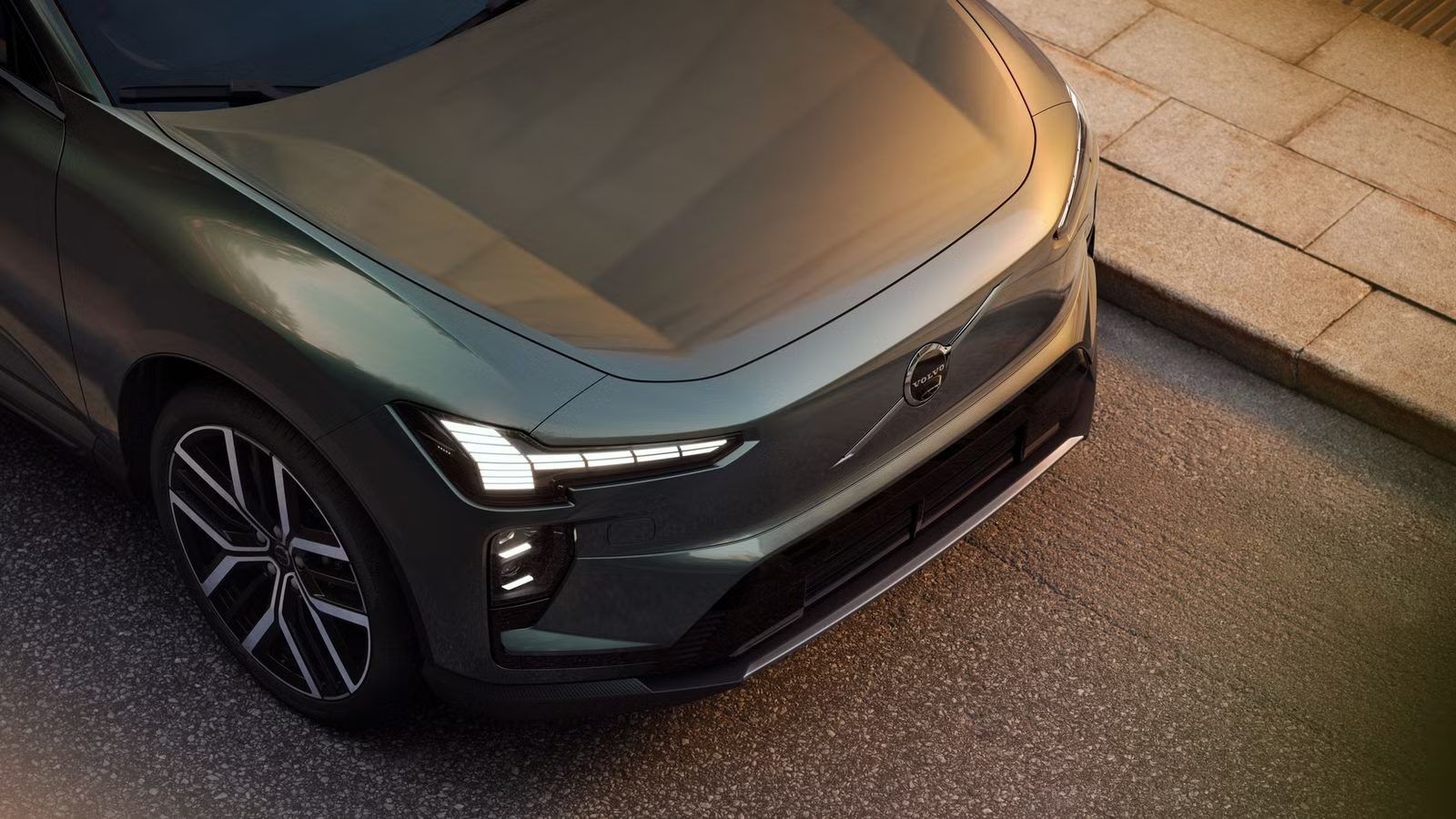
2027 Volvo EX60
The transition to electrification has forced legacy automakers to completely rethink their platform architectures, and the 2027 Volvo EX60 stands as one of the most compelling executions of this mandate. Earning the title of overall best midsize SUV in a populated and highly competent segment requires far more than just slapping a large battery pack into an existing chassis. No, it demands a holistic, ground-up synergy between software, structural engineering, and driving dynamics.
Built upon a dedicated, scalable EV architecture, the EX60 abandons the packaging compromises inherent in internal combustion platforms that have been retrofitted for battery use (think the first-gen EX40 Recharge). By integrating the high-capacity battery casing directly into the floorpan, Volvo has achieved a level of torsional stiffness that translates to exceptional cornering stability. The center of gravity is much lower than its gas-powered predecessors, virtually eliminating the lateral body roll that typically plagues vehicles carrying this much curb weight.
2027 Volvo EX60 driving shots + details.Volvo
Powertrain efficiency and thermal management are where the EX60 truly distances itself from the immediate competition. The dual-motor, all-wheel drive configuration provides linear, immediate torque vectoring to individual wheels, and the engineers have calibrated the EX60’s power delivery to be exceptionally progressive and easily modulated in dense traffic. According to Volvo, the active liquid thermal management system surrounding the battery cells ensures sustained peak performance and minimal range degradation during high-speed highway cruising—a critical factor for range-anxious buyers.
The implementation of an 800-volt electrical architecture reduces DC fast-charging times, and it mitigates the logistical planning of long-distance interstate travel. Regenerative braking is well-tuned, too, offering a true, calibrated one-pedal driving experience that smoothly brings the vehicle to a complete halt without jarring deceleration spikes.
The EX60’s cabin continues with Volvo’s clinical Scandinavian restraint, yet the execution is undeniably premium and structurally sound. The industry’s over-reliance on easily scratched piano black plastics has been replaced by sustainably sourced, acoustically dampening wool-blend textiles and tactile open-pore wood trims. The seat frames provide precise lumbar and lateral support, and the acoustic isolation is frankly staggering; the inherent absence of mechanical engine noise is matched by aggressive aero-acoustic engineering. Flush door handles, aerodynamic wheel designs, and extensive underbody paneling seal out wind and tire noise.
2027 Volvo EX60Tom Murphy / CarBuzz / Valnet
In terms of its tech, the EX60 leaps forward with its advanced driver assistance systems. The native Google operating system within the central interface eliminates the high latency and clunkiness of proprietary infotainment software. When you open the built-in navigation, it automatically displays real-time DC fast-charging stations and initiates battery pre-conditioning. Yet Volvo hasn’t abandoned utility; the interior cargo volume is vast and is aided by the absence of a transmission tunnel. For those who often tow a trailer, the reinforced structural towing capacity remains strong enough to handle moderate hauling loads without threatening the rear subframe.
Interestingly, the aero-efficiency of the exterior achieves a drag coefficient that rivals some sedans, slicing through the air to maximize every kilowatt-hour of battery capacity. Even the HVAC (heating, ventilation, and air conditioning) system has been redesigned with a high-efficiency heat pump that draws minimal power from the main traction battery in sub-zero winter testing. Every physical component, from the dampening of the suspension bushings to the software governing the motor inverters, is synchronized.
“The 2027 Volvo EX60 may lack the emotional tug of a 1990’s 850 T5-R, but it’s finally a Volvo that can go toe-to-toe with BMW and Mercedes again without any ifs or buts about it.”
– Roger Biermann, Managing Editor, CarBuzz
Sources: Kia, Subaru, Volvo
