

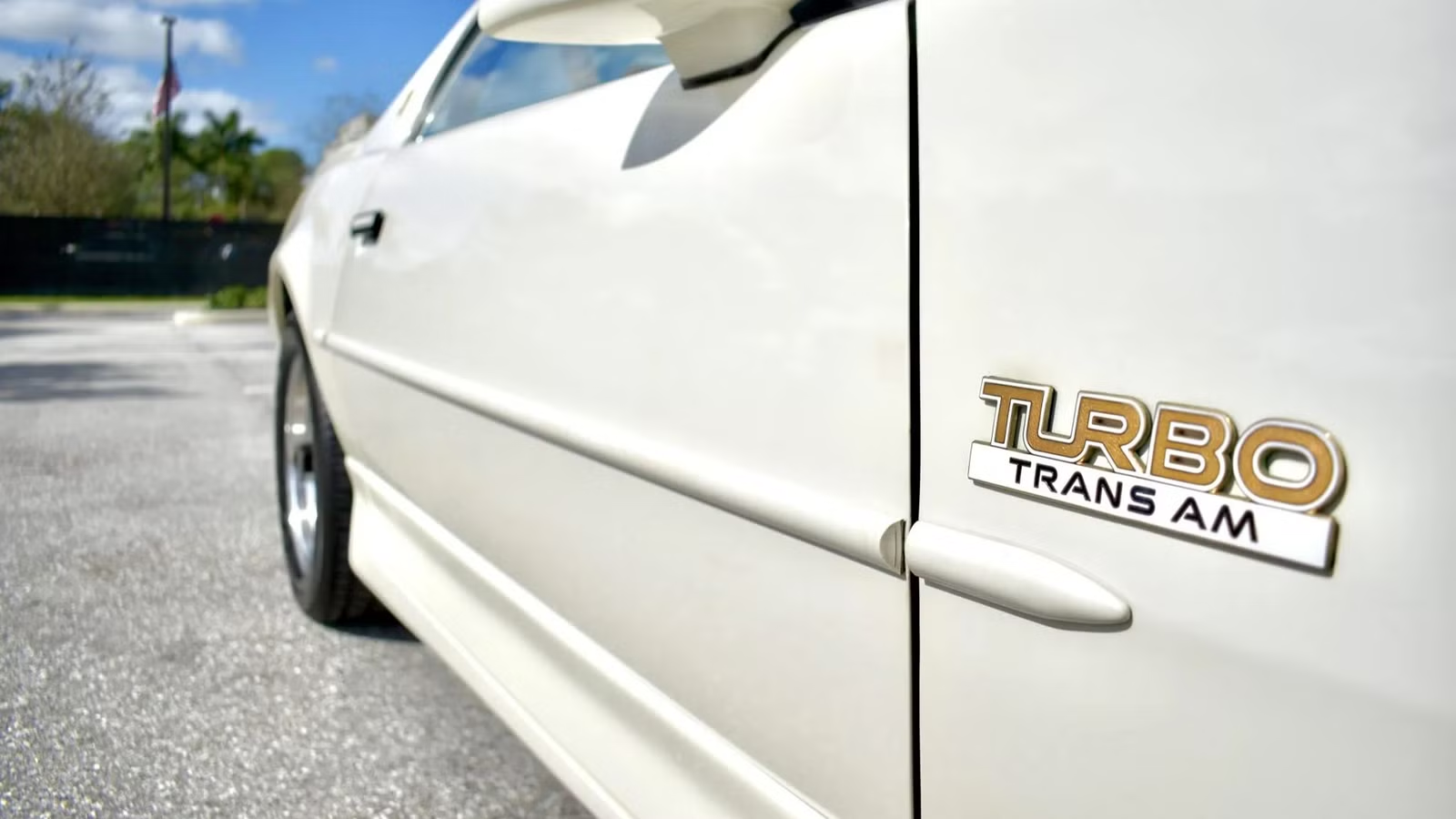
In the 1980s, Chevrolet was justifiably proud of the Corvette and felt that it sat safely at the top of the performance hierarchy at General Motors. But elsewhere under the GM umbrella, rival designers wanted to shake things up with something even quicker than the ‘Vette. Pontiac celebrated the Trans Am’s 20th birthday with a car that could not merely edge past the contemporary Corvette but turned out to be more than a second quicker to get to 60 mph. It was one of the most extraordinary production cars the company had ever created. And while the backstory was rooted in early turbo-era ingenuity, the project may also have led to some awkward internal chats.
Pontiac Put Buick’s Turbo Six Where Nobody Expected It
1989 Pontiac Firebird 20th Anniversary Turbo Trans Am Pace Car front 3/4Bring A Trailer
This Pontiac-versus-Chevrolet story actually began at Buick, where by 1988 the company had already demonstrated what its turbocharged 3.8-liter V6 was capable of. It had shoehorned this engine into the Grand National, which turned that car into a performance icon. Meanwhile, the limited-production GNX also showed how a Buick coupe could embarrass sports cars further up the pecking order.
After seeing those accomplishments, Pontiac decided to find out what it could do with that engine. The brand commissioned a special version of the Firebird GTA to celebrate the Trans Am’s 20th anniversary, which would use a modified version of Buick’s turbocharged and intercooled V6.
Pontiac handed much of the development and special assembly work to PAS Inc. in California, which would then send its creations to GM’s Van Nuys plant for installation, then return them for final assembly, inspection, and testing. Pontiac produced 1,555 Firebird 20th Anniversary Turbo Trans Am cars, most of which were white with saddle interiors, excluding five pre-production pilots.
The organizers of the 73rd Indianapolis 500 race in May 1989 chose the finished car as the pace vehicle, with Bobby Unser behind the wheel. Each of the three identical track cars needed additional safety communications, lighting, and TV equipment, but were otherwise stock in terms of performance.
The 250 hp Rating Told Only Part Of The Story
1989 Pontiac Firebird 20th Anniversary Turbo Trans Am Pace Car engineBring A Trailer
Although some might call the Turbo Trans Am engine simply a Grand National transplant, that simplification underplays the amount of engineering work that Pontiac engineers and their partners had to conduct to make everything work. For example, the team couldn’t simply lower that Buick V6 into the Firebird unchanged because of the narrow engine bay. They had to use cylinder heads from a transverse front-wheel-drive application of the 3.8-liter engine instead. Those different cylinder heads also improved exhaust flow and made for a more efficient combustion chamber design, while matching pistons preserved the engine’s 8.0:1 compression ratio.
Elsewhere, other changes included short-runner stainless-steel headers, a high-pressure fuel regulator, a recalibrated engine computer, and a bigger GNX-style intercooler. All Turbo Trans Ams had the Turbo-Hydramatic 200-4R four-speed automatic and also had Australian-built nine-bolt Borg Warner rear axles with a limited-slip differential and a 3.27:1 final drive ratio.
Pontiac claimed the finished engine produced 250 hp at 4,400 rpm and 340 lb-ft of torque at 2,800 rpm, but many observers at the time were skeptical. One outlet suggested that the V6 probably produced closer to 300 hp based on its actual performance. Perhaps GM simply didn’t want a Pontiac to officially outrank the Corvette when it came to those all-important performance numbers. But it seemed clear that the advertised rating didn’t really align comfortably with its independently measured acceleration.
The Corvette Lost The Drag Race
C4 Chevrolet CorvetteChevrolet
If there was any internal controversy within the GM empire, those GM chiefs may not have been overly happy to see the results of independent and major tests. These provided a comparison between the Turbo Trans Am and the Corvette under similar drag-race conditions.
In one test, the Pontiac accelerated from 0 to 60 mph in 4.6 seconds, covered the quarter-mile in 13.4 seconds at 101 mph, and reached a measured top speed of 153 mph. At the time, this was evidently the quickest 0 to 60 mph car available in any American showroom. The same testers later sampled a 1989 Corvette Z51, albeit on a separate day, and it took 6.0 seconds to reach 60 mph and completed the quarter-mile in 14.2 seconds at 98 mph. By these metrics, the Pontiac had a decisive advantage in a straight line.
The news was even worse for a completely different manufacturer, with a comparison to Ford’s Mustang GT that was even less flattering. The Mustang reached 60 mph in 6.3 seconds and recorded 14.7 seconds to the quarter-mile at 94 mph. But as far as the GM story is concerned, Pontiac’s automatic V6 Firebird was able to accelerate significantly harder than Chevrolet’s flagship sports car.
The Package Beyond The Engine
To turn a 150-mph Firebird into something actually usable, Pontiac had to pay a lot of attention to the broader package. So, the Turbo Trans Am got substantially larger front brakes, including 11.9-inch vented rotors and twin-piston aluminum calipers.
Pontiac had already removed approximately 100 pounds from the front of the car by using the lighter V6 engine, compared to the V8s that generally powered Trans Ams. So, to compensate for this, Pontiac introduced slightly softer front springs while retaining the GTA-style combination of front struts, a live rear axle, stiff coil springs, and larger anti-roll bars. And to top everything off, Pontiac fitted 245/50 ZR16 Goodyear tires and 16-inch aluminum wheels.
Looking at the package in total, it’s clear how much engineering effort Pontiac and its partners put into this Turbo Trans Am. And that certainly separates this project from many of the era’s different appearance-based packages. But the significance of this car clearly comes from the mechanical packaging underneath, and this was far more than just a Pontiac powered by an automatic Buick V6.
Pontiac’s Fastest Firebird Was Still A Very 1980s Firebird
1989 Pontiac Firebird 20th Anniversary Turbo Trans Am interior frontBring a Trailer
For all its impressive specifications and performance, the Turbo Trans Am was still not a well-honed supercar. Independent testers liked what they found and praised the Pontiac’s precise steering and stable behavior near the limit. But they also complained that the suspension was far better on smooth pavement than on rough roads, as the rear could bottom out or the tires could rub on the bodywork. They also criticized the vehicle’s brake balance after the rear discs locked prematurely during one of their 70-to-0 mph stopping procedures.
Meanwhile, the Turbo Trans Am was very costly, going on sale for approximately $31,000, which was roughly $9,000 more than a similarly equipped 5.7-liter Trans Am GTA. This made it far more than just a car with an affordable engine upgrade, pushing the Pontiac close to Corvette territory anyway.
As it turned out, the big chiefs over at Chevrolet didn’t really need to worry after all. The Turbo Trans Am certainly wasn’t a more sophisticated sports car than Chevy’s Corvette. It may have been faster, but that may have been down to the efforts of a small group of engineering experts using a well-developed turbocharged engine and an unexpectedly effective automatic drivetrain. After all, it took a very specific set of circumstances to come together at the right time to produce a car with such an extraordinary launch and relentless mid-range acceleration.
In the end, the story of the Turbo Trans Am didn’t last long, and the 20th-anniversary model was just a one-year experiment, with 1,555 examples. And this meant that the Corvette survived the temporary melee and remained GM’s flagship. However, it still had to stand aside temporarily for one remarkable model year when the quickest car in the corporation’s showroom actually wore a Pontiac badge. And that temporary upset may make the 1989 Turbo Trans Am one of the crown jewels of Pontiac’s history.
Sources: GM, Indianapolis Motor Speedway.
