

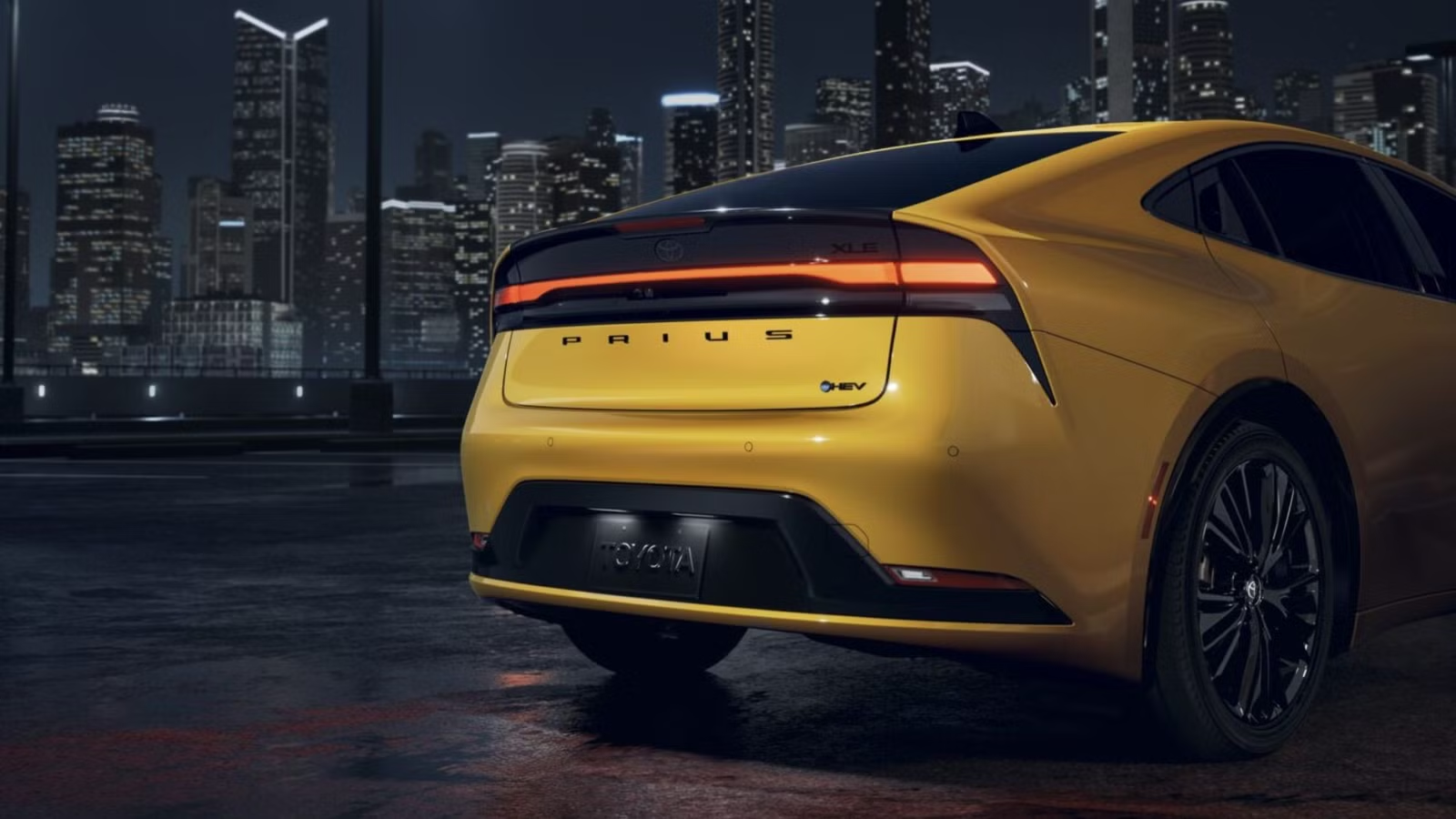
Most shoppers today buy SUVs, not cars, as a default solution for practicality and fuel efficiency. Could the Toyota Prius be the ultimate anti-crossover of the SUV scene? This slick, sleek hybrid hatch is a few hundred dollars worth of roof-mounted cargo carrier away from SUV storage capacity, and could cut your gas bill in half (or more) compared to something like a Honda HR-V.
2026 Toyota Prius Plug-In Nightshade rear angle in black while drivingToyota
If you’ve stuck to your guns and avoided buying an SUV for years, the latest Prius is more worth a look today than ever, thanks to its latest-generation platform. As we’ll see below, Toyota’s famous hybrid challenges the compact SUV in numerous metrics, and makes many look thirsty, pricey, and sluggish in comparison.
How Toyota Priced The Prius To Land Inside Honda HR-V Territory
2026 Honda HR-V 3rd Gen (RV3_4_5_6) Facelift SUVHonda
Examining this stacked pricing structure highlights how closely packed the entry-level options are compared to models at the top end. The base HR-V LX FWD has the lowest cost of entry on our list, but adding AWD or moving to the Sport FWD quickly closes the gap on the Prius. At just $28,755, the base Prius LE FWD slots directly between the mid-tier HR-V variants.
Notice how the base Prius undercuts several mid-tier HR-V trims while including safety tech the HR-V charges extra for.
2026/2027 Toyota Prius And Honda HR-V Trim Grades And Pricing
- HR-V LX (FWD) — $26,600 (Base)
- HR-V LX (AWD) — $28,100 (+$1,500)
- HR-V Sport (FWD) — $28,400 (+$300)
- Prius LE (FWD) — $28,755 (+$355)
- HR-V Sport (AWD) — $29,900 (+$1,145)
- Prius LE (AWD) — $30,155 (+$255)
- HR-V EX-L (FWD) — $30,450 (+$295)
- HR-V EX-L (AWD) — $31,950 (+$1,500)
- Prius XLE (FWD) — $32,200 (+$250)
- Prius Nightshade (FWD) — $33,005 (+$805)
- Prius XLE (AWD) — $33,600 (+$595)
- Prius Nightshade (AWD) — $34,405 (+$805)
- Prius Limited (FWD) — $35,770 (+$1,365)
- Prius Limited (AWD) — $37,170 (+$1,400)
But price parity only matters if the Prius can actually compete on what drivers experience behind the wheel.
2026 Honda HR-V 3rd Gen (RV3_4_5_6) Facelift SUVHonda
The Prius range also gives shoppers more high-end options to consider, with the HR-V line capped at $31,950 for a top-tier EX-L AWD, and the Prius range pushing beyond $37,000 for a Limited AWD. From a strategy standpoint, the HR-V sticks to an accessible $5,350 price span across all trims, but the Prius expands its reach across a broader $8,400 range, allowing for shoppers after higher-end tech and premium features.
So the Prius matches the HR-V on price and beats it on standard features — but does it actually perform better, or does the hybrid system sacrifice driver engagement for fuel savings?
Going Hybrid Is A Power Move In 2026
The Prius doesn’t just sip less fuel – it’s genuinely faster than the HR-V, reaching 60 mph in under 7.5 seconds versus the Honda’s nine-plus. Here’s why the hybrid system makes that possible.
With its hybrid system supplementing the gas engine, drivers get 194 horsepower in front-drive models and 196 hp with AWD. Note that the Prius’ AWD system uses an electric rear “e-axle”, electrically driving the rear wheels without the need of a driveshaft for a physical connection to the front section of the powertrain. Numerous other Toyota models use this setup, as well.
The Toyota Prius is the world’s OG hybrid.Toyota
The HR-V instead uses a traditional AWD system and a traditional four-cylinder engine of 2-liter displacement, no hybrid gear added. That’s good for 158 hp, giving the Prius an output advantage of 36 to 38 hp.
While Toyota doesn’t provide a net torque output figure for it, the hybrid-electric torque from the Prius engine makes for low-rpm throttle response that’s sharper and more responsive than the HR-V’s, not to mention quieter. Between this pair, the Prius is the racier machine, not only in looks, but also in performance.
2010 Toyota Prius Hybrid Synergy Drive badge on coverToyota
Both the Prius and HR-V have fairly noisy engines, though the Prius manages some redemption by way of smoother and snappier performance to back it up. Both machines come in front- or all-wheel drive, both run a CVT transmission in all configurations, each runs just fine on 87-octane gas, and neither has a towing rating.
The Gas Math Reveals A Penalty That Prius Owners Skip
2023 – 2026 Toyota Prius exteriorToyota
According to EPA data, the Honda HR-V gets 28 combined MPG with front-wheel drive and 27 combined MPG with AWD, resulting in an annual fuel cost of $2,200 to $2,300. By comparison, the Toyota Prius delivers an impressive 57 combined MPG with front-wheel drive and 54 combined MPG with AWD, cutting annual fuel expenses down to around $1,125. The gas cost penalty of adding AWD to either machine is negligible, with the HR-V’s AWD system costing an extra $100 in fuel, and the Prius adding just $50 to your annual gas bill.
In dollar terms, the Prius will cost about $1,125 per year less on fuel than the HR-V, despite its performance and output advantage. In this comparison, Toyota’s hybrid system gives drivers a 24-percent horsepower boost, while cutting fuel costs in half. If you keep either of these machines for five years, that amounts to nearly $6,000 saved on fuel costs alone.
2026 Honda HR-V 3rd Gen (RV3_4_5_6) Facelift SUV – front 3/4 angle in white while parkedHonda
Beyond that, there is an additional penalty that the Prius allows HR-V shoppers to avoid. Driving the Honda HR-V in the city brings fuel efficiency down by as much as six miles per gallon, adding 20 percent to fuel consumption in city-cycle driving versus highway cruising.
On the other hand, the Prius gets roughly the same fuel economy whether it’s being driven in the city or on the highway, and the hybrid system actually makes front-drive Prius variants slightly more fuel efficient in the city (57 MPG) than on the highway (56 MPG). So, in addition to drinking about half the fuel of a Honda HR-V overall, the Prius’ hybrid tech also shrinks the roughly 20-percent city-driving fuel consumption penalty to virtually nothing, or even reverses it slightly.
Long-distance drivers should take note of the EPA-provided range figures as well: the Prius can go up to 644 miles with FWD, compared to the HR-V’s 392-mile figure. That’s an extra 252 miles per tank in the Prius, a64 percent advantage in driving distance versus the HR-V.On paper, the Prius dominates – but paper specs don’t capture the one area where the HR-V fights back hard.
Does This Make The Prius An SUV Killer?
2023 – 2026 Toyota Prius exteriorToyota
Is a Prius a viable alternative to a slower, thirstier crossover SUV like the Honda HR-V? Maybe. When deciding between these two machines, it is important to bear a few additional factors in mind.
Consider overall height. The HR-V sits about 7 to 8 inches taller than the Prius, a factor to consider if you’ll frequently be loading and unloading roof-mounted gear. If you’re on the vertically challenged side, the Prius’ roof-mounted accessories will prove easier to reach.
The Toyota Prius is the world’s OG hybrid.Toyota
Though the Prius cuts the fuel bill in half, it also has considerably less ground clearance than the HR-V. On the plus side, that helps with a sportier and more car-like ride that some drivers will like. On the downside, less ground clearance limits off-road capability, and can be an issue for drivers in climates that frequently see heavy snow and road slush.
The HR-V has a suspension tuned for all-round comfort, and ride quality stands up well on rough road surfaces. Many drivers will find the Prius to feel sportier and more agile, though noisier and harsher when encountering poorly maintained asphalt.
The HR-V’s SUV Shape Wins On Headroom And Rear Space – But Cargo Is Nearly A Tie
The HR-V offers the more spacious cabin overall, with 97.3 to 98.7 cubic feet of total passenger volume compared to the Prius’ 91.2 cu ft. That’s an advantage of at least seven percent for the HR-V, which also wins on headroom in both seating rows by no less than 0.4 inches and as much as 1.6 inches, depending on trim grade and seating position. Look for 1–4 percent more headroom for the HR-V driver, and more than 4 percent (1.6 inches) for rear-seat occupants versus the Prius.
2023 – 2026 Toyota Prius interior view of the front cabinToyota
The Prius gives front occupants 1.3 inches (3 percent) more legroom, while the HR-V prioritizes rear passengers with significantly more rear legroom than the Prius, beating it by 2.9 inches (over 8 percent).
Wide-shouldered occupants will have a better time in the HR-V as well, since it offers 1.3 inches more room up front and 2.4 inches more in the rear. Front hip room is virtually a dead heat, with the Prius holding a slight advantage, but pulling ahead significantly in rear hip room, where it beats the HR-V by 4.3 inches.
2023 – 2026 Toyota Prius interiorToyota
On cargo hauling capability, the base Prius LE matches the HR-V almost cubic-foot for cubic-foot, offering 23.8 cu ft of space compared to the HR-V’s 24.4 cu ft. That’s a negligible difference of just 0.6 cu ft, roughly the volume of a medium-sized kitchen microwave oven. Stepping up to higher Prius trims (XLE, Nightshade, Limited) drops cargo capacity slightly to 20.3 cu ft due to interior packaging.
2026 Honda HR-V 3rd Gen (RV3_4_5_6) Facelift SUV – interior detail shot of the infotainment screenHonda
Toyota doesn’t list a seats-folded cargo metric for the Prius, though we know the HR-V has the practical advantage of its shape when its rear seats are folded down, opening cargo volume up to 55.1 cu ft. Ultimately, the Prius might not be an outright compact SUV killer, but it’s a highly worthy alternative for the driver who doesn’t mind giving up a little roominess in exchange for some sleeker style, or installing that bike rack or cargo box when a little extra space is required.
-
Base Trim Engine
2L I4 Hybrid
Base Trim Transmission
2-speed CVTi-S CVT
Base Trim Drivetrain
Front-Wheel Drive
Base Trim Horsepower
150 HP @6000 RPM
-
Base Trim Engine
2L I4 ICE
Base Trim Transmission
CVT
Base Trim Drivetrain
Front-Wheel Drive
Base Trim Horsepower
158 HP @6500 RPM
Sources:KBB.com, Carsdirect.com,Consumerreports.org, Truecar.com, iSeeCars, EPA, Toyota, Honda
