

When theHonda Preludefirst arrived in 1978,Honda had been selling cars in the US for eight years, mostly in the form of the pioneering Civic. A new model was needed to introduce bold breakthroughs to the market in a range-topping halo model, adding technological DNA that would trickle down to Honda’s mass-market gene pool. The Prelude would be that model.
How Honda Turned A Sports Coupe Into A Rolling Proving Ground For Mass-Market Tech
Front quarter view of a 1982 Honda PreludeBring A Trailer
The first-generation car ran from 1978 to 1982, marketed as a sports coupe for grown-ups. According to Honda, it was the first mainstream car with an electric sunroof as standard. This generation Prelude gave Honda vital experience in platform engineering and adaptation, as it applied the brakes, suspension, and engine of the Honda Accord of the day to a new chassis.
Rear quarter view of a 1986 Honda PreludeBring A Trailer
The second-generation Prelude was phased in across 1982 and 1983, bringing a sleeker, sportier 80s look with pop-up headlights and a lower-profile face. More power came from a larger engine, matched by this generation’s defining new technology: anti-lock brakes (ALB). This was a forerunner to more modern ABS technologies, again helping the Prelude lay down real-world experience for Honda that would help with future engineering breakthroughs.
Front quarter view of a 1986 Honda PreludeBring A Trailer
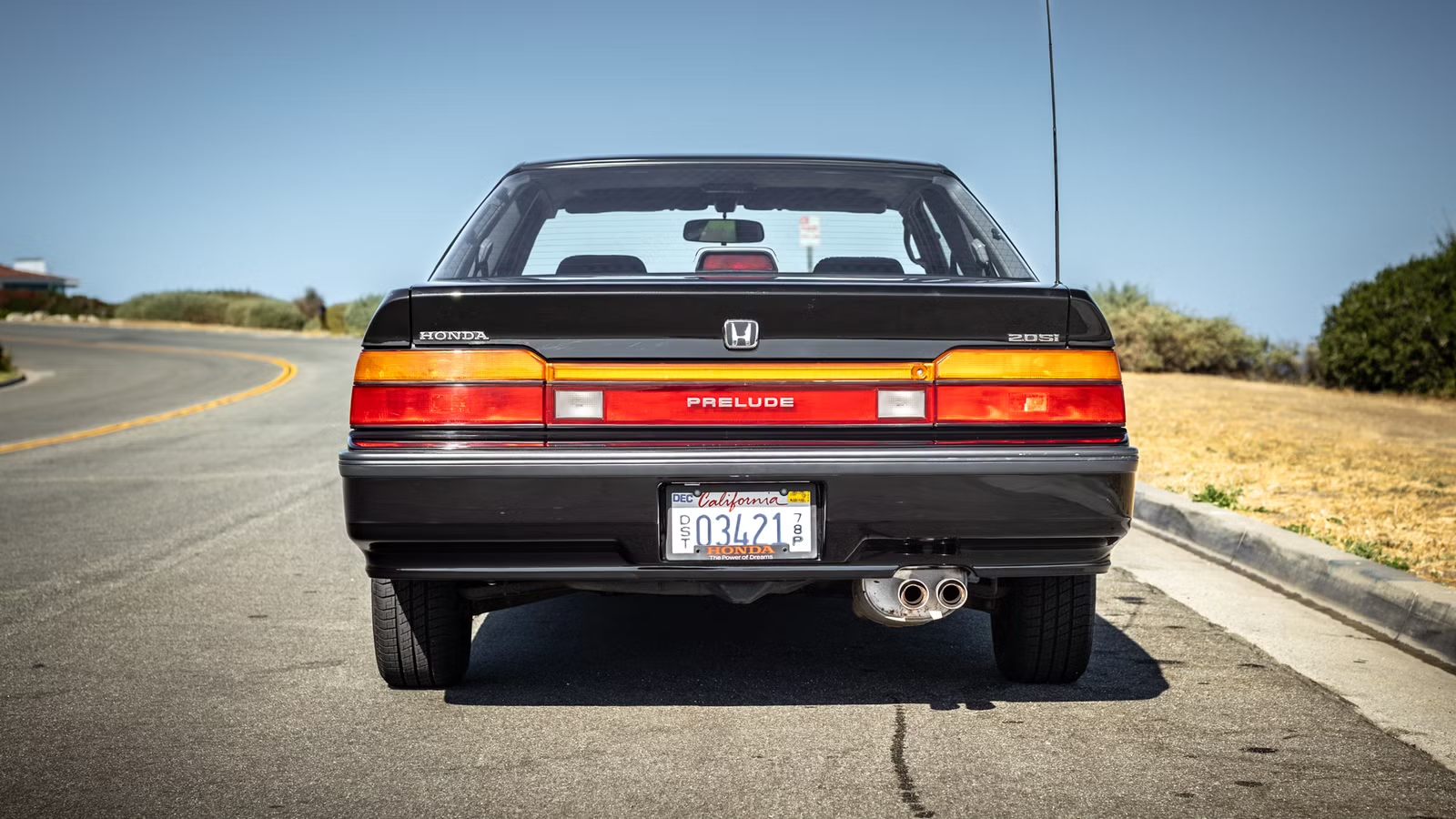
These came in spades by the time the third-generation Prelude arrived in 1987. That year, the Prelude put Honda on the map with a new system called Four-Wheel Steering (4WS) that would change the way it handled. At launch, this groundbreaking innovation was marketed as the “Steering Angle Sensing Honda Four-Wheel Steering System (Honda 4WS).”
Now able to steer from all four corners of the car, the Prelude was generating considerable buzz in the press about Honda’s handling innovations in an era when sports car handling technology was about to explode. That is how the Prelude became the first mass-produced car with four-wheel steering, though it was a technology ultimately too far ahead of its time.
1988 Honda Prelude SiBring a Trailer
It might be one of the Prelude’s most famous moments, but the rollout of Prelude innovations didn’t stop with 4WS, either. Later, the fourth-generation Prelude would arrive in the early 90s to bring Variable Valve Timing & Lift Electronic Control (VTEC) technology from the Acura NSX to Honda’s popular four-cylinder engines.
Now the Prelude was more capable than ever, replacing the previous generation’s mechanical linkages with an advanced electronic 4WS system that adjusted rear wheel angles based on vehicle speed and steering input. The fifth and final generation of the original Honda Prelude arrived in 1996 for the 1997 model year, building on all earlier engineering pillars and bringing one final innovation to Honda’s collection: the Active Torque Transfer System (ATTS).
Using a trick front differential, this generation Prelude gained the ability to increase the driving force to the outside wheel when cornering. With ATTS on board, Preludes of this era effectively gained handling superpowers that negated the need for four-wheel steering, moving instead to a less hardware-intensive solution.
1997 Honda Prelude Silver Front Angled ViewHonda
This early application of a torque-vectoring differential would go on to form a vital part of the Super Handling All-Wheel Drive (SH-AWD) System launched by Acura in 2004 for the 2005 Acura RL.
But before all of that could happen, Honda needed to figure out how to make four wheels steer from a single mechanical input.
Honda’s 4WS Had No Electronics: Just A Shaft, A Gear, And Mechanical Genius
Honda Prelude 4WS from 1987Honda
Unlike complex electronic setups, Honda’s third-generation Prelude used a purely mechanical shaft connecting the front steering rack to a planetary gear inside a dedicated steering box on the rear axle. Visualize looking up while standing beneath a rear-drive vehicle on a hoist: you would see a metal driveshaft running from the front of the car to the rear axle and then to a differential.
The physical layout of the Honda 4WS system in the Prelude was similar: a shaft physically connected the front steering rack to the steering box between the rear wheels. According to Honda, this mechanical system could steer the front and rear wheels in the same direction (in phase) or opposite directions (reverse phase) depending on the steering angle, with no electronics in sight.
Honda Prelude 4WS from 1987Honda
At high speeds, steering inputs are smaller, so the rear wheels are turned in the same direction as the front wheels. At low speeds, the steering angle is larger, so the rear wheels are turned in the opposite direction to the front wheels. In this way, Honda’s 4WS system was intended to deliver both agility and maneuverability while effectively shrinking the Prelude’s turning radius.
When drivers turned the Prelude’s steering wheel, the rear wheels responded instantly. Special gearing within the rear steering box allowed the rear wheels to steer slightly in the same direction as the front wheels during small steering inputs, and then back to center en route to the opposite direction as more steering angle was added by the driver.
1988-91 Honda PreludeHonda
Put another way, turning the front wheels fully from center to lock would cause the rear wheels to turn briefly in the same direction, return to center, and then turn in the opposite direction as more steering was applied. Honda’s engineering had created a fully mechanical system capable of turning the rear wheels in two directions from a single steering input in one direction.
“By controlling the rear and front wheels simultaneously with a 4WS system, the vehicle would change its course without delay in response to the driver’s steering wheel operation. As a result, collision avoidance performance and, thus, overall safety would be enhanced.” – Honda Motor Company
Interestingly, 4WS was initially developed as a safety feature. According to Honda, in the 1970s, the National Highway Traffic Safety Administration (NHTSA) in the US was working on the Experimental Safety Vehicle (ESV) program, with the goal of combating rising traffic collision stats on the basis of collision avoidance.
Most Early Shoppers Said “No Thanks” To 4WS Because Better Options Were Incoming
1993 Eagle Talon TSi AWD front three-quarters view in blue while parkedBring A Trailer
Though Honda sold plenty of 4WS-equipped Preludes and went on to offer rear-steer systems in modern Acuras as late as the 2020 model year via the Precision All-Wheel Steer (P-AWS) system, numerous factors kept 4WS from becoming a mainstream safety or handling technology.
Ultimately, Honda’s 4WS was a legendary engineering solution to a problem the motoring public wasn’t really too concerned about.
A significant hurdle was that 4WS was primarily marketed as a halo technology for a front-wheel-drive sport coupe in a marketplace where the most serious performance buyers were favoring rear-wheel-drive contenders.
1985 Chevrolet Camaro IROC-Z Black Rear AngleBring A Trailer
Price was another major barrier: optioning a 3rd-generation Prelude with 4WS added a significant premium and pushed the MSRP into the same territory as more powerful and capable competitors. Shoppers cross-shopping the top-tier Prelude 4WS found themselves in territory overlapping that of vehicles like the Ford Mustang, the Chevrolet Camaro IROC-Z, the Toyota Supra, or even a base-level BMW 3 Series Coupe of the day. Four-wheel steering was impressive, but many enthusiasts stuck with their six- and eight-cylinder rear-drive options instead.
Some drivers found the low-speed sensation of the steering system to be strange or jarring, and the benefits at high speed were subtle and not always easy to appreciate. Further, as these vehicles aged, the extra componentry turned 4WS-equipped models into potential liabilities on the used market, with linkages, seals, and bushings that could result in premium-car maintenance costs.
1990 Toyota Celica All-Trac Turbo front offside quarterToyota
Of course, the market timing was also slightly off. In the Prelude’s segment, turbocharged, all-wheel-drive competitors like the Eagle Talon TSi/Mitsubishi Eclipse GSX and Toyota Celica All-Trac Turbo doubled the number of driven wheels and provided significant power and traction advantages. These made subtle handling enhancements like 4WS pale in comparison on the showroom floor.
Nissan also launched a more sophisticated four-wheel steering system called HICAS on the 240SX just a few years after the Prelude launched its system. Honda’s setup offered a mechanical linkage for a direct, linear steering angle tied strictly to steering wheel movement. Conversely, Nissan’s system reacted dynamically based on vehicle speed and cornering loads. Enthusiast drivers often found HICAS-equipped cars to feel artificial, floaty, or unpredictable during aggressive turn-in, earning the system a reputation for handling like “soggy bread.”
1990 Nissan 240SX base modelNissan
As the 240SX transformed into a drift icon and left the front-drive Prelude on the sidelines, drivers routinely removed the HICAS system entirely (if equipped) using aftermarket “HICAS Delete Kits”, damaging the reputation of rear-steer handling for an entire generation of drivers. Besides, a rapid technological revolution was giving shoppers more and more handling breakthroughs to consider.
A Rear Three-Quarter Shot Of A Red 1997-2001 Honda Prelude Type SHHonda
Before long, adaptive suspension technology, torque-vectoring AWD, and active aerodynamics would all emerge to enhance the handling of some of the fastest cars on the road, virtually all of which managed with two-wheel steering.
Was Honda Actually Right All Along?
Front 3/4 2022-2024 992.1 Porsche 911 GT3 TouringPorsche
Decades after Honda retired 4WS in favor of the lighter ATTS solution, chassis engineers returned to the same core concept. This time, active rear steering and torque vectoring became essential for balancing long-wheelbase stability with short-wheelbase agility, and some of the fastest cars on the road adopted the technology.
Today, four-wheel steering can be found across a wide range of models, from the Porsche 911 GT3 to the GMC Hummer EV to the Ferrari 812 Superfast, as well as numerous Mercedes-Benz offerings. For the second coming of four-wheel steering, today’s modern systems are more powerful, smarter, faster-acting, and far more finely tuned than their early predecessors.
2026 GMC Hummer EV Pickup 1st Gen – frint 3/4 angle in grayGMC
Designed to enhance the driving character of the vehicle they are equipped to, rather than alter it, features like Ferrari’s “Virtual Short Wheelbase” or GM’s “CrabWalk” system show how far the technology has advanced in terms of manufacturing capability, electronic control, and system packaging.
As it turns out, Honda was not wrong about 4WS; the automaker was simply a few decades ahead in terms of technology and customer acceptance.
Base Trim Engine
2.0-liter inline-4 gas hybrid
Base Trim Transmission
eCVT
Base Trim Drivetrain
Front-Wheel Drive
Base Trim Horsepower
200 hp
Base Trim Torque
232 lb-ft
Infotainment & Features
9 /10
Sources: Honda
