

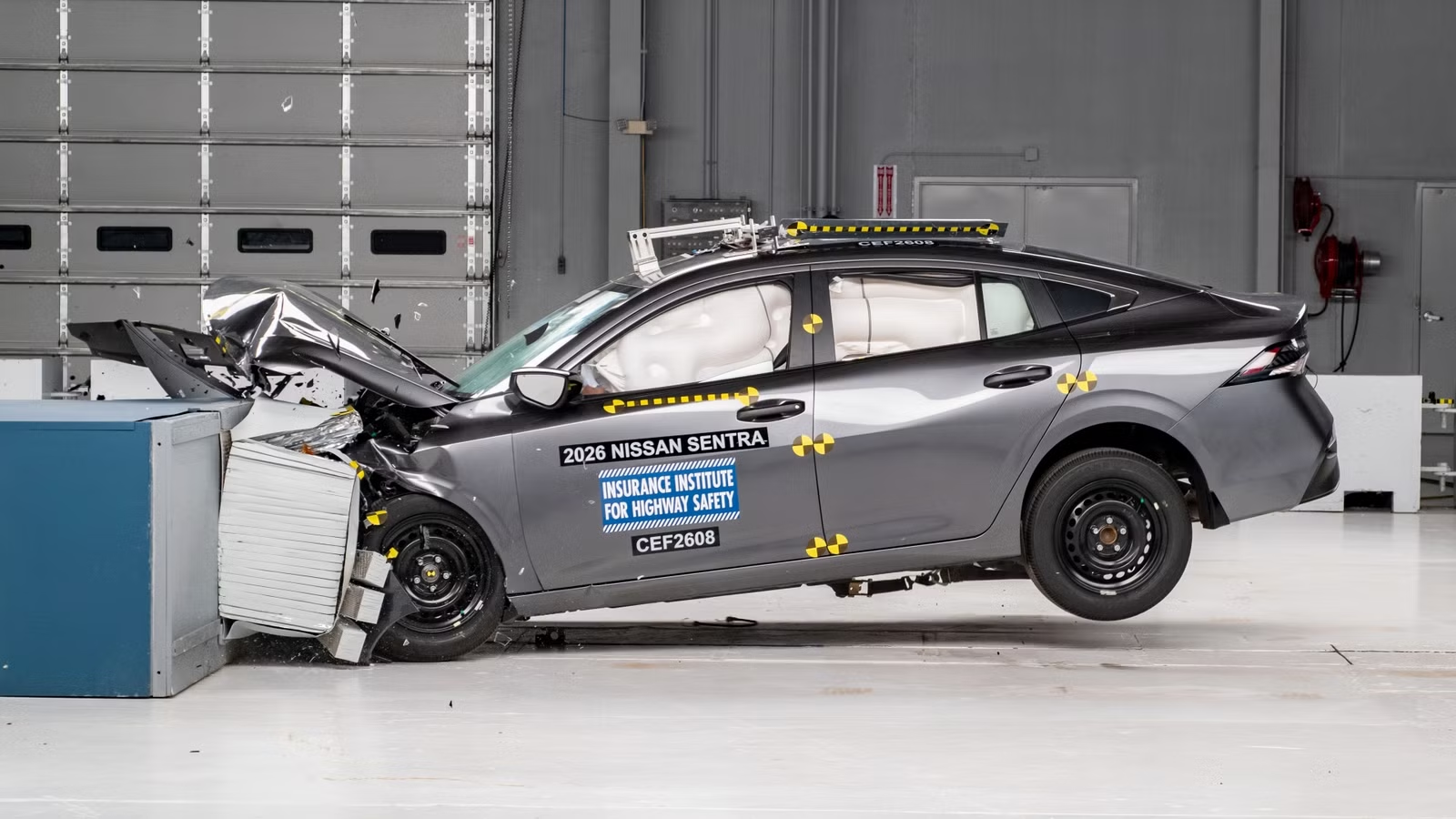
Small car safety is often cited as one of the reasons why people buy bigger, and in general, it’s hard to argue that they’re wrong. A smaller car will almost always come off second best against a larger car in a crash, especially if they come from comparable eras with similar philosophies on construction and crumple zones. The simple science is that big cars have more momentum in a crash, and the smaller car will absolutely get blasted out the way. But that doesn’t mean small cars are unsafe.
In 2026, eight small cars have earned an IIHS Top Safety Pick award, and of those, six have gone a step further to be awarded as a Top Safety Pick+. That plus at the end is huge, and for safety-conscious buyers, it can be the difference between buying a car or walking away from a great deal. But what do all these cars have in common? Aside from being small, there’s not a single American or European car on the list. Asia dominates, and the cars that earn these awards are all great cars to drive, too.
All IIHS Top Safety Pick awards are accurate at the time of publishing. The IIHS conducts testing at different intervals throughout the year, at which points, new models may become eligible. Small cars are defined by the IIHS categorization, referring largely to vehicles in the compact and subcompact categories.
2026 Subaru Crosstrek Hybrid
IIHS Top Safety Pick+
2026 Subaru Crosstrek Hybrid in dirtBrett T. Evans/CarBuzz/Valnet
There’s only one crossover on this list, and it’s the Crosstrek Hybrid, and making it more impressive is that it scored the TSP+ rating. Key to that are two factors, namely the headlights and front crash prevention systems, which are two areas Subaru has been ahead of the game for quite some time.
The IIHS scores for the Subaru Crosstrek Hybrid read like a straight-A student, except in IIHS speak, As are actually Gs, for Good – the highest score you can achieve in a given test. A handful of categories within categories scored A for acceptable, but there was not a single M or P for Margina or Poor, and the child seat anchors even scored a G+.
But there’s an important caveat to all this. Only the Crosstrek Hybrid earned a TSP+ award. The regular Crosstrek? Not even a lower-tier Top Safety Pick. Why? While in most categories, the regular Crosstrek scores G, the updated moderate front overlap test lets it down. In this metric, it scored an overall M(arginal) rating, owing to the same score for rear passenger restraints and dummy kinematics results.
2026 Toyota Prius
Top Safety Pick+
2023 – 2026 Toyota Prius front 3/4 angle in white while parkedToyota
We’ve questioned why the Prius still exists when you can get a Corolla Hybrid with more space, close to the same gas mileage, and at a more appealing price, but the Corolla isn’t a Top Safety Pick, the Prius is a Top Safety Pick+.
The IIHS hasn’t completed full testing on the plug-in hybrid version of the Prius yet, so the TSP+ award applies only to the regular hybrid hatchback. Like the Crosstrek Hybrid, this one scores high in all key areas, but loses out in the headlights department, where a best score of A9cceptable) was awarded due to an inadequate beam scatter pattern to the right-hand side of the vehicle and the high beams falling short of what the IIHS deems optimal high-beam illumination.
But in the rear passenger test, which became a trickier test to pass in 2026, the Prius excelled, despite receiving only an A for those rear passenger dummy kinematics that hurt the regular Crosstrek’s results. The Prius also scored brilliantly for front crash prevention, despite not providing warning sounds in an adequate timeframe at low speeds. Despite this, it still avoided crashes in time.
2026 Nissan Sentra
Top Safety Pick+
2026 Nissan SentraIan Wright/CarBuzz/Valnet
After a recent test drive, we said the new Nissan Sentra “might make you forget the Civic and Corolla ever existed,” and from a safety perspective, it outscores them both. A car with a starting MSRP of $22,600 (for the 2026 model year, 2027 variants now start at $22,890) isn’t the one you expect to dominate safety, but the Sentra scores top G ratings across the board, and a G+ for LATCH anchor ease of use, only faltering in the vehicle-to-vehicle front crash prevention metric. This was one of several tests made even more difficult for 2026 testing, but the standard system still earned the Sentra an A(cceptable) rating.
Nissan sells every 2026 Sentra model with automatic emergency braking, pedestrian and cyclist detection, forward collision warning, blind-spot monitoring, rear cross-traffic alert, lane departure warning and prevention, driver alertness monitoring, and traffic sign recognition, with upper trims availing rear automatic braking, lane keep assist, and a surround-view camera with moving object detection. It’s as comprehensive a safety suite as you’re likely to find at this price point, and the IIHS approves.
After three years of failing to achieve even a standard Top Safety Pick, the Sentra is back with the added +, something it hasn’t achieved since the 2016 model year.
2026 Mazda 3 Hatchback and Sedan
Top Safety Pick+
2026 Mazda3 hatchbackMazda
If you want to know which brand dominates the leaderboard for Top Safety Pick+ awards in 2026, it’s Mazda. The brand has nine Top Safety Pick+ titles to its name this year, spanning all size categories. The only Mazda’s not to earn these awards were the MX-5 Miata and the CX-50 Hybrid.
The Mazda 3 Sedan and Hatchback duo scored brilliantly, with green Gs littering the IIHS results page. The only areas the duo lost marks in were scoring A(cceptable) in the updated front crash prevention systems against other vehicles, and the headlights on certain trims. Trims that nailed the headlight tests were those with the curve-adaptive projector LEDs, namely the 2.5 S Premium and 2.5 Turbo Premium Plus. The trims lack the curve-adaptive functionality, ultimately costing them the best possible score.
As for the vehicle-to-vehicle forward-collision avoidance, the Mazda 3 is able to avoid most accidents, but failed to avoid all of them, particularly against motorcycles. However, even in those where a collision wasn’t avoided entirely, a significant reduction in speed prior to impact ensures the risk of injury and/or death is greatly reduced.
2026 Kia K4
Top Safety Pick+
2026 Kia K4 SedanKia
The only non-Japanese entry to earn a 2026 Top Safety Pick+ is the Kia K4, and only the sedan body style, at that. However, while it achieves the honor, it didn’t score anywhere near as well as the preceding models on this list. In actual crashes, it scored G(ood) in all three categories, the small front overlap, moderate front overlap, and updated side impact test. The standard pedestrian impact avoidance systems also scored it top marks.
But vehicle-to-vehicle crash prevention, headlights, seatbelt reminders, and LATCH ease of use tests all came back only A(cceptable). So how did it find itself a Top Safety Pick+? The pedestrian protection system did it, elevating it from a regular TSP with the G score, while the A in the updated vehicle-to-vehicle test 2.0 was good enough to get that top award.
It’s important to note that the Kia K4 Hatchback did not fare as well, missing out on any TSP tier due to a M(arginal) score in the updated moderate overlap front test. 2026’s tests focused on rear passenger kinematics (the likelihood of a whiplash injury occurring), and this is where the hatchback fell short.
Honorable Mentions: Top Safety Pick Winners
2026 Honda Civic Hatchback and 2026 Hyunda Elantra Sedan
Two small cars earned Top Safety Pick awards but didn’t do enough to get the + for different reasons. In the case of the Civic Hatchback, it was the A(cceptable) pedestrian crash avoidance score that precluded it from taking top honors, but the Honda also notably scored M(arginal) for its seatbelt reminders. In the case of the Hyundai Elantra, it hasn’t been tested for its vehicle-to-vehicle crash avoidance capability. It did, however, score G(ood) for pedestrian avoidance systems and headlights.
It’s important to understand that neither of these cars have actually been tested in 2026, and their TSP awards were based on previous years’ tests for the same generation. When automakers update their vehicles, they can push for IIHS tests to be redone to earn them those top marks, but Honda and Hyundai seem content with only having had the 2025 tests conducted.
For Hyundai, this makes perfect sense, as a new generation is about to launch imminently for the 2027 model year. The Civic has been around since 2022 in its current form, and is due for replacement by 2028.
Sources: IIHS 1, 2, 3, 4, 5, 6, 7, 8, 9
