

The collector car world has a long memory — but it has been slow to give Japanese sports cars their due. That is finally changing. Values for the most iconic Japanese performance machines of the 1980s and 1990s have been climbing steadily, and the window for getting in at a reasonable price is narrowing fast.
Models like the Nissan Skyline GT-R and Toyota Supra are at last receiving the recognition they always deserved. A generation that grew up chasing lap times on PlayStation consoles has grown up, earned real money, and is now turning those digital obsessions into garage realities.
1994 Nissan 300ZX Red Rear ViewBring a Trailer
But nostalgia alone does not explain the surge in interest. These cars also packed class-leading technology for their era and took the fight directly to the European establishment. The classic car market is still waking up to the magic of the 1990s Japanese sports car, and there is genuine value to be found if you know where to look. One particularly compelling example has spent much of its life in the shadow of its GT-R big brother.
The Nissan 300ZX
1994 Nissan 300ZX Red Side ViewBring a Trailer
300ZX
300ZX TT
Engine
3.0-liter V6
3.0-liter V6 Twin-turbo
Power
222 hp
300 hp
Torque
198 lb-ft
283 lb-ft
0-60
6.7 seconds (est)
5.5 seconds (est)
Model Years
1990-1996 (US)
1990-2000 (Global)
The 1990s were a golden era for Japanese motor manufacturers. From the budget-friendly Mazda Miata MX-5 to the opulent Lexus LS400, there was a Japanese car for every taste — especially if sports cars were on the menu. Practically every major manufacturer from Japan had something to offer. Mazda, Toyota, Nissan, Subaru, Mitsubishi, and Honda were all at the top of their game, experimenting with turbocharging, all-wheel drive, rotary engines, and much more.
Even amid this wealth of automotive riches, the arrival of the Nissan Z32 300ZX in 1990 was a notable event. It was a development of the sporty Z-car line that could trace its roots back to the original 1969 240Z. While that original model was revered for its raw and engaging driving experience, the Z-car formula had softened over the years, and the Z31 300ZX (1982–1989) was a much heavier and less edgy offering.
1994 Nissan 300ZX 3.0L Twin-turbo VG30DETT V6 EngineBring a Trailer
Sales had been strong, especially in the US, and Nissan carried the luxury theme forward into the new Z32 300ZX — while also giving the car the sporting edge many customers had been craving. A 222-hp 3.0-liter V6 was offered first, and thanks to variable valve timing, it produced nearly as much power as the outgoing turbocharged engine. A 300-hp twin-turbo variant arrived shortly after launch, giving the 300ZX genuinely serious straight-line performance.
1994 Nissan 300ZX Red Front Angled View Hood OpenBring a Trailer
The technology story did not end there. The 300ZX also featured four-wheel steering — dubbed Super HICAS by Nissan’s acronym-loving engineers — along with an advanced multi-link suspension that made it handle as well as it went. Tipping the scales at around 3,350 lbs, the 300ZX was no lightweight in the tradition of the original 240Z, but it was a far more sophisticated machine, and it had moved firmly up the ranks in Nissan’s sports car hierarchy. A new entry-level model, the 240SX (sold as the 180SX in Japan), sat below it, while the range-topping GT-R32 sat above.
Current Values
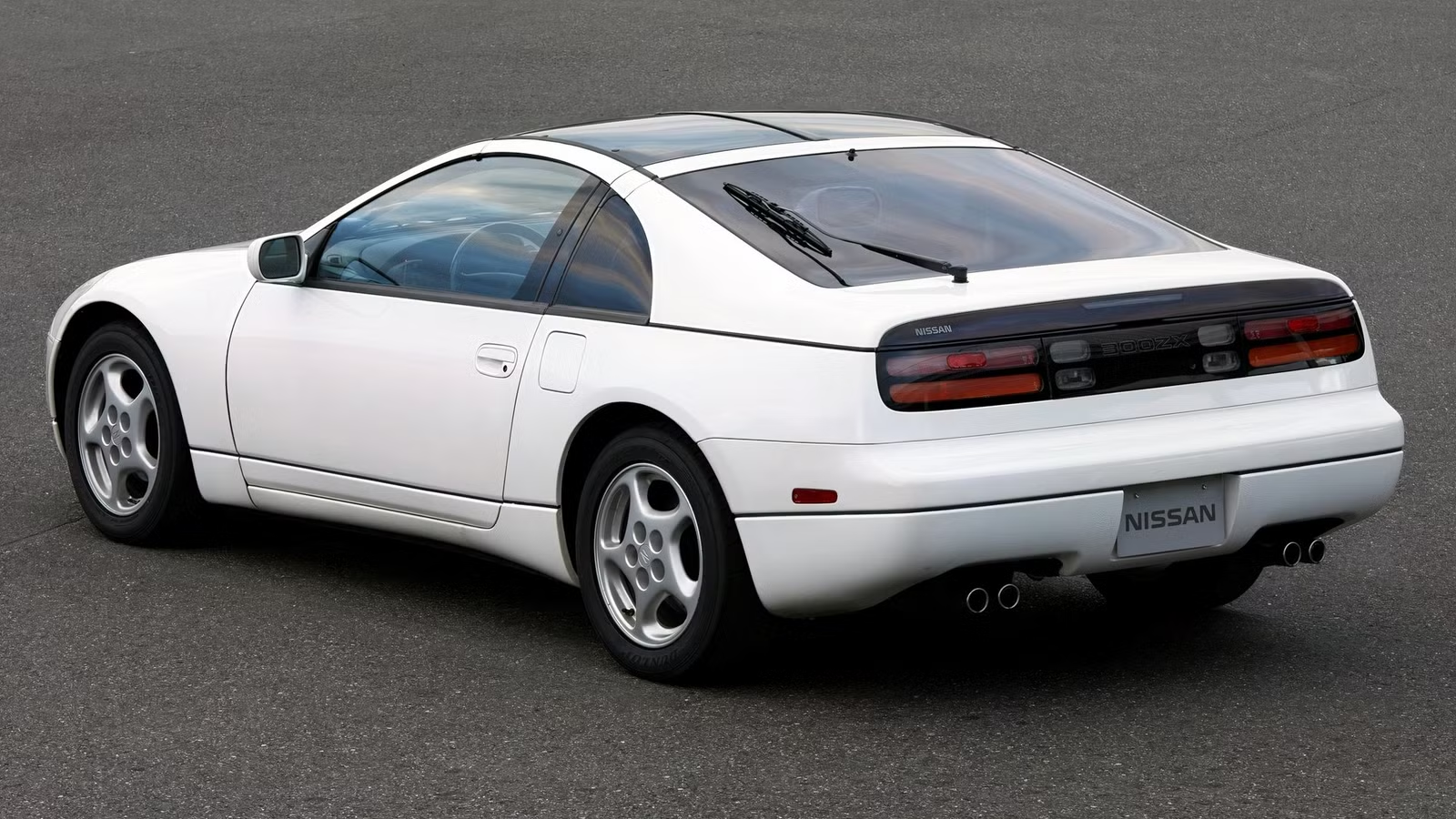
1992 Nissan 300ZX White Rear Angled ViewNissan
Used values for the Nissan 300ZX in the United States vary significantly depending on generation, factory forced induction, mileage, and transmission choice. The first-generation Z31 (1984–1989) remains the most accessible entry point into classic Z ownership. Naturally aspirated Z31 models generally fetch between $8,000 and $15,000, while cleaner Z31 Turbos range from $15,000 to $25,000. Rare editions, such as the 1984 50th Anniversary Edition or the 1988 Shiro Special, command premium prices pushing $30,000 to $40,000 for ultra-clean examples.
The sleeker, second-generation Z32 (1990–1996) sits higher on enthusiast wish lists. Standard naturally aspirated Z32s typically trade between $12,000 and $20,000. However, the desirable Z32 Twin Turbo models command a substantial premium; daily drivers hover near $20,000 to $30,000, while pristine, low-mileage, manual-transmission examples frequently clear $35,000 to $50,000+ at major online auctions.
Original, unmodified condition and five-speed manual gearboxes remain the strongest value drivers across all years.
Contemporary Rivals
Toyota Supra
Toyota Supra fornt angle in redToyota
Toyota Supra Mk4
Engine
3.0-liter twin-turbo inline-six
Power
276 hp
Torque
318 lb-ft
0-60 mph
5.0 seconds (est)
Model Years
1994-1998 (US)
1994-2002 (Global)
Average Values
$76,350
Introduced just two years before the 300ZX went out of production in the US, the Toyota Supra Mk4 was a slightly more modern offering, also marketed with a 3.0-liter six-cylinder engine in naturally aspirated and turbocharged forms. The 2JZ engine was beloved by tuners for its ability to handle enormous boost, and as a result, very few Supras from this era have remained stock. Automatic, naturally aspirated cars are the most attainable, but any Supra in largely unmodified condition with low mileage can command between $80,000–$100,000. A handful of pristine twin-turbo examples have sold for close to twice that figure.
Mazda RX-7
1992 Mazda RX-7 sideMazda
Mazda RX-7
Engine
1.3-liter twin-rotor twin-turbo
Power
252 hp
Torque
217 lb-ft
0-60 mph
5.0 seconds (est)
Model Years
1993-1995 (US)
1991-2002 (Global)
Average Values
$43,865
Sold for just three years in the US, the third-generation Mazda RX-7 was not a big seller here, despite — or perhaps because of — its advanced twin-turbo rotary engine. It was a superb sports car, though, with exceptional handling and looks that still turn heads today.
The rotary engine has a reputation for fragility, but well-maintained examples are not particularly troublesome — the key is to look for regular oil changes using the correct grade of oil in the service records. Stock examples are almost non-existent, and good ones will cost two to three times what you would pay for a decent Nissan 300ZX.
Mitsubishi 3000GT
1991 Mitsubishi 3000GT VR-4 Series 1 Front Overhead AngleBring a Trailer
Mitsubishi 3000GT
Engine
3.0-liter twin-turbo V6
Power
300-320 hp
Torque
307-315 lb-ft
0-60 mph
5.0 seconds (est)
Model Years
1990-2000 (US)
Current Values
$22,859
The 3000GT (also sold in the US as the Dodge Stealth) is arguably the closest in concept to the 300ZX, and was similarly offered with a turbo and non-turbo 3.0-liter V6, available in coupe and convertible body styles. It was packed with technology, too, including Mitsubishi’s own four-wheel steering system.
Where it differed was in its standard AWD setup, which delivered superb grip but added weight over all its rivals. It was certainly quick, but the extra complexity and mass made it more of a grand tourer than a focused sports car. Values remain low for non-turbo models in need of work, and even a solid twin-turbo car is rarely more than $30,000. Maintenance can be expensive, however, and parts are often difficult to source — though that caveat applies to many early-1990s performance cars.
A Great Starter Classic
1992 Nissan 300ZX in white Front Static ShotNissan
The Nissan 300ZX never achieved quite the same level of desirability as the Toyota Supra, Nissan GT-R, or Acura NSX, but its unique character and genuine capability have stood the test of time — as have its looks.
We would not be surprised if the 300ZX becomes the next big story on the classic car market. Until that day arrives, it offers outstanding value for anyone looking to own a piece of 1990s Japanese sports car history.
Sources: Mazda, Nissan, Toyota, Classic.com
