

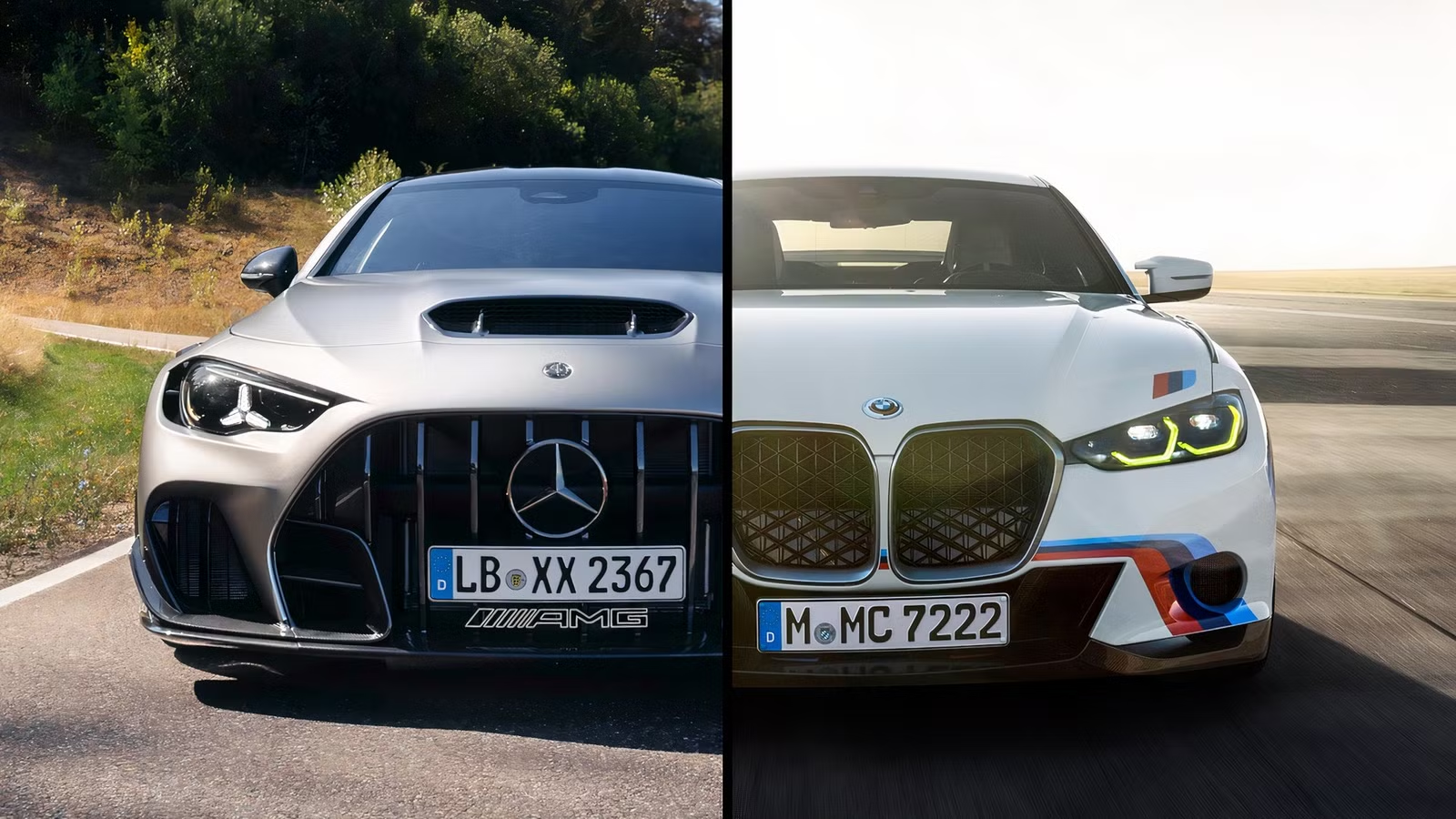
Both BMW and Mercedes-Benz have transformed relatively familiar coupes into exceptionally rare, track-focused collector cars, with extensive changes extending far beyond styling. Carbon fiber bodywork, aggressive aerodynamics, and significant mechanical upgrades give both cars a far more focused character than their production counterparts.
Yet despite pursuing essentially the same formula, the two German manufacturers have taken dramatically different approaches. BMW has prioritized lightweight construction, a high-revving twin-turbo straight-six, a six-speed manual gearbox, and rear-wheel drive, while AMG has instead chosen a much more powerful V8 and an automatic transmission. Question is, how do these two stack up against each other?
Two Coupes, Two Very Different Starting Points
The BMW 3.0 CSL is not simply a rebodied M4 with a retro-inspired design. Its development began with the G82-generation M4, which was then transformed into the more focused M4 CSL before BMW went considerably further for the 3.0 CSL. The M4 CSL already featured a weight reduction to 3,640 lbs, a two-seat layout, model-specific suspension, and extensive carbon-fiber components. The 3.0 CSL took that foundation and added bespoke bodywork, further carbon-fiber construction, a revised chassis, and extensive aerodynamic development. BMW even subjected it to a complete series development process, including crash testing.
Mercedes-AMG followed a similarly comprehensive path with the CLE 646 Spezialanfertigung, using the CLE 53 as its starting point before effectively rebuilding the car. AMG removed the 4MATIC+ system, extensively modified the bodyshell, retuned the chassis, and introduced bespoke bodywork and lightweight components. Mercedes says the result is a new performance system rather than a collection of upgrades, with the car hand-built in Affalterbach.
BMW’s Straight-Six Versus AMG’s V8
The BMW 3.0 CSL’s 3.0-liter twin-turbocharged straight-six produces 560 hp and 405 lb-ft, with BMW developing the engine specifically for this limited-production model. Its high-revving character is reflected by a 7,200-rpm maximum engine speed, while technologies including a closed-deck crankcase, forged lightweight crankshaft, and 3D-printed cylinder-head core add some serious motorsport influence.
The Mercedes-AMG takes a very different route. Its extensively developed 4.0-liter twin-turbocharged V8 produces 646 hp and 627 lb-ft, with a flat-plane crankshaft intended to reduce rotating mass and sharpen throttle response. The engine also uses three separate cooling circuits to cope with sustained high loads.
The transmission choices underline possibly one of the most significant differences between these two cars. BMW uses a six-speed manual, deliberately putting the driver in charge of gear selection, while Mercedes employs its nine-speed SPEEDSHIFT TCT 9G automatic. The AMG also uses an electronically controlled limited-slip rear differential, allowing it to vary torque distribution between the driven wheels and even facilitate controlled drifting.
Lightweight BMW Meets Lightweight AMG
Weight reduction is central to both projects, but BMW and Mercedes-AMG achieved it in noticeably different ways. The 3.0 CSL uses carbon fiber extensively, with the material forming its roof, hood, trunk lid, front and rear aprons, side panels, and aerodynamic components. BMW also fitted carbon-fiber seats, ceramic brakes, and lightweight forged wheels, helping bring the car’s weight to 3,580 lbs. The rear seats were also removed, with a carbon-fiber storage area taking their place.
AMG took a more comprehensive approach to reducing the CLE 646’s mass. Compared with the CLE 53 on which it is based, it has been stripped of its rear seats, rear-seat sound insulation and various comfort and convenience components. Lightweight carbon-fiber body panels and aerodynamic parts further reduced mass, while forged aluminum alloy wheels with ceramic brakes cut unsprung weight. AMG also uses lightweight glass and a titanium exhaust system. The result is a saving of 231 lbs compared with the donor car (4,409 lbs) for a total of 4,178 lbs. BMW wins the weight category and Mercedes-Benz the power category.
Rear-Wheel Drive Makes Both Driver-Focused Weapons
Rear-wheel drive gives both cars a distinctly different character from the all-wheel-drive performance machinery that has become increasingly common in the performance car sector. In the BMW, the decision is closely tied to its traditional M-car philosophy. The six-speed manual gearbox allows the driver to control every gear change, while the Active M Differential can vary its locking effect continuously, even providing up to 100 percent lock when required. BMW specifically developed the system to give the driver feedback about available rear-axle grip when accelerating out of corners.
Mercedes-AMG’s approach is more technologically intensive. Removing the CLE 53’s 4MATIC+ system not only saves weight but fundamentally changes the car’s dynamics. The electronically controlled limited-slip differential constantly adjusts torque distribution between the rear wheels to optimize traction and stability, while the nine-speed transmission can perform multiple rapid downshifts to access the V8’s performance. The AMG therefore retains the freedom to rotate the rear axle and drift, but uses electronic systems to make its substantial power more exploitable.
Serious Aero Separates Them From Standard Cars
Neither car relies on styling alone to distinguish itself from its production counterpart. The BMW 3.0 CSL’s most obvious aerodynamic feature is its large, side-enclosed rear wing, which is designed to increase downforce over the rear axle. It works with a pronounced carbon fiber rear diffuser to optimize airflow beneath the car, while the extensive carbon fiber bodywork incorporates model-specific aerodynamic features. BMW subjected the car to around 200 hours of aerodynamic development, including 50 hours in the wind tunnel.
The Mercedes-AMG CLE 646 takes aerodynamic development even further. Its package includes a manually adjustable rear wing, a two-position front diffuser, vented front fenders, additional front apron flicks, and a carefully shaped flat underbody with longitudinal fins. The diffuser can be switched between Street and Race settings, with the latter designed specifically for circuit use. AMG says the complete aerodynamic system generates well over 550 lbs of downforce at top speed, giving the car an unusually strong emphasis on high-speed stability and circuit performance.
Performance Numbers Tell Only Part Of The Story
On paper, the Mercedes-AMG has the advantage in outright performance, reaching 62 mph from rest in a claimed 3.9 seconds, 124 mph in 11.4 seconds, and a top speed of 193 mph. Its 4,178 lb curb weight and 646 hp (with 627 lb-ft) give it a power-to-weight ratio of approximately 6.47 lbs per hp. That is remarkably close to the BMW, despite the Mercedes weighing considerably more.
The BMW’s official figures are less straightforward because BMW did not publish acceleration figures for the 3.0 CSL. Its 560 hp and 6.39 lbs per hp power-to-weight ratio suggest formidable performance, while its top speed, according to BMW, is over 186 mph. The closely related M4 CSL manages 0-60 mph in 3.6 seconds and 0-120 mph in 10.5 seconds, but those figures should not be presented as official 3.0 CSL figures. Having a manual gearbox will add a few tenths to these times.
Ultimately, the numbers do not capture the BMW’s appeal. Its manual gearbox makes outright acceleration less important than the driver’s involvement, whereas the AMG’s automatic transmission is better suited to exploiting its enormous reserves of power.
Which German Special Is The Bigger Collectors’ Car?
Exclusivity is where these two cars become particularly difficult to separate. BMW limited the 3.0 CSL to exactly 50 consecutively numbered examples, created to mark BMW M’s 50th anniversary. BMW did not officially publish a price, but leaked details at the time put the figure at approximately €750,000 per car, and all 50 were allocated. That price has since increased tremendously.
The Mercedes-AMG CLE 646 Spezialanfertigung is even rarer, with production restricted to 30 examples worldwide. More significantly, Mercedes says every car had already been sold before its world premiere. The company has not disclosed a price, although that figure is arguably less important now that the entire production run has been allocated.
Model
2023 BMW M4 3.0 CSL
Mercedes-AMG CLE 646 Spezialanfertigung
Engine
In-line six-cylinder twin-turbo
V8, twin-turbo
Power
560 hp
646 hp
Torque
405 lb-ft
627 lb-ft
Weight
3,580 lbs
4,178 lbs
Power-to-weight
6.39 lbs per hp
6.47 lbs per hp
Acceleration (62 mph)
N/A (likely >3.6 seconds)
3.9 seconds
Top speed
>186 mph
193 mph
Number manufactured
50
30
The BMW arguably has the stronger historical appeal. Its 3.0 CSL name directly recalls the legendary 1970s E9, while the modern car was explicitly conceived as a contemporary interpretation of that heritage. Mercedes takes a newer approach with the CLE 646. It is only the second model in the Mythos Series, a collection intended specifically for exceptionally rare collector cars. With its hand-built construction and impressive V8-powered specification, however, it could establish its own place in AMG history.
Sources: Mercedes-AMG, BMW, Hagerty
