

To clear up any further confusion the announcement of the Nissan Altima’s death has caused, it has one more model year before being completely discontinued. 2027 will be the last year Nissan produces its mid-size sedan, and we’re not sure how to feel about it. Sad, definitely. Happy, not quite. Relieved about the number of cars careening through traffic on two spares and missing a bumper? Absolutely.
Not all Altimas are the same, but we can’t help but address the image it has garnered as vessels of anarchy. Things weren’t always this way for the Altima, so before we kick it, we ought to pay our respects and give a small history lesson to one of the most popular mid-size sedans ever sold.
A Funeral for a Friend
A front three-quarter shot of a 2007-2009 Nissan Altima sedanNissan
We talk up the Altima quite a bit in reviews when we don’t hold back on our opinions (both of praise and degradation). We’re sad to hear it’s going away, but we’re more upset about what it means for the future of the mid-size sedans that are left. The Altima lived through a strong 6 generations before being shown the door. Here’s a quick highlight reel of the Altima’s life.
1st Gen – 1992-1997: New Name, New Face
The Altima was not seen as something whose condition embodied their driver’s emotional state until recently. In fact, it was quite the venerable machine in its day. Our story starts on June 11, 1992, when the first Altima rolled off the line in Nissan’s Smyrna, Tennessee assembly plant. Designed in California to serve the American market, Nissan wanted to pick a fight with Honda and Toyota, which had stronger roots serving the US.
By this time, Toyota had already issued the third-generation Camry designed in the US, and Honda was working on the fourth-generation Accord across its design centers in both the US and Japan. Japanese firms were shifting to American-designed cars built primarily for North America, and Nissan was no different. The Altima replaced the imported Stanza, offering a gutsier 150-horsepower 2.4-liter inline-4 and extra luxuries like a digital speedometer read-out, automatic climate control, and better stereo system.
2nd Gen – 1998-2001: Not the Glow-Up We Expected
Nissan was still playing it safe with the second-generation Altima and it shows. The design didn’t evolve from the first generation so much as it was penned with an inflated trunk and watered-down interior. The Altima was never premium, but if you only caught a quick glance at the dashboard and center stack in the first-generation, we wouldn’t fault you for thinking it’s something European. Leather came as standard on the higher GLE trim, something that used to be an option. The update also standardized other amenities like airbags and added 5 extra horsepower, though that was shared throughout the model range.
3rd Gen – 2002-2006: Something Wicked This Way Comes
A massive departure from Nissan’s humdrum designs over the 10 years prior, the 2002 Altima was a chic, crisp approach to the family sedan that caught the eyes of sedan buyers. If you only cared about what’s on the surface, you would’ve been hooked. Anyone who wanted more was in for a treat with the SE, which put one of Nissan’s VQ 3.5-liter V6 engines under the hood. The V6 was good for 240 horsepower and could be mated to a 5-speed manual or 5-speed automatic.
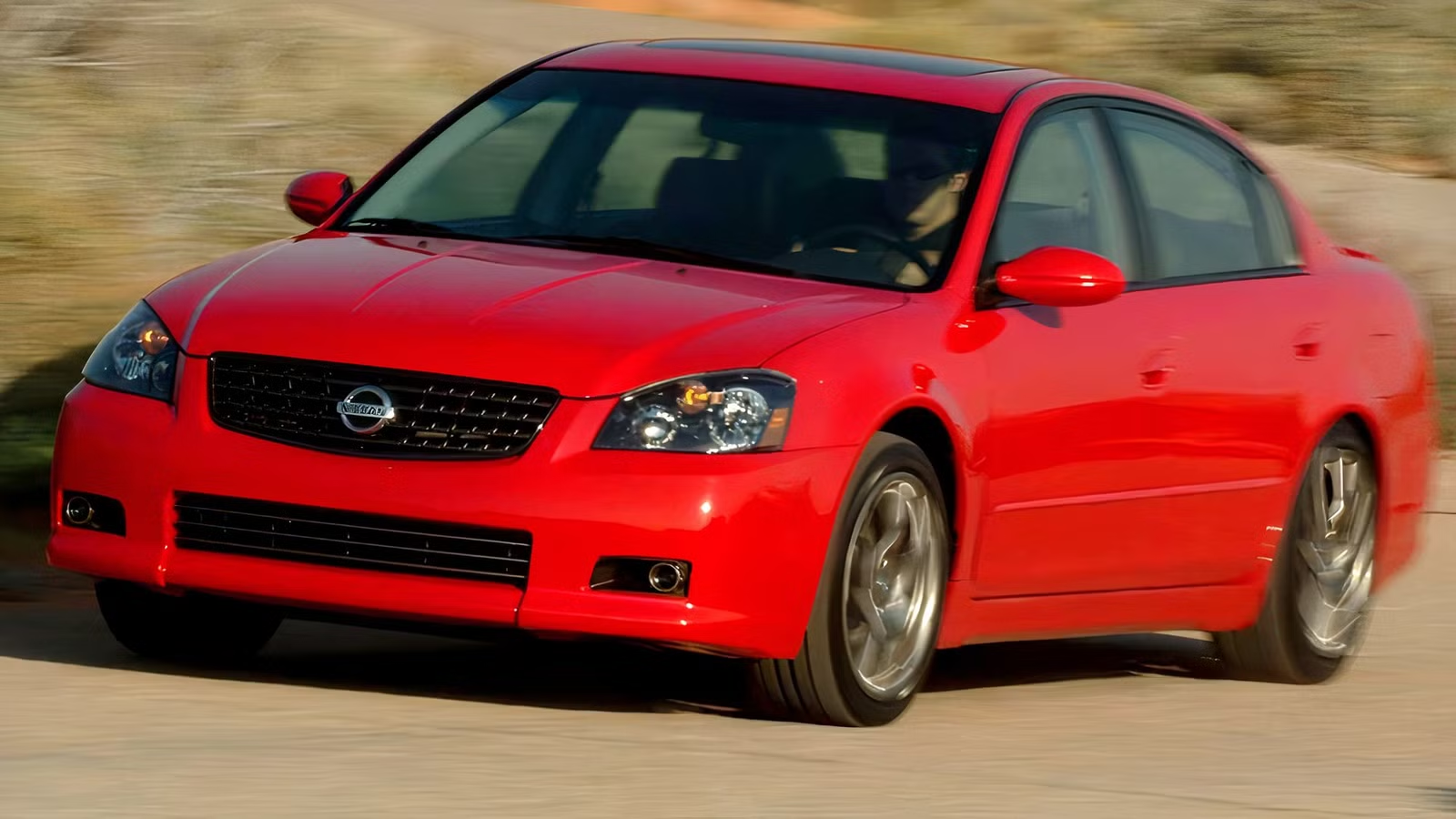
Our favorite Altima of this generation was the 2005 and 2006 SE-R, which fired out 10 extra horses over the base 250 horsepower SE models. It made good use of its 6-speed manual gearbox to shoot to 60 mph in under 6 seconds. Its $29,930 base price in 2004 was eye watering at best, roughly $52,600 in today’s money. Some of us fondly remember the SE-R, still hoping to get our hands on one.
4th Gen – 2007-2012: A Coupe, a Hybrid, and Push-Button Start
The Altima was getting with the times, staying ahead of the curve, and trailing behind all in the same generation. It finally offered a coupe, something Honda and Toyota had been doing for a while, and a hybrid—a powertrain that was still new to the segment. Nissan’s Intelligent Key push-button ignition system was integrated into fourth-generation models, giving them more modern amenities as standard. Sadly, this would be the only generation that offered a 2-door variant of the Altima.
5th Gen – 2013-2018: The Agent of Anarchy is Born
This generation secured the Altima’s name in the history books. Not because of any marketable feat it achieved or the awards it received, but because of its unwavering ability to end up in the worst kind of condition and still be driven down the highway. Owners of this generation—a generation known for heralding both the brand’s Zero-Gravity Seats and Easy-Fill TPMS aid—have rewritten what we’ll remember most about it, as most appear to not bother opening the garage door before pulling out.
Personal stories involving the fifth-generation Altima from the CarBuzz team include it being the only car Brett Evans has felt carsick in, as well as Adrian Ma warning us all to “hover over the brake and grip your steering wheel in case the unpredictable happens.” Always throw caution to the wind and give them wide berths when they appear in the mirror. Ian Wright says the fastest car money can buy in America is a white Altima with a bumper delete. No matter how fast you try to evade them, they’ll find a way to catch up and overtake you like a dinghy filled with pirates on the choppy seas of I-95.
6th 2019-2027: The Final Chapter
Gone is the VQ V6 engine, which made the Altima a powerful force even in cheaper forms. The two engines powering the last Altima are either a 2.5-liter naturally-aspirated 4-cylinder, or a 2.0-liter turbocharged inline-4 that make 188 and 236 horsepower, respectively. Continuously variable transmissions have been stuffed into Altimas since the fourth generation starting in 2007 and were made standard after the manual was dropped from sedans in 2010 (though they continued in coupe models until 2012).
The Altima’s final form—not the boss-level Altima you spot on your way to work with a missing bumper and no panel left undented—is actually great value for a new mid-size sedan. It has since dropped its 2.0 turbo, but the rest of what makes it a pleasant place to be remains. Soft leather, sporty driving position, excellent fuel economy, and AWD all for around $30,000 is a bargain for the segment. We don’t like the lack of a tuning knob, but we’ll settle for physical buttons remaining in the cabin for the climate control.
The Altima wasn’t Always the Heathen we Know it as
A front angle shot of a 2005-2006 Nissan Altima SE-RNissan
In fact, it was just that for a different reason. With the benefit of hindsight, we understand the 2005 and 2006 SE-R was the Altima’s midlife crisis. At the end of the third-generation’s run, we were given the greatest Altima ever conceived by Nissan.
SE-R was peak Altima, coming in hot to pick up the Maxima’s legacy as a gutzy front-wheel-drive sports sedan once the Maxima got fat and ugly for its sixth generation. A neat monotone exterior, with the VQ V6 and a manual, this was an unsung performance hero in the mid-2000s. – Chris Smith, News Lead Editor
It’s always upsetting to us enthusiasts when another sedan is killed, no matter the segment. Sedans are notorious for having low profit margins, and each time one is pronounced dead, it’s an admission of car companies giving up on them altogether to make room for another crossover. The Altima’s death was drawn out thanks to conflicting ideas about Nissan’s future plans. Now that we know it’s officially leaving us after 2027, it’s actually quite sad.
Who is Batman without the Joker? The Avengers without Thanos? The mid-size sedan market without the Nissan Altima? As a pillar of the family sedan market for nearly 35 years, the Altima is more than deserving of an honorable farewell, but the Viking funeral we could give it won’t come close to the kind of send-off Altima owners will already be giving it. No wall will go un-driven through, no curb not scraped, no spare wheel unused. Farewell, Altima, may you ride off into the sunset with…well, what’s left of you.
Sources: Nissan News
