

It’s not too wild a thought to assume that consumers are exhausted from serving as beta testers for unfinished software and finicky powertrains. So when they’re in the market for a genuinely dependable small SUV, it’s not about the Audi badge on the nose or a brand driven by the entire family. It’s about what the data backs up and how it translates into the real world. The BMW X1 and Land Rover Velar have bad reputations for their reliability issues, but are there any small luxury SUVs that buck this trend? We put a few to the test.
The information in this article was correct at the time of writing. Authoritative sources were used to substantiate claims and are listed at the end of the article.
Most Reliable Luxury SUV Tested In 2026
2026 Audi Q3
2026 Audi Q3Jared Rosenholtz/CarBuzz/Valnet2026 Audi Q3 from the rear in greenAudi
Reliability Metrics:
- JD Power quality & reliability: 86/100
- NHTSA recalls: 1
- NHTSA complaints: 4
Securing an 86/100 JD Power quality and reliability score is a great achievement in a segment plagued by electronic gremlins. The broader industry average languishes in the low 70s, pulled down by premature component failures and finicky electrified drivetrains. The Audi Q3 avoids these pitfalls by streamlining its mechanical footprint. Federal data from the National Highway Traffic Safety Administration (NHTSA) reinforces this, documenting only a single recall and four registered complaints for this model year.
When all-new models have historically suffered double-digit recall campaigns within the first twelve months, logging one minor recall for a sunroof malfunction represents exemplary production discipline. The mere four complaints also demonstrate that Audi eradicated systemic assembly defects before units reached dealerships. This competence cements the German SUV as the undisputed best small size SUV for drivers who prioritize long-term mechanical durability over marketing promises.
Takeaways from our 2026 Audi Q3 road test:
The Q3’s underlying engineering validates why the telemetry looks so favorable. Rather than overwhelming assembly lines with complex hybrid variants, Audi simplified the portfolio down to a single, battle-tested mechanical configuration. Under the hood sits a turbocharged 2.0-liter four-cylinder engine (EA888), generating 255 horsepower and 273 lb-feet of torque. Power routes to the road through a seven-speed dual-clutch transmission and standard quattro all-wheel drive.
During our real-world test, this powertrain exhibited flawless composure. The dual-clutch gearbox executes crisp, decisive shifts without the low-speed hesitation or shudder that ruins many transmission setups. Acceleration is brisk, too, propelling the SUV from 0–60 mph in 5.5 seconds. We’d dare to say that the chassis balance delivers hot-hatch agility wrapped in a lifted body, proving that building a genuinely reliable small SUV does not mean you must compromise on throttle response or driver engagement.
“Handling and ride also fall into a solid compromise of responsive and compliant. It’s well-controlled and feels stable and flat in corners.”
– Joel Stocksdale, Motor Journalist, CarBuzz
2026 Audi Q3 interior view of the steering wheel and dash/front cabinAudi
Audi stretched the Q3’s overall length by 1.8 inches and height by 1.2 inches, while keeping the wheelbase virtually identical to the outgoing generation. Combined with the exterior updates, the SUV yields an aggressive exterior with split headlights and customizable daytime running lights. Unlike some competitors that force buyers into massive wheel packages, Audi allows drivers to pair standard 18-inch wheels with the engine to preserve ride comfort. Thankfully, the cabin avoids the all-digital aesthetic common among the smallest SUVs.
There’s a welcome maturity about the cabin, nicely offsetting harder plastics located lower around the center console. Heated eight-way power seats provide superb support, while sliding and reclining rear seats expand cargo volume from 25 to 29 cubic feet, or 50 cubic feet when the seats are folded flat. Moving the climate controls into the 12.8-inch touchscreen is not particularly high on our list of likes, but at least the physical steering column stalks click with deliberate precision.
Other Reliable SUVs Tested In 2026
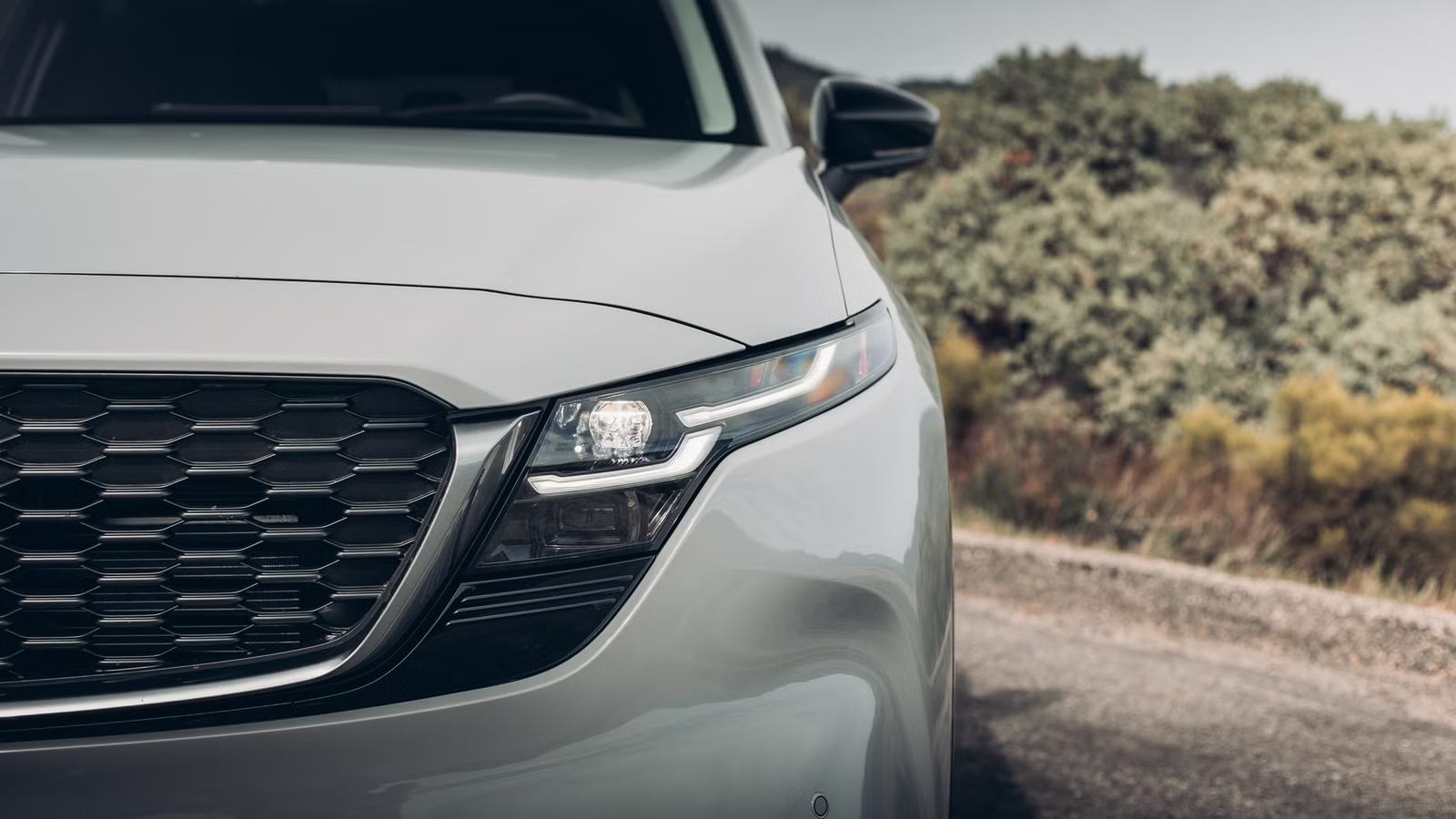
2026 Mazda CX-5
2026 Mazda CX-5Ian Wright/CarBuzz/Valnet2026 Mazda CX-5Ian Wright/CarBuzz/Valnet
Reliability metrics:
- JD Power quality & reliability: 82/100
- NHTSA recalls: 0
- NHTSA complaints: 14
Japanese precision remains a dominant force in automotive dependability, and the redesigned crossover from Hiroshima makes an undeniable case. Posting an 82/100 JD Power quality and reliability score, this SUV places comfortably above luxury counterparts costing nearly double. Where the data becomes genuinely astounding is in the NHTSA registry: zero recalls.
Launching an overhauled vehicle generation without a single federally mandated safety recall is a rare industrial feat in modern manufacturing. The 14 NHTSA complaints on record consist largely of trivial accessory gripes and minor sensor calibrations rather than structural or major mechanical breakdowns. Mazda attained this operational resilience by adhering to a conservative engineering strategy that’s defined it for decades, deliberately rejecting volatile experimental hardware in favor of optimized, thoroughly vetted mechanical components.
2026 Mazda CX-5Ian Wright/CarBuzz/Valnet
Takeaways from our 2026 Mazda CX-5 road test:
Dimensionally, the CX-5 expands where it matters most, which is to address longstanding criticisms regarding second-row cabin packaging. Engineers stretched the overall length by 4.5 inches and broadened the width by half an inch, translating directly into generous rear legroom. Power comes from a naturally aspirated 2.5L inline-four engine producing 187 hp and 185 lb-ft, paired with a traditional six-speed automatic transmission.
The power output is undeniably modest compared to turbocharged rivals, and the ongoing absence of a hybrid variant will deter efficiency-focused shoppers. However, this non-turbo powertrain is essentially unkillable, and free from the excessive heat and cylinder pressure that degrade boosted engines over time. On the road, standard all-wheel drive, brilliantly weighted steering, and sophisticated suspension dampening deliver an engaging, ultra-quiet cruising experience that could easily put one over some dedicated luxury marques.
“The 2026 CX-5 can certainly be hustled, even with the non-turbo engine, as Mazda has a long history of not relying on power to create a fun car to drive.”
– Ian Wright, Motor Journalist, CarBuzz
The cabin redesign brings quite a bit of modernization, marked by the departure from Mazda’s long-standing rotary controller philosophy. The dashboard now hosts a standard 12.9-inch touchscreen, with top trims sporting an immense 15.6-inch display running Google Built-In software. While the system operates smoothly, the larger screen is ergonomically excessive and requires quite a reach from the driver’s seat to access menus furthest from the driver. While we like digital ingenuity, absorbing climate controls into the digital display takes away the tactile satisfaction of physical dials. Fortunately, Mazda preserved its premium tactile standards across the remaining switchgear, upholstery stitching, and supportive front seats.
2026 Mazda CX-5Mazda2026 Mazda CX-5Mazda
2026 Volvo EX30
2026 Volvo EX30Ian Wright/CarBuzz/Valnet2026 Volvo EX30Ian Wright/CarBuzz/Valnet
Reliability Metrics:
- JD Power quality & reliability: 63/100
- NHTSA recalls: 1
- NHTSA complaints: 1
Evaluating this electrified Scandinavian entry – be it the standard Volvo EX30 or the Cross Country derivative – makes for interesting reading. A JD Power quality and reliability score of 63/100 looks alarming on paper, but an audit of federal safety data reveals a starkly different reality: just one recall for a seatbelt warning system malfunction and a lone complaint. It’s almost safe to assume that the poor JD Power score stems almost entirely from owner frustration with the hyper-minimalist digital interface, rather than battery degradation or motor failure.
Backing this is that consumer quality indexes often penalize vehicles when drivers struggle to adjust mirrors or headlights through a touch menu. From a pure hardware standpoint, the drivetrain and battery pack demonstrate exceptional structural durability. And with production having shifted to Ghent, Belgium, the EX30 and EX30 Cross Country arrived on American soil with their assembly issues resolved. It’s fair, then, that the EX30 family is a resilient electric runner-up.
2026 Volvo EX30 Cross CountryJared Rosenholtz/CarBuzz/Valnet
Takeaways from our 2026 Volvo EX30 Cross Country road test:
2026 Volvo EX30 Motor Options
Single Motor Extended Range
Twin Motor Performance
Cross Country
Battery
69 kWh
Transmission
Single-speed
Drivetrain
Rear-wheel Drive
All-Wheel Drive
Power
268 hp
422 hp
Torque
253 lb-ft
400 lb-ft
0-60 mph
5.02 seconds (tested)
3.4 seconds
Range
261 miles
253 miles
227 miles
Beneath its sculpted exterior, the rear-wheel-drive single-motor EX30 delivers 268 hp, rocketing the subcompact from 0–60 mph in a blistering 5.02 seconds (tested). It drives with the aggressive composure of an electric hot hatch, though the electronic steering assist is calibrated too light to provide meaningful road feel. The EPA driving range maxes out at 261 miles, which is plenty of capacity for urban commuting even if long-distance road trips require well-planned charging stops.
The newly introduced Cross Country trim, which we spent more time with, elevates ground clearance to 7.5 inches and adds rugged 18-inch wheels with all-terrain tires. While the aggressive tread incurs a slight range penalty (227 miles), it gives the vehicle genuine rough-road capability and visual attitude, especially when paired with the optional rooftop cargo basket.
“The twin-motor all-wheel-drive setup hits 60 mph in under 3.5 seconds. That’s the kind of pace that will unsettle owners of much more expensive, performance-oriented cars.”
– Ian Wright, Motor Journalist, CarBuzz
Packaging inside the compact 166.7-inch overall length is solid for such a small sUV, though rear passengers face a cramped 32.2 inches of legroom. Volvo stripped the interior down to bare essentials to contain manufacturing costs by eliminating traditional gauge clusters entirely. Every primary readout, including vehicle speed, navigation, and cabin climate, is clustered onto a single 12.3-inch portrait touchscreen powered by Google. While the lack of physical buttons remains an ergonomic nuisance, the cabin showcases innovative storage solutions, including a slide-out center console tray and clever pop-out cupholders. Premium wool blend and tailored textile fabrics replace traditional leather for a modern, sustainable character.
2026 Volvo EX30Ian Wright/CarBuzz/Valnet2026 Volvo EX30Ian Wright/CarBuzz/Valnet
Sources: Audi, Mazda, Volvo, JD Power, NHTSA
