

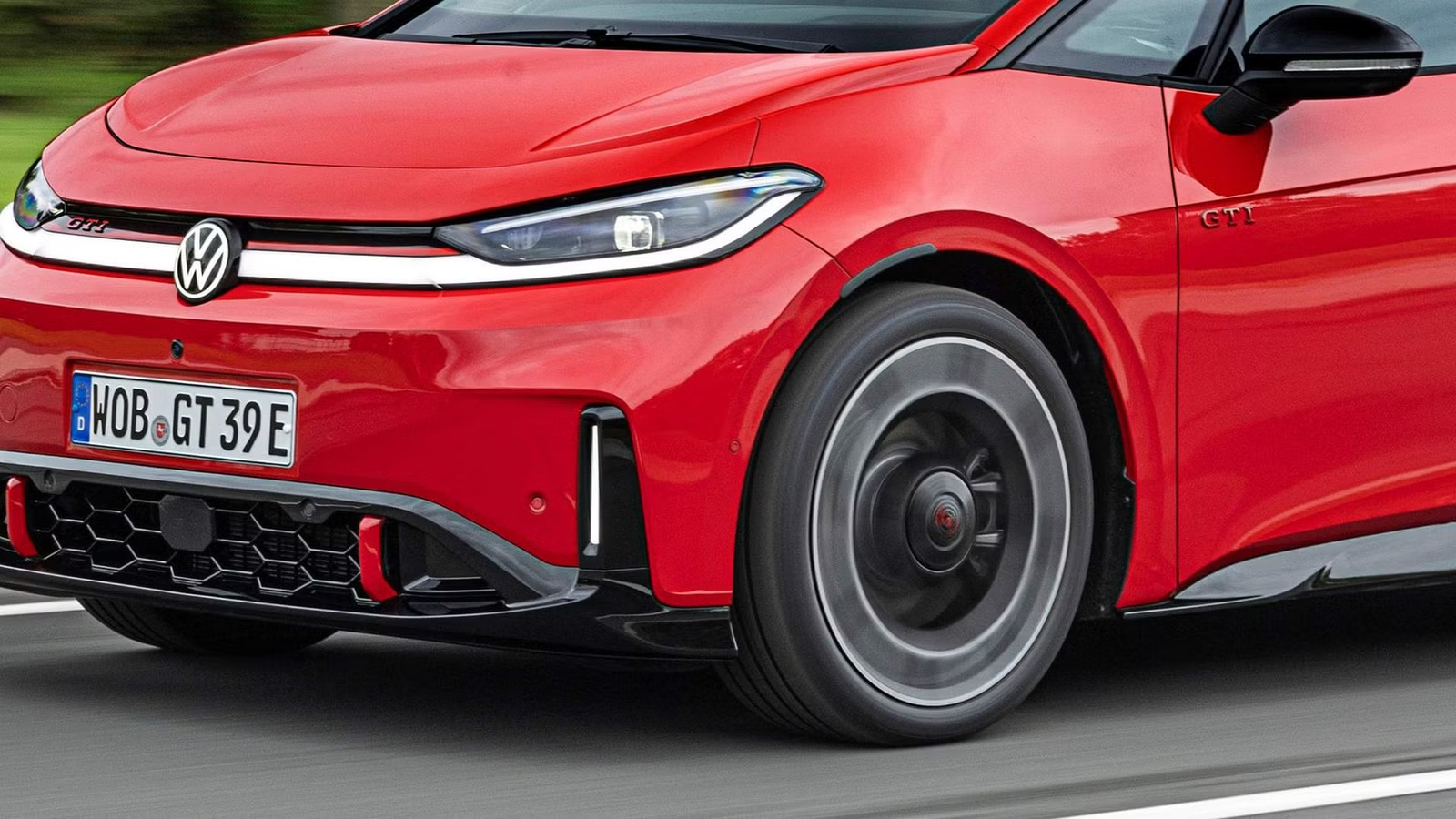
Volkswagen is still betting big on electric, partly because it has to for Europe, but that also means it has to evolve its GTI badge/brand if the automaker is to hold on to enthusiasts’ attention. As a result, the Volkswagen ID.3 GTI is here with a 322-horsepower electric motor that powers the rear axle and also supplies 402 pound-feet of torque. Those figures make the amped-up ID.3 the most powerful GTI yet.
While it might be the most powerful of the bunch, there’s still a factory-built GTI out there that is quicker off the mark. And it’s not electric.
The Golf GTI Edition 50 Is The Gold Standard
Volkswagen Golf GTI Edition 50 front view.Volkswagen
If we go through all the specs, we find that the Golf GTI Edition 50 makes 321 hp and 310 lb-ft of torque. Horsepower is almost identical, but the gas-powered GTI Edition 50 is way down on torque. There’s an old adage that states torque gets you moving, horsepower keeps you moving, so with such a difference in twist, we’d expect the Golf to lose out to the ID.3.
However, that’s not the case. VW lists the Golf GTI Edition 50 going zero to 62 mph (0-100 KM/H) in 5.3 seconds. But stats for ID.3 GTI are a bit slower, doing the same run in 5.6 seconds. In the grand scheme of things, that’s a negligible difference for road use, but it’s still an interesting result. More power does not equal faster, in this case.
On top of that, the ID.3 GTI is limited to 124 mph, while the Golf GTI Edition 50 is free to hit a top speed of 168 mph. That’s not an important difference for road use for the majority of drivers, maybe even the vast majority. But it’s odd because the all-electric car not only makes more power for higher speeds, but also has torque that is technically all available instantly — which is the key factor in getting the car off the line.
Why Isn’t the ID.3 GTI Faster?
Volkswagen ID.3 GTIVolkswagen
Volkswagen’s GTI cars have never been about power. At some point, using a laptop and AI to crack the security, someone will likely hack into the ID.3’s software and change parameters to make it blisteringly fast. The ID.3 GTI already has a GTI mode that changes the throttle and chassis parameters, and also raises the philosophical question of whether it’s actually an ID.3 GTI before the GTI button is pressed.
The GTI badge has always been about being affordable, quick, and a joy to drive. Given that an electric drivetrain is programmable to the Nᵗʰ degree and the ID.3 is rear-wheel-drive versus the traditional front-wheel-drive layout, the latter is generally accepted as the best for a two-wheel-drive performance car.
CarBuzz Insight – Why This Matters:
Volkswagen ID.3 GTIVolkswagen
It appears Volkswagen has deliberately kept the acceleration performance between the Golf GTI and ID.3 GTI similar, much in the way Mazda refuses to add meaningful power to the MX-5. Whether that’s because of a tightly held belief that they should be similar for reasons of concept or heritage, or because the ID.3 GTI absolutely slaying the Golf GTI in a straight line would hurt sales of Golf GTI models, is something only Volkswagen knows. But we do know gas-powered cars are more profitable for Volkswagen to sell.
The fact that the ID.3 GTI is rear-wheel-drive doesn’t help figure that out. While people can and will argue about whether a GTI should be rear-wheel-drive or not, the reason hot hatches are traditionally front-wheel-drive comes down to cost and practicality. However, electric drivetrains are typically on a skateboard chassis and the motors are compact, making it easy to make vehicles rear-wheel-drive without much added cost or impact on interior space. It’s interesting to note, though, that the ID. Polo GTI is front-wheel-drive.
That said, electric vehicles are typically more expensive and the price hasn’t been released yet, so don’t expect the ID.3 GTI to cost the same as or less than a Golf GTI.
