

Looking back over the past 25 years, this millennium’s first quarter-century of automotive history has had several seismic shocks. Think back to the unveiling of the Bugatti Veyron or the Porsche Cayenne as pioneers in their vehicle categories. The Tesla Model S and hybrid hypercars, such as the Ferrari LaFerrari and Porsche 918, demonstrated the progress of electrification. There were also downsides, such as the Dieselgate scandal.
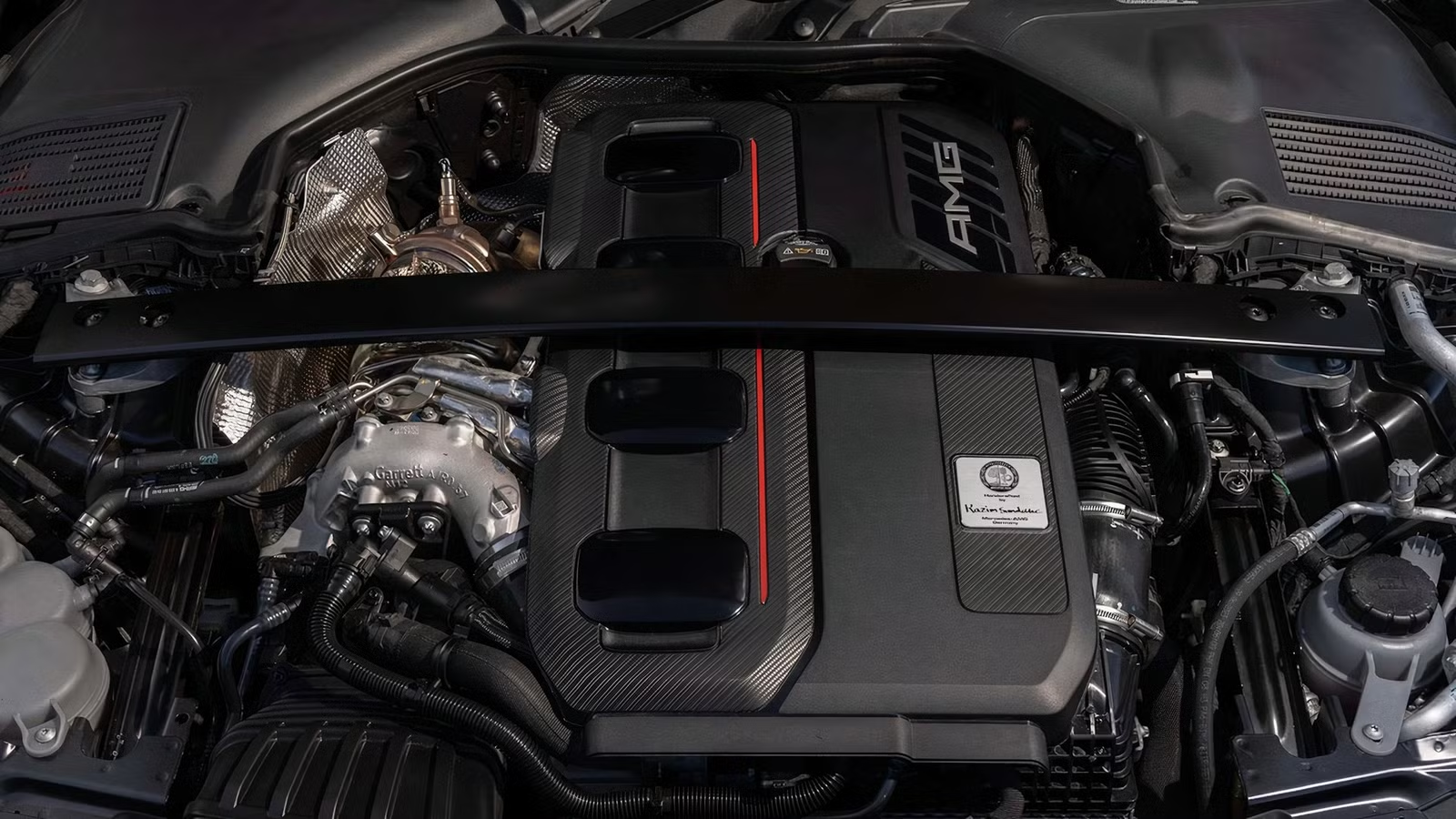
Even before the arrival of the Mercedes-AMG C63 S E Performance, the M159 turbocharged four-cylinder engine was already the world’s most powerful production 2.0-liter engine. The addition of hybrid power has taken that engine to the next level, making it unrivaled among four-pot powerplants.
Base Trim Engine
2.0-Liter Turbo I4 Plug-In Hybrid
Base Trim Transmission
9-Speed Automatic
Base Trim Drivetrain
All-Wheel Drive
Base Trim Horsepower
671 hp
Base Trim Torque
752 lb-ft
0-60 MPH
3.3 Seconds
Segment
Compact Luxury Performance Sedan
Find 2026 Mercedes-AMG C63 Sedan and more cars for sale on our Marketplace
Shop Now
Unquestionably, looking at the ever-greater proliferation of hybrids and EVs, emissions have become a significant aspect of the motoring industry. Not a single vehicle category has been spared, including that of performance vehicles, where makers of legacy large-displacement engines, such as BMW, Aston Martin, Audi, and Mercedes-Benz, have had to downsize and add turbocharging to produce similar levels of power while complying with emissions regulations.
Related
Mercedes Has Held The Title For Most Power Dense Four Cylinder For More Than A Decade
Mercedes-Benz was always known for its bruising V8 engines, though in recent years it has been wowing audiences with its power dense four-pots.
The Hybrid Mercedes-AMG M139 Is The Most Powerful Production Four-Cylinder Today
Mercedes-Benz C63 front three-quarter dynamic sunset Mercedes-Benz
When the M133 first appeared in 2013’s Mercedes-AMG A45 (and later the GLA45 and CLA45), the world marveled at the thought of a production two-liter turbo able to produce 310 horsepower. Even with a 20% lower displacement, it was a direct competitor to the five-cylinder powerplant in the Audi RS3.
As emissions regulations continued to tighten, Mercedes continued its mission of downsizing elsewhere in its performance lineups. The company killed off the M157 twin-turbo 5.5-liter V8, formerly found in the CLS-Class, E-Class, G-Class, and S-Class. Mercedes replaced it with the M177 4.0-liter twin-turbo V8 that debuted in the AMG GT.
In 2015, the second-generation C63 lost its mighty naturally aspirated 6.2-liter V8 and received the 4.0-liter twin-turbo V8 instead.
Mercedes’ crystal ball didn’t stop glowing, though. When the company announced the new turbocharged four-cylinder in 2019, the automaker likely had an inkling that the engine would feature in models beyond the A-Class.
Mercedes-Benz
When the C63 S E Performance debuted in 2022, it was less noisy and more fuel-efficient than before. There was still plenty of power, though. The car no longer featured a large V8, but a hybrid-assisted 2.0-liter was the most powerful four-cylinder mill on the market at the time.
Mercedes-AMG A45 S
Mercedes-AMG C63 S E Performance
Engine
2.0-liter, four-cylinder, mounted transversely
2.0-liter, four-cylinder, mounted longitudinally + electric motor
Turbocharger
Single, twin-scroll
Single, electrically operated
Electric Motor
None
201 hp Rear Axle Motor
Power
421 hp @ 6750 rpm
470 hp @ 5000-5500 rpm
Torque
369 lb-ft @ 5000-5250 rpm
752 lb-ft (peak electric and internal combustion torque produced at different engine/motor speeds)
Transmission
8-speed dual-clutch automatic
9-speed multi-clutch automatic and 2-speed E-Drive (rear)
0-62 MPH
3.9 seconds
3.4 seconds
Top Speed
168 MPH
174 MPH
Fuel Consumption
(WLTP method)
26.4 MPG
34.1 MPG
The Sound Of Speed Is Still A Science
The M139 engine is hand-built by a master technician. When it is completed, the builder adds his or her name to the engine with a special placard. Mercedes-AMG
The technical specifications of the Mercedes-AMG C63 S E Performance are a showcase of how state-of-the-art eco-engineering can be applied to enhance a car’s athletic prowess, to, indeed, produce similar or superlative speeds to a V8 with half the engine capacity, half the number of cylinders and half the turbochargers, all the while allegedly saving the planet.
As a parallel hybrid, the battery can rapidly charge and deplete as the electric motor works in unison with the internal combustion engine. On a twisty road, regenerative braking can recoup energy for the hybrid system, allowing drivers to benefit from it immediately. Liquid cooling lets the battery pack run cool.
And the electrically driven turbocharger, no longer traditionally dependent on the generation of exhaust gases to start spooling, all but eliminates turbo lag.
There are several elephants in the room, though. There’s a sizable difference between peak and continuously available torque on offer from the C63’s electric arrangement. On paper, there’s a claimed 201 hp available, though after 10 seconds of wide-open throttle driving, more than half of that has already disappeared from the 6.1 kWh battery. Meaning that Mercedes-AMG’s very impressive-sounding torque figure of 752 lb-ft is somewhat on the theoretical side, as that peak figure isn’t constantly available.
Related
Driven: 2024 Mercedes-AMG GT 63 S E Performance 4-Door Coupe Shocks With Supercar Acceleration
It’s far from perfect, but the hybrid AMG GT is an unparalleled beast.
Without Hybrid Boost, the M139 Was Actually Beaten
Mitsubishi Lancer Evolution X FQ-440 MRCollectingcars.com
Another four-cylinder was even more powerful, and it wasn’t from a European brand. In its final iteration, Japan’s Mitsubishi Lancer Evo X arrived as the limited-run FQ-440 MR. Its engine developed 220.2 horsepower per liter. The model celebrated Mitsubishi UK’s 40th anniversary. The limited run of 40 units came out in 2014.
Mitsubishi Lancer Evolution X FQ-440 MRCollectingcars.com
Specific power is a useful metric for measuring how efficiently an engine produces power from its available displacement. It reveals the engineering differences between two engines. For example, how is it possible that one 2-liter motor can produce a wheezy 50 hp per liter and another double that?
Comparing that power is also helpful for comparisons of varying displacements. For example, a Ferrari 296 GTB produces 215 hp/liter and the Koenigsegg Jesko tops the comparison chart at 313.6 hp/liter from its 5-liter V8.
Mitsubishi Lancer Evo X FQ-440 MR
Engine
2.0-liter, 4-cylinder, turbocharged
Power
440 hp @ 6800 rpm
Torque
412 lb-ft @ 3100 rpm
Related
The Hot Hatch With A More Impressive Power Output Than A Bugatti Chiron
The Bugatti Chiron has a W16 engine that produces a stupendous 1,500 hp. One hot hatch, though, has more horsepower per liter than the Bugatti.
The M159 Is A Double-Edged Sword
2025 Mercedes-AMG C63 S E PerformanceMercedes-Benz
Yet it’s not the move to hybridization that grates the most in a car like the C63. Yes, some of the cabin noise is necessarily fake, and, in appreciating the M139’s on-paper benchmarks, it’s a superlative piece of engineering. Even the M133 in the first-gen A45 felt more like a science experiment than a soulful expression of speed, and the addition of a hybrid setup in its successor only underlined that feeling.
Mercedes-AMG C63 Badge Close UpMercedes-Benz
The biggest trade-off, though, is that turbo fours are inherently acoustically dull, and no number of synthesized noises can make up for the rich, rewarding, and emotionally stirring surge of sound that AMG V8 drivers know and love. However, a redeeming factor is that as hybrid integration and battery technology continue to improve, power outputs in engines such as the M139 rise while emissions correspondingly drop.
On the other hand, there’s a point where power outputs reach an ideal level. At what stage does AMG start investing a little more in better sound acoustics? Now that would be a win-win for all.
Sources: Autocar.co.uk, Mercedes, Topspeed.com
