

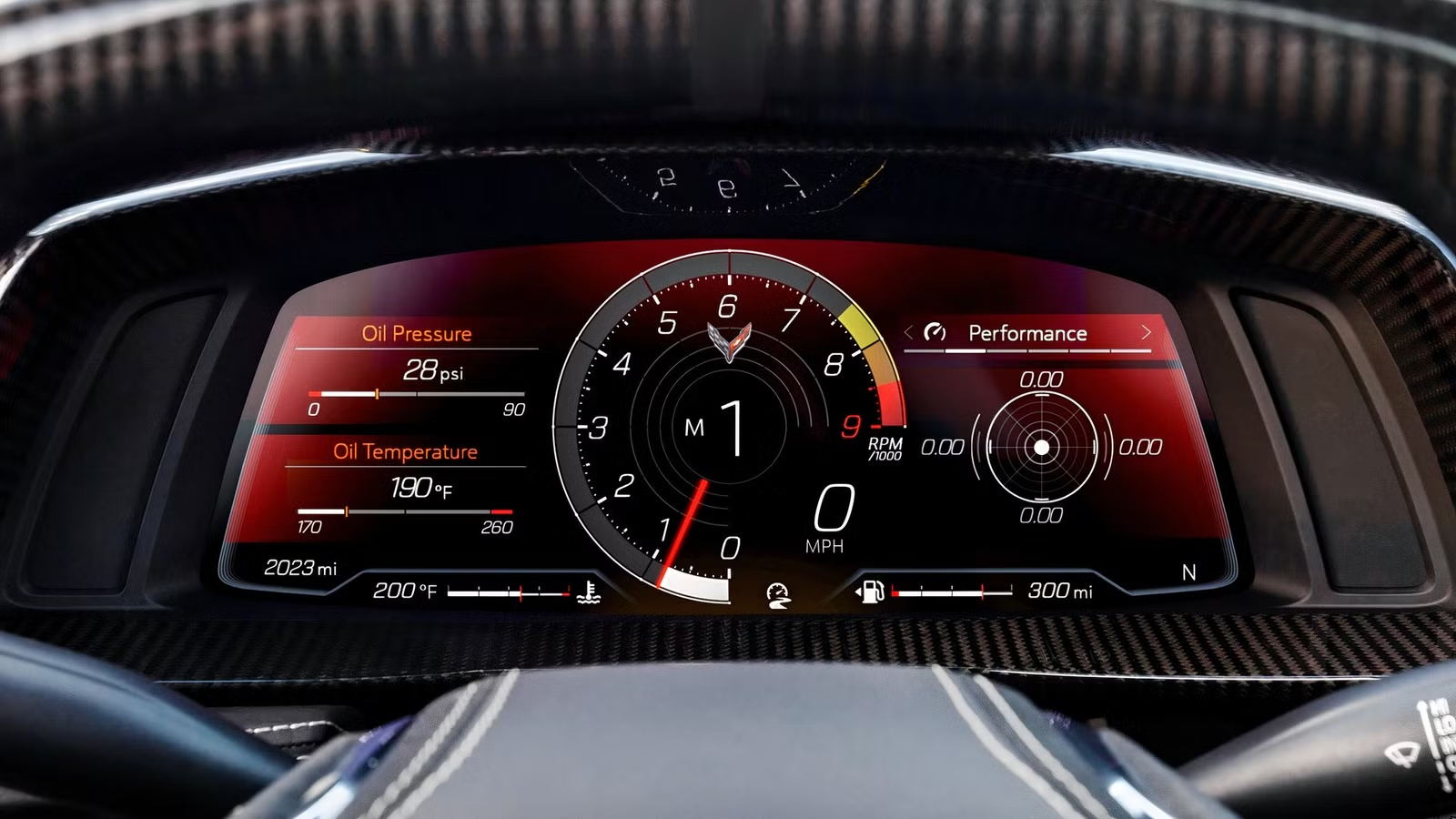
In the quiet, turbocharged tundra of modern emissions compliance, a few predators are still on the hunt for maximum revs. As the auto industry pushes towards exhaust-muffling turbochargers and noiseless electric motors, a few final holdouts can be found within the habitat, including the top-of-the-food-chain Chevrolet Corvette Z06, complete with an 8,600-rpm howl for a price tag that flips a finger at pricier exotics.
Other contenders are far more affordable. While competitors retreat behind hybrid batteries and forced induction, the past several generations have seen vehicles such as the Civic Si and Lexus LFA chasing the taste of full combustion theater while breathing uncompressed air at an alarming rate. Below, we’ll take a look at the Corvette Z06’s return to natural aspiration, some more budget-friendly alternatives for maximum RPMs, and an exotic challenger or two.
Some figures below are rounded for easy reading and visual clarity. Power ratings, rev ceilings, and market pricing may vary slightly depending on model year, regional market specifications, and local currency conversions. Real-world results and vehicle conditions may vary slightly.
The Z06 Is The Granddaddy Of Chasing The Redline
Pricing Starts At Just $121,500
2023 Chevrolet Corvette 70th Anniversary Z06 CoupeBring A Trailer
If you’re looking for maximum revs on a sub-$150,000 budget, nothing quite compares to the Corvette Z06. Its powerplant, the LT6, is the culmination of a decades-long push into motorsport V8 engineering that put the emphasis on airflow and revs over displacement or boost. By leveraging economies of scale forged through decades of small-block V8 production, the LT6 gives drivers a cost-effective way to access the power curve that defines far pricier 9,000 RPM poster cars like the Ferrari 458 or Porsche 911 GT3. No domestic competitor currently plays in this ballpark, though at least one has in the past, and we’ll meet it a bit further down the page.
2026 Chevrolet Corvette Z06 Selected Specifications
Type
LT6 5.5L V8, Naturally Aspirated
Block
Cast aluminum with pressed-in iron cylinder liners and four-bolt main bearing cap.s
Oiling System
Six-stage dry sump (8-qt. capacity); oil-spray piston cooling
Compression Ratio
12.5:1
Valvetrain
Dual overhead camshafts, dual-coil valve springs
Fuel Delivery
Direct Injection
Firing Order
1-4-3-8-7-6-5-2
Throttle Body
Twin 87mm
Horsepower (hp)
670 @ 8400 rpm
Torque (lb-ft/ Nm)
460 / 623 @ 6300 rpm
Maximum Engine Speed
8,600 RPM
In the 2027 Corvette Z06, the LT6 is the ultimate expression of naturally aspirated rage. It’s an exotic, free‑breathing V8 built for extreme revs and output per liter. Unlike the traditional Small Block V8, the LT6’s “Gemini” configuration features a rare flat-plane crankshaft and a unique overhead-cam valvetrain as two of its major technological flexes.
Before the current LT6, hot ‘Vettes used engines like the 1990-1995 C4 Corvette ZR-1’s quad-cam LT5, which was a 5.7-liter V8 making 375 hp at 7,200 rpm. The 2006-2013 C6 Corvette Z06 used the LS7, a 7.0-liter displacement that made 505 hp at 7,000 rpm. They were the go-to Corvette engines for drivers who wanted power to build explosively to a high-RPM climax. The remarkable LS7 remains an icon to this day for its rare combination of displacement and revs.
For the C7 Corvette, the mission changed, and high-performing variants boosted power with superchargers instead of higher revs. After the C6 Z06 with its fast‑revving LS7 V8, the C7 Z06 used a supercharged V8 instead: the LT4, a 6.2‑liter unit with 650 hp. For the mid‑engine C8 Corvette Z06 we see today, the order of the day is a return to revs, and the clean-sheet Gemini family’s LT6 is the powerplant for the job. This is the first flat‑plane‑crank V8 in Corvette history, and it’s a doozy.
With it, the driving dynamics shift closer to a Ferrari 458, capable of revving to 9,000 rpm, or a Porsche GT3, revving to 8,400-9,000 rpm. To dominate on the world’s fastest circuits, the Z06 is also widened 3.6 inches over the Stingray to clear the steamroller 345-series rear rubber and feed air into larger side air intakes. The bespoke front fascia routes airflow into a center heat exchanger – one of five keeping the powertrain cool as a cucumber during extended track sessions. In contrast, the dual-clutch 8-speed keeps the Gemeni screaming in its powerband.
2023-2026 Chevrolet Corvette Z06 LT6 5.5L NA V8 EngineChevrolet
This philosophy is baked into the Z06’s identity. As Tadge Juechter, Corvette Executive Chief Engineer, put it: “Racing was the reason the Z06 was developed in the first place in 1963, and it continues to support development of the road models that make them better on the street and the track. It also means we’ve tested the Z06 on the best tracks around the world, from Circuit of the Americas in the United States, to the Nürburgring in Germany.”
Flat-plane V8s spinning to 8,000 RPM and beyond typically live in cars with much higher asking prices, and the Z06 delivers that at a price point that rubs shoulders with a Porsche 911 Carrera S. That makes the Z06 one of the most accessible high-rev exotics ever built.
On a tighter budget? Not to worry: there’s still plenty of fun to be had.
Big Rev Predators From $20,000 to $200,000 And Beyond
2026 Shelby GT350Shelby American
High-rev engines are becoming rare in 2027, but a handful of new and used options still offer cost-effective access to similarly thrilling redline theatrics. Consider the Audi R8 V10. Its 5.2-liter free-breathing quad-cam V10 makes at least 525 horsepower, revs to an 8,700 RPM limit, and shares over 50% of its physical parts, including the core dry-sump block and valvetrain, with the GT3-class LMS race cars that conquered the 24 Hours of Nürburgring. Today, an early copy costs about half the price of a new Z06: around $75,000.
The Ford Shelby GT350 / GT350R is America’s other famous take on a flat-plane, high-rpm V8. The Voodoo engine could rev to 8,250 rpm, which required engineering around tremendous challenges. It earnedan immediate spot on Ward’s 10 Best Engines list for its sheer mechanical audacity. The result was a track-focused Mustang that gave its driver a V8 power curve that didn’t even start getting serious until 6,000 RPM, with plenty of revs still to go. Today, you could pick up your own copy for around $60,000.
2020 Ford Mustang Shelby GT350 Selected Specifications
Type
5.2L Voodoo Flat-Plane Crank V8, Naturally Aspirated
Block
Cast aluminum with Plasma Transferred Wire Arc (PTWA) cylinder liners
Oiling System
Deep-sump oil pan; track-ready air-to-oil cooler
Compression Ratio
12.0:1
Valvetrain
Dual overhead camshafts, 4 valves per cylinder with Ti-VCT
Fuel Delivery
Sequential Multi-Port Electronic Fuel Injection (Port Injection)
Firing Order
1-5-4-8-3-7-2-6
Throttle Body
Single 87mm
Horsepower (hp)
526 @ 7500 rpm
Torque (lb-ft/ Nm)
429 / 582 @ 4750 rpm
Maximum Engine Speed
8,250 RPM
The BMW M3 E90/E92 packs the S65 V8 that revs to 8,400 rpm. Loosely derived from BMW’s Formula 1 V10 program, this high-revving 4.0-liter unit came with an individual throttle body setup straight from motorsports.
The sensation and sound of this V8 revving to the moon can give enthusiasts goosebumps. It’s the last of BMW’s naturally-aspirated performance V8s, and you can capture a piece of the era for around $50,000 today. It might be as close as you’ll get to the Z06’s power curve for the price.
BMW’s M3 V8 saloon… 420 hp of screaming V8 power in a four-door saloon.BMW
The right second-hand Honda S2000 can also rev to 8,900 RPM, making it the era’s affordable king of giving drivers an F1 power curve for the road. The original 2.0-liter F20C held the global record for the highest specific output of any naturally aspirated production car—an astonishing 120 horsepower per liter. Today, you can pick up a nice one for around $35,000.
Speaking of Honda, don’t forget the Civic Si. Before the current turbocharged engine and the upsized, downsped 2.4-liter engine before it, the 8th-generation model ran Honda’s famous K20 engine, good for 8,000 revs all day long. Built around a cast-aluminum block that tuners routinely pushed past 9,000 rpm on stock crankshafts, it helped cement a long-lasting sport compact icon. With a limited-slip differential, six-speed stick, and front-wheel drive, you can pick up a copy today for well under $20,000.
The Corvette Z06 Tore Down The Exotic RPM Paywall
2025 Porsche 911 GT3 side-profile facing leftPorsche
Beyond the Z06’s price bracket, high‑rev engines are still sought after, though they exist almost exclusively in exotic supercars priced much deeper into six-figure territory.
The Porsche 911 GT3 at $180,000 to $300,000 is the most obvious reference point. Across multiple generations, this 911 variant has treated its engine’s redline as a design target and pushed the flat-six engine to its atmospheric limit. The Z06 virtually matches its rev ceiling at half the price. Engines that rev this high are usually million‑dollar art pieces, not production V8s found in Chevrolets. The Lexus LFA at $1.6M-$2 million reminds you of this. Collectible now, it’s on track to earn a place in the history books for its legacy, engineering, and Yamaha-tuned V10 that could spin to 9,000 RPM.
Lexus
Both GM and Ford benchmarked the Ferrari 458 Italia when developing their flat-plane V8 approaches from the same cloth: naturally aspirated, razor‑sharp, and happiest at the top of the tachometer. The 458’s 9,000‑rpm ceiling is a benchmark the LT6 aimed at, like Ford’s Voodoo V8 before it. Together, these big-money exotics highlight the Z06’s key strength in today’s market: it stands shoulder to shoulder with some of the most thrilling engines ever built, at a fraction of the cost.
Sources: Audi, GM, Ford, BMW, Porsche
