

On paper, the Nissan VQ37VHR V6 shouldn’t have succeeded when it was introduced. In 2008, its debut year, the automotive world was already moving away from larger, naturally aspirated engines toward smaller, turbocharged inline-four units that took advantage of advanced electronics and emissions-control measures. Instead of following the curve, Nissan decided to double down and push on with the mill regardless.
The VQ37VHR belongs to Nissan’s venerable VQ-series engine family, produces an impressive amount of power, and can rev up to 7,500 rpm with ease. The surprising thing is, many of those small four-pots that were around when the Nissan mill entered the fold had been replaced many times over, yet the VQ37VHR soldiered on for 12 years.
Nissan Chased V6 Perfection While Others Chased Turbos
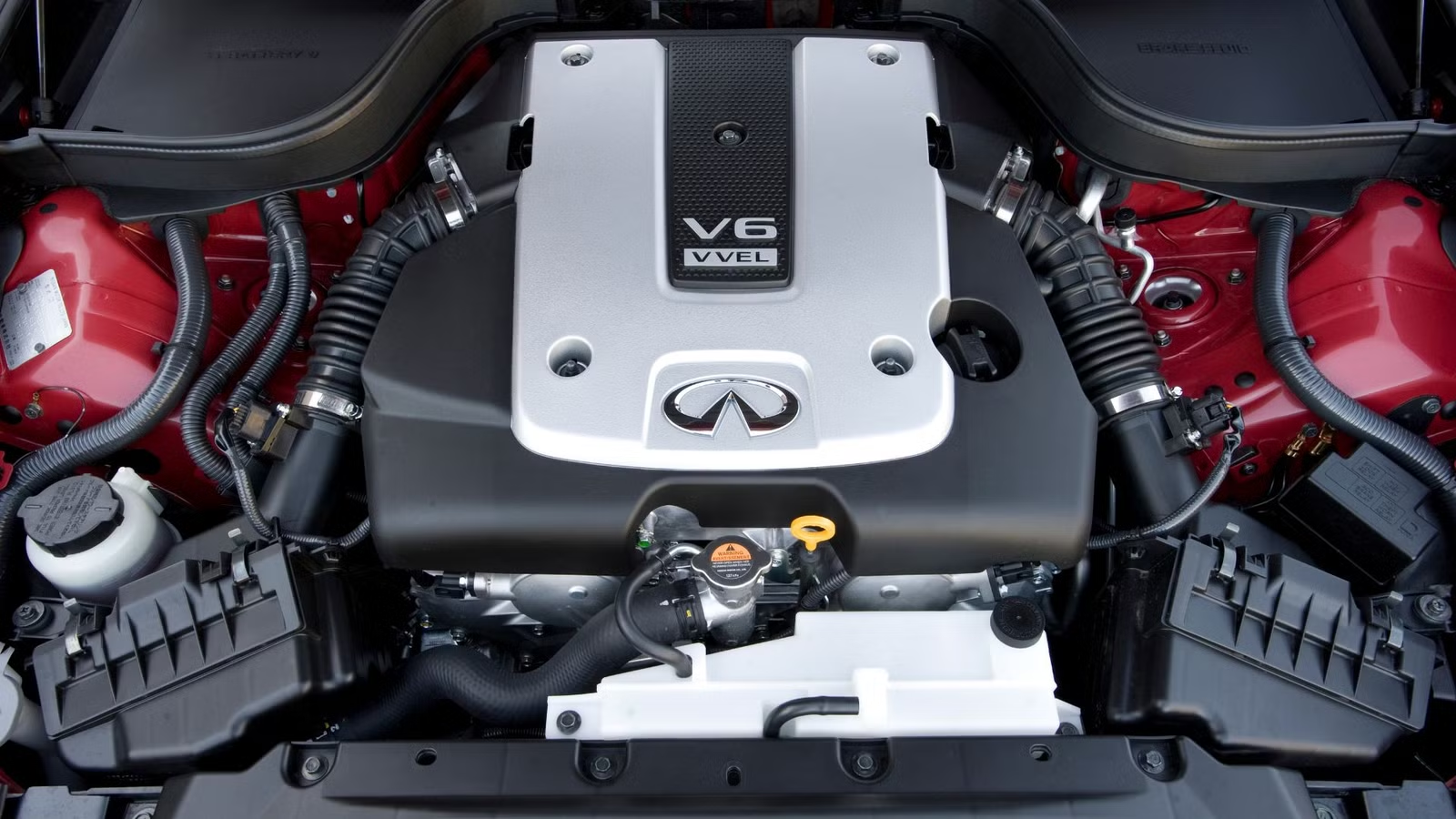
Infiniti VQ37 engine found in the Infiniti M, Q70, Nissan Cima, and Mitsubishi Proudia.Infiniti
The VQ37VHR is a performance-oriented member of Nissan’s VQ-series V6 family. The VQ series as a whole had already lived a storied life by the time the mill in question was introduced. Over the course of its life, it was mentioned on Ward’s 10 Best Engines list a record-breaking 16 times, with 14 of those consecutive from 1995 through 2008, in addition to mention in 2012 and 2016.
Once the VQ37VHR hit the market, it was tasked with powering several high-profile models. Arguably, its most famous application was the Nissan 370Z, introduced in late 2008 for the 2009 model year. It was also found within the Infiniti G37, the Infiniti EX37/FX37, and, later, the Infiniti Q50, among others. Not to mention, it was also found in the second-gen Mitsubishi Proudia, which was, in essence, a rebadged Nissan Fuga.
2018 Nissan 370Z Heritage Edition Front 3/4 ViewNissan
The VQ37VHR is a 3.7-liter mill, and its namesake breaks down to “VQ” for its family, “37” for its 3.7-liter displacement, and “VHR” for Variable Lift Event High Revolution. In its hottest application, the Nissan 370Z Nismo, the powerplant could chuck out 350 horsepower and 276 pound-feet of torque with ease. Its 7,500-rpm redline was achieved thanks to an extremely stout rotating assembly, VVEL tech, and an oversquare configuration, wherein its cylinder bores are wider than its piston stroke.
Nissan wasn’t concerned with keeping up with the times when it designed the VQ37VHR. The brand already knew it had an award-winning blueprint for a great V6 engine, and it likely made much more sense to continue building on that template while it still could, rather than investing money in designing a clean-sheet turbocharged four-banger. After all, Nissan had done that; much of the brand’s 2010s-era on-road performance models could have been very different from what we remember.
VVEL: The VQ37VHR’s Secret Weapon
2009-2013 Nissan 370Z NISMO 3.7L VQ37VHR V6 EngineNissan
When it comes to what made the VQ37VHR such a revolutionary V6 for its time, much of the praise should be directed at its VVEL technology. Its full name is Variable Valve Event and Lift, and it can continuously alter the engine’s valve lift and timing.
One of the major advantages of the VVEL setup is vastly improved throttle response, and it also reduces something called pumping loss, which is energy lost when an engine draws the air/fuel mixture into the combustion chamber, as well as when it exhausts the combusted gases. Another major upside is VVEL’s ability to broaden the VQ37VHR’s torque curve, a benefit often achieved via turbocharging or supercharging.
2009 Nissan 370Z Engine BayNissan
However, the VVEL tech is just one large piece of the engine’s performance puzzle. In addition, the VQ37VHR employs a symmetrical dual-intake system, which greatly improves flow over standard intakes. Its cylinder heads were designed to maximize free-flowing air, and its crankshaft is forged steel. To make things even more techy, Nissan added its Continuously Variable Valve Timing Control (CVTSC), which worked in conjunction with VVEL.
Thanks to that litany of tech and upgrades, the VQ37VHR became one of the fastest-revving V6 engines on the market upon its debut. Its turbocharged rivals, while producing similar power, mostly suffered from turbo lag, giving the Nissan mill a unique and crucial edge in performance, especially on a tight racing circuit. The mill could also effortlessly provide said power, too.
Who Needs Forced-Induction Engines Or V8s?
2012 Infiniti G37 Couple IPL engine bayInfiniti
Because the VQ37VHR was going to be used as an Infiniti mill, it needed to deliver enough power to compete with mills from BMW, Mercedes-Benz, and Audi. At the time, BMW was busying itself with turbocharging a slew of inline-four and inline-six engines, many of which went into models like the 3 Series. Mercedes-Benz and Audi were also busy tinkering with boost for their four-pots and V6s. However, the VQ37VHR shone especially brightly compared to European V8s built at the time.
For example, Audi’s 4.2-liter V8, which was significantly heavier and more complex, only produced 340 hp in its base state. That’s 10 less than the VQ37VHR’s maximum factory output of 350 hp. Other brands from around the world were also behind the Nissan mill in terms of output, with Ford’s 24-valve Modular 4.6-liter V8 managing to throw out roughly 300 hp in 2010, exactly 50 hp less than the aforementioned Nissan 370Z Nismo application. The Toyota 3UZ-FE 4.3-liter V8 also came up short, with just 290 hp on tap.
The VQ37VHR offered several benefits over its rivals, particularly in terms of component complexity. Turbocharged and supercharged engines require a host of additional parts to operate properly. For example, turbocharged engines require more cooling because they can get much hotter than naturally aspirated engines. That means you typically need intercoolers. Plus, if a turbo or supercharger fails, repairs can be extremely costly. V8s also tend to be heavier and more complicated than V6 mills, as well.
Nissan’s VQ37VHR, on the other hand, has none of those things. Without the added stress of forced induction, the mill can stay cooler and have fewer components that could go wrong. Its linear power delivery is a huge plus, too, since you don’t have to wait for a turbocharger to spool up. Its simple nature and two fewer cylinders than a V8 meant it was lighter on its feet and less cumbersome.
Why It Continues To Deserve Praise
The Nissan SynchroRev Match technology not only makes the 370Z faster on a racetrack, it also reduces the impact on the drivetrain when the driver pushes on.Nissan
One of the major upsides to the VQ37VHR is its exceptional reliability. Despite the myriad systems within its makeup, the mill is extremely capable of withstanding repeated hard use, and all it asks for is routine maintenance. Its forged crank, ladder-frame main-bearing design, and robust timing chains are a few key contributors to its durability. As far as actual, real-world longevity is concerned, one owner reported a VQ37VHR reaching over 430,000 miles without much fuss, and many others report mileages in excess of 250,000 and even 300,000 miles.
It’s Still One Of Japan’s Greatest Performance Engines
Infiniti G37 engine baySean McManus/CarBuzz/Valnet
Today, the naturally-aspirated engine, especially a V6, is a rare find. Especially when you look for one in a sedan, as most of them are now found in base-model pickup trucks and family SUVs. The VQ37VHR, with its esteemed durability and penchant for performance, can easily fill this gap, so long as the prospective buyer doesn’t mind springing for a used car. If you’re one of those gearheads who’s lamenting the loss of naturally-aspirated power, however it may come, the venerable Nissan mill will likely fill the void sufficiently.
Modifications are also well accepted by the engine, and its strong bottom-end and ladder-framed main bearing design mean it takes more power than average actually to break the engine. Many anecdotal reports state that the VQ37VHR can safely accept up to 550 hp before you’d need to swap out bottom-end components for beefier ones. It helps to know that the engine was found in some cool cars, like the Infiniti G37 and the Nissan 370Z, so adding power comes with an additional upside.
2018 Nissan 370Z Heritage Edition Engine BayNissan
The mill also enjoys a huge amount of aftermarket support these days, making components cheap and plentiful. Because it was such a widely used powerplant, parts are easy to find. It’s also only been out of production for six years, so coming across a discontinued part shouldn’t be an issue for a while yet. Infiniti owners with a VQ37VHR installed in their model have the added benefit of not paying premium-brand component prices because, hey, it’s just a Nissan engine.
Demand for models like the ones listed above is still alive and well, and knowing that the engine is likely to last longer than average brings another plus into the mix. If you think about it, the VQ37VHR could very well be one of the last great naturally-aspirated V6 engines ever to hit the market before emissions controls became too tight, downsizing became normalized, and hybridized powerplants became much more commonplace.
The Nissan VQ37VHR wasn’t happy to just exist. It also had to go toe-to-toe with the Germans and other Japanese brands, while also outliving them.
Sources: Nissan, Infiniti, Facebook.com, MyG37, Drifted.com.
