

Few automakers have built a reputation for mechanical longevity the way Toyota has. Decade after decade, the brand sets the benchmark for engines that simply refuse to quit — a track record that has earned it a dominant position across global markets and a fiercely loyal following among buyers who measure value in hundreds of thousands of miles rather than model-year refresh cycles.
But even within Toyota’s catalog of overbuilt powerplants, one engine occupies a different category entirely — a diesel straight-six so deliberately un-modern, so insistently mechanical, that the rest of the industry essentially forgot how to make something like it. And Toyota is still building it today for use in one of its most rugged vehicles ever, the Land Cruiser 70 Series.
UPDATE: 2026/08/06
We have updated this article with relevant information.
What Makes The 70 Series Such An Important Model
The 2024 70 Series Land Cruiser tackling off-road terrain Toyota
The Toyota Land Cruiser 70 Series holds major importance in the global market because it fills roles that modern SUVs no longer address. The Japanese brand designs it as a working vehicle intended for markets where durability matters more than comfort. Governments, aid agencies, mining companies, farmers, and militaries swear by the 70 Series because it handles extreme heat, poor fuel quality, heavy loads, and constant mechanical use without showing signs of fatigue.
Another key aspect of the 70 Series is its ladder frame construction, providing immense durability and versatility in the harshest and most challenging conditions. Despite the global automotive world embracing more modern and cost-effective designs, Toyota remains committed to the 70 Series because of how effectively it supports select economies — serving as ambulances, utility trucks, troop carriers, and expedition vehicles in regions where most new SUVs and trucks simply wouldn’t survive.
If the Land Cruiser eroded Land Rover’s market share in Africa, the 1HZ effectively eroded it. As you can see, it’s not a particularly powerful engine, but it has three important things going for it. First, it’s an extremely durable engine. Secondly, it does without complex electronics and emissions systems, which is also why it can’t be sold in the USA. Third, it delivers maximum torque at 2,200 rpm, and that’s what makes it so good to drive off-road. When the going gets tough and you engage low-range, this beast of a car simply idles up and over obstacles like they don’t exist.
What I love most about the 70 equipped with the 1HZ as opposed to the turbocharged V-8 diesel option is the fact that it forces you to slow down and enjoy whatever journey you’re on. A 70 Series equipped with this naturally aspirated six-cylinder diesel settles nicely at 65 mph, making the journey slow-going and more relaxing as a result.
– Gerhard Horn, Senior Editor, CarBuzz
Predictable reliability builds trust in the Toyota brand and reinforces the company’s reputation for long-term dependability. Few vehicles still offer this level of toughness straight from the factory, which makes the Land Cruiser 70 Series a cornerstone product with global relevance despite its age and significantly higher production cost.
The Engine That Refuses To Die
A black Land Cruiser 70 descending a hill Toyota
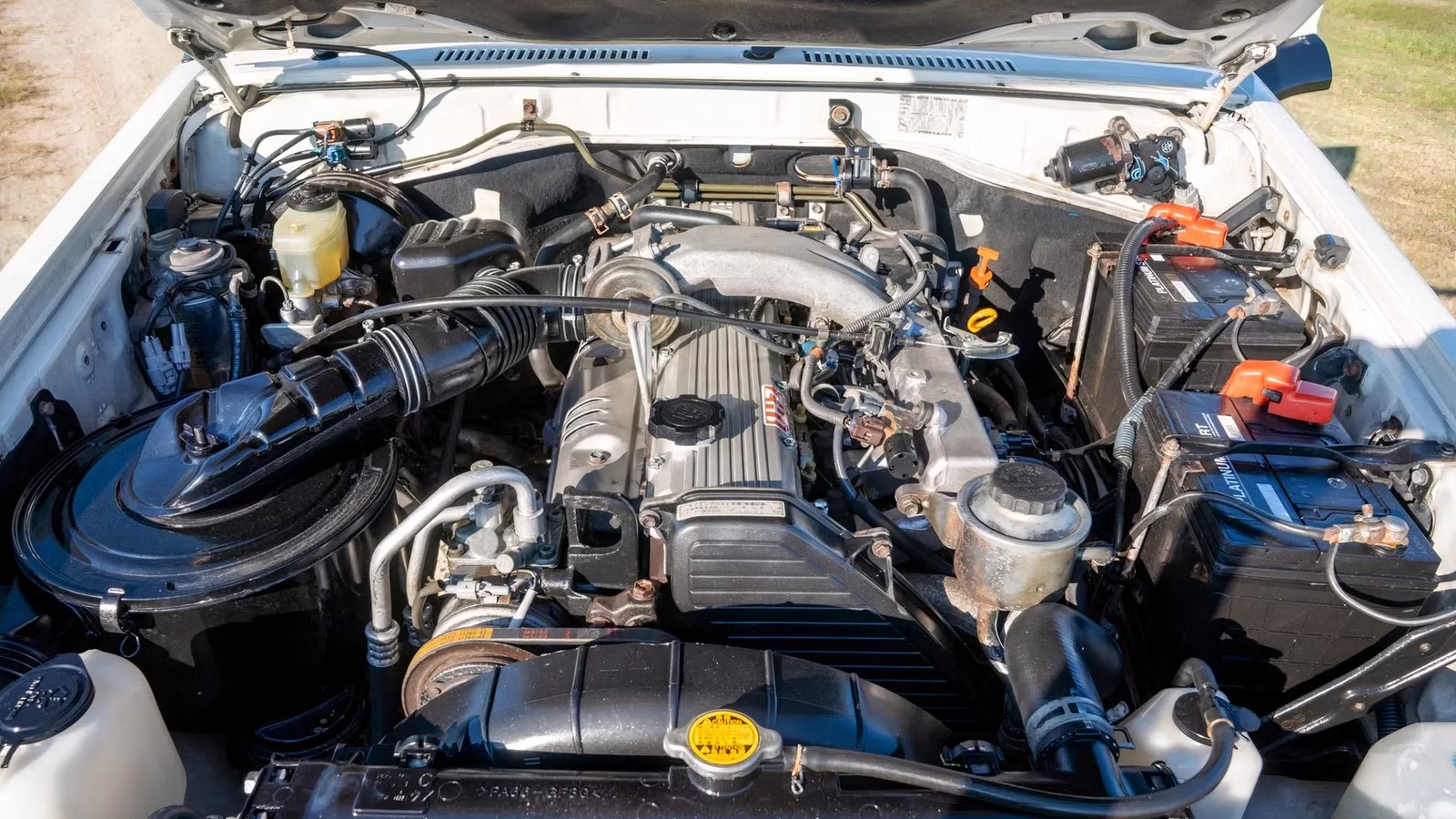
Toyota officially introduced the 1HZ in 1990 for the Land Cruiser 70 Series SUV and truck duo as an official replacement for the 2H diesel powertrain. This configuration consists of a 4.2-liter inline-six block with single overhead cams and a cast-iron block and cylinder head with an indirect injection design, producing 129 horsepower at 3,800 RPM and 210 pound-feet of torque at an impressively low 2,200 RPM to the four-wheel drive system. Because it produces so little power relative to its massive 661 pounds of thermal mass, the internal components are never subject to stress, allowing it to easily exceed 300,000 miles while only requiring basic oil changes and timing belt maintenance.
This engine remained in production for more than two decades — a remarkable run by any measure. The Toyota 1HZ was a revolutionary example of over-engineering, arguably making it the best workhorse powertrain to ever have existed, with reliability being the central focus of its design, regardless of conditions or environments. From a design standpoint, its outright rejection of technology that was modern at the time is exactly what made it so revolutionary, as Toyota fully adopted the “if it isn’t broken, don’t fix it” philosophy.
The interior of the 2024 70 Series Land CruiserToyota
Toyota designed this engine so that it could operate for the duration of its life without any ECU or electrical sensors, making it based purely on mechanical components. This is exactly how it earns its reputation for being a crucial survival tool in remote regions, especially those where high-grade fuel and diagnostic laptops are non-existent.
Why It’s Still Running After 25 Years
Engine bay shot of the 2024 70 Series Land CruiserToyota
The Toyota 1HZ benefits from a reliable reputation thanks to its simple and robust engineering, featuring strong internal components designed to tolerate heavy use with minimal maintenance. Key design elements include the aforementioned cast-iron block with a forged steel crankshaft and large bearings. Toyota builds these to handle high loads and long service intervals. Employing an indirect injection design reduces stress on the fuel system and allows the engine to tolerate low-grade fuel and harsh environments.
The 1HZ utilizes a swirl-chamber indirect injection design and an incredibly high compression ratio of 22.7:1, which Toyota later reduced to 22.4:1. Adopting this design allows the engine to ignite even the worst quality of diesel fuel with ease. The block features a massive 94 mm bore and 100 mm stroke, optimizing low-end grunt rather than high-speed performance. This makes sense, given that 1HZ-powered models — then and now — predominantly tackle low-speed driving environments.
A detailed breakdown of the Toyota Land Cruiser 70 Series chassis and engineToyota
The head gasket area benefits from impressive stability with predictable wear and minimal weak points, resulting in strong performance even in extreme heat. Toyota keeps electronics minimal and opts for mechanical fuel injection, which reduces complexity and limits failure modes compared to modern common rail systems. Long-term owners consistently praise the engine’s ability to run for hundreds of thousands of miles in harsh conditions with nothing more than basic servicing and routine oil and filter changes. Many examples survive decades of off-road and commercial use because parts remain widely available and affordable, and technicians understand the design well enough to make repairs straightforward and fast.
The One Thing That Can Actually Kill It
70-Series Toyota Land Cruiser Splashing Up WaterToyota
While this engine is built to literally survive apocalyptic scenarios, there are some upkeep tips from those that have either owned or are familiar with the engine’s behavior. Forums and owner testimonials all glaze its durability and overall minimal maintenance requirements, but only in its non-turbo factory form. Digging around reveals owners advise against turbocharging it, which is a common upgrade due to the low power of the 1HZ. This can lead to the surrounding components failing prematurely, which is a worry with most turbo engines, more so if it’s an older design.
One of the main problems with adding boost is that the top of the 1HZ’s pistons are rather thin, and when you introduce hot gases to its operation, they can blow a hole through the top of it, leading to critical failure and costly repairs. Overheating is also a common issue when turbocharging the 1HZ. The 1HD-T is the factory-turbo equivalent to the 1HZ, and most buyers prefer the 1HD-T over the 1HZ. The main takeaway is this: it’s better to leave the 1HZ naturally aspirated, but if you absolutely need more power, opt for a low-boost setup running around 10 to 12 psi to keep its integrity (relatively) intact.
Why You’ll Never Find One In A U.S. Dealership
The 2024 70 Series Land Cruiser off-roadingToyota
Toyota does not sell the Land Cruiser 70 Series in the U.S. because its relatively archaic design does not meet modern safety and emissions standards required for sale. Toyota chooses not to engineer it to comply, because doing so would be a costly endeavor and would ultimately change the core philosophy of the model.
The 70 Series uses an older truck platform that lacks advanced crash structures and modern restraint systems that regulators require. It also uses a diesel engine and mechanical systems that fail to satisfy stringent EPA and CARB emissions rules without significant redesign. Toyota would need to add expensive hardware like advanced exhaust treatment and electronic controls to comply, which would raise costs and alter the character of the vehicle.
A dynamic front-quarter tracking shot of a Toyota Land Cruiser 70 Series driving on gravelToyota
Toyota evaluates the potential sales volume and finds it too low to justify the investment in redesign and certification. U.S. buyers prefer SUVs with higher levels of comfort and safety tech, and Toyota already offers the Land Cruiser nameplate in different forms that meet local rules. Toyota instead focuses on models that blend off-road capability with technologies that pass U.S. regulatory hurdles. Ultimately, the 70 Series is a workhorse intended for conditions that the majority of Americans will never have to face.
How Toyota Keeps The 70 Series Alive In Stricter Markets
Front three-quarter view of a Land Cruiser 70 GXL pulling a trailerToyota
Toyota applies its more modern and modular 1GR-FE and 1GD-FTV engines to keep the Land Cruiser 70 Series relevant while meeting modern expectations in the regions where it sells the vehicle, such as Europe and Australia. The 1GR-FE is a naturally aspirated 4.0-liter V-6 gasoline engine with an equally simple and proven design. Key features include port fuel injection, a timing chain, and a conservative state of tune that supports long service life and tolerance in demanding conditions, while also accounting for variable fuel quality. This engine suits markets where gasoline remains more accessible than diesel and where buyers value smooth power delivery and straightforward maintenance.
The 1GD-FTV is a more modern 2.8-liter turbodiesel that delivers improved efficiency, better emissions compliance, and a stronger torque curve compared to the 1HZ. Toyota equips it with a modern combustion design and reinforced internals, along with emissions hardware tailored to regional regulations rather than global extremes — allowing compliance without sacrificing durability.
Where It Goes From Here
Four 70-Series Toyota Land Cruisers with different body styles parked on a fieldToyota
Toyota is unlikely to ever discontinue the 70 Series because it serves markets and use cases that no modern replacement can fully cover. Governments, utilities, aid agencies, and industrial buyers operating in environmentally challenging areas that will never experience modern infrastructure will always depend on it as a tool rather than a lifestyle vehicle. Even electrification adoption remains uncertain.
Consistent global demand justifies continued production with minimal development costs. The platform uses amortized tooling, proven manufacturing processes, and shared components, which keep margins healthy. Regional regulations still allow its sale with targeted updates rather than full redesigns. Discontinuing it would leave Toyota without a dedicated heavy-duty work vehicle and would weaken brand loyalty in key developing regions where long-term durability drives purchasing decisions.
Sources: Toyota, Hagerty, and EngineExplained
