

Cruiser bikes perfectly capture the American spirit of motorcycling. And American bikemakers do that better than anyone else. However, with the rise in popularity, Japan has repeatedly tried to match and beat America’s finest cruisers. It has successfully done that several times, too, with a variety of cruisers that try different approaches. This can be a fully liquid-cooled six-cylinder machine or simply a stripped-down chopper to give enthusiasts a factory option rather than promoting customization. We’re talking about one such example here that continues to capture the spirit of American cruisers–particularly a Harley–while being thoroughly Japanese.
Bobbers Have Long Defined The Spirit Of Custom American Cruiser Bikes
Riders lined up with Harley-Davidson motorcycles in front of an American flag to promote the Let;s Ride challenge 2026Harley-Davidson
Post World War II, custom American V-twin cruisers became ardent symbols of freedom, rebellion, and individuality. Back alleys and garages were packed with creative minds that transformed heavy V-twin machines from Harley and Indian into personalized bobbers and legendary long-fork choppers. Much of this work was done by returning veterans with mechanical skills and a relentless desire for nonconformity.
Rider sitting on a 2026 Indian Scout BobberIndian Motorcycle
The “bobber” trend started when riders wanted to make their cruisers faster. Stripping off heavy fenders, the extra lights, and bulky parts helped with the weight loss. The bobber trend began in the late 1920s and 1930s as a visual treat, but it slowly became a staple, as it also helped improve speed and handling. It evolved into a lasting minimalist custom culture with both Harley and Indian offering factory bobbers today.
But Factory Choppers Have Always Been Rare
A parked Harley-Davidson Breakout with rider walking up to itHarley-Davidson
Later in the 1960s, there was a shift in the custom cruiser bike scene as bobbers evolved into radical choppers with stretched-out frames and extended forks. The focus of customization completely shifted from a balance of form and function to a “loud” form only. The word “chopper” comes from the fact that the frame is literally chopped; the steering neck is cut and re-welded or replaced to create an extreme rake angle and stretch out the front end.
Choppers had more cultural penetration thanks to the use of these wild custom-styled cruisers on the big screen. The earliest and most popular example is the 1969 movie Easy Rider, which showcased a custom 1950s Harley-Davidson Hydra-Glide Panhead chopper with the now-famous American-flag-painted gas tank. Furthermore, Orange County Choppers made custom choppers for various celebrities, corporations, and charities and showcased them on the dramatic TV show—American Chopper.
A studio shot of the Honda FuryHonda Powersports
A few years after that, Japan realized the potential of such bikes in the market and began its own custom-style cruiser efforts. There were some surprising bikes as part of this attack on American brands, and one of these showcases a proper chopper build with an insane rake angle, a massive front wheel, and an extra-wide handlebar design. Plus, it comes from the world’s largest bikemaker.
The Honda Fury Captures Harley’s Spirit Distinctively
Price: $11,499
Rider aboard a silver Honda FuryHonda Powersports
The Honda VT 1300CX Fury was introduced as a 2010 model when the chopper craze was at its peak. Although the popularity of choppers started diminishing soon after, Honda didn’t falter and went ahead and held onto their factory chopper. Visually, the Fury is spot on, and no “stock” Harley or Indian can come close to matching its custom charisma. Furthermore, with virtually no updates made in the last 15 years, the Fury has turned out to be a timeless classic.
This Is The Closest Thing To A Factory Chopper From Japan
Rider accelerating on a Honda Fury along a city road, side profile viewHonda Powersports
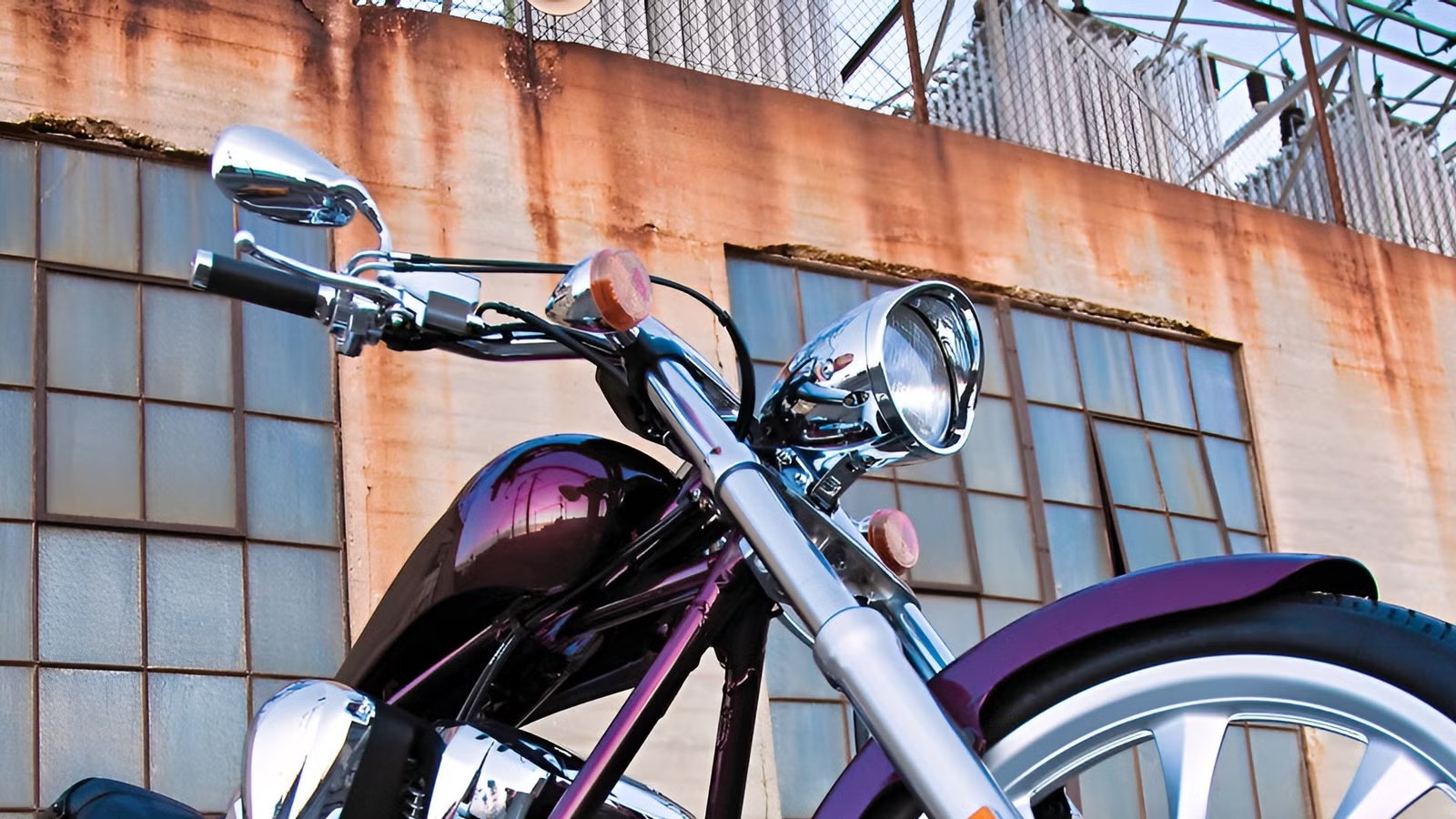
The design is intriguingly both loud and minimal thanks to the clean lines and curvy body panels. The Honda Fury stays true to the chopper build with a sweeping flyline, a raked-out front end, an elongated fuel tank, and a large exposed V-twin. The front flaunts a large 21-inch wheel with a slim tire, whereas the rear offers contrast with a 200-section tire wrapped around an 18-inch wheel. There is a lavish spread of chrome across the motorcycle, including the two-into-two exhaust, the cylinder heads, and the uniquely designed elongated headlamp enclosure.
2025 Honda Fury static side profile shotHonda Powersports
All this while, Honda maintains a clean, minimal design with a subtly mounted radiator that preserves the bike’s lines and neatly routes wiring and hoses. The passenger seat and footpegs can be easily removed for a clean, solo look, too. That means the Fury is more of a blank canvas that can be easily made wilder with subtle modifications. Add a tall sissy bar, a colorful seat, complementary handlebar grips, and a flame decal kit on the tank, and you have a chopper that looks straight out of a custom shop and not a factory.
Powered By A Dramatic-Looking But Highly Reliable V-Twin
A studio shot of the Honda Fury V-twinHonda Powersports
The Fury is powered by the biggest V-twin engine in Honda’s arsenal. This is derived from the same family as the humble Honda Shadow. But unlike the Shadow, it was future-proofed with modern technology like fuel injection and liquid cooling. Other than these bits, it’s a simple engine with an old-school valve layout comprising an SOHC valvetrain with two intake and one exhaust valve per cylinder.
The 1,312 cc mill has a very low compression ratio of 9.2:1, so performance is clearly not the emphasis here. Accordingly, the output is 57 horsepower at 4,250 RPM and 79 pound-feet of torque at 2,250 RPM. Power is sent to the rear wheel via a five-speed manual gearbox and a final low-maintenance shaft drive system.
Complemented By Traditional Underpinnings With A “Chopper” Twist
Studio shot of a blue 2010 Honda FuryHonda Powersports
The Honda Fury has a fairly ordinary chassis design with a double downtube frame that cradles the engine and gearbox. This is the same layout as the smaller and more mundane Shadow too. But much like the concept of building a chopper, Honda chopped the steering head and tilted it for a raked-out stance that extended the wheelbase to an eye-popping 71 inches. It is further complemented by super-long 45 mm telescopic front forks with 5.1 inches of travel. The rear end is simpler with a hidden monoshock (3.7 inches of travel).
Honda Fury parked in dealership, facing left.AutoTrader
Braking duties are courtesy of a 336 mm disc coupled to a two-piston floating caliper up front. The rear gets a 296 mm disc coupled to a single-piston caliper. It has a rake angle of 32 degrees and a trail of 3.6 inches. Despite the wild looks and obvious urban riding restrictions, the Honda Fury still offers fairly comfortable ergonomics. It has an accessible seat height of 26.7 inches with the rider sitting upright thanks to the rider-focused ape hanger handlebar design. The footpegs are forward-set, meanwhile.
Barebones Feature List Helps It Be Minimal And Timeless
Closeup of the fuel tank and headlight of the 2010 Honda FuryHonda Powersports
The instrument cluster is minimal and analog, and the only electronic intervention is dual-channel ABS. Otherwise, the Honda Fury is as barebones as it gets in terms of features. However, Honda offers a concise accessory list to spice things up. These include a windscreen, chrome grips, a passenger seat kit, and a passenger backrest. Given the Fury has been around for so long with minimal changes, aftermarket support for this chopper is very strong, so modifying it further will not be a hassle.
The Honda Fury Is Truly One Of A Kind
Low angle shot of a purple 2010 Honda FuryHonda Powersports
There is no direct rival to the Fury, and that is what puts it in the spotlight. Kudos to Honda for keeping this chopper around, as the Fury yields little commercial incentive for Honda because sales have been poor. It’s still alive and kicking because there is still a thriving community of bikers who strongly believe in expressing their passion in wild, vibrant, and head-turning packages. As mentioned earlier, only two motorcycles come close to this factory chopper in wild visual appeal.
These include the Kawasaki Vulcan 900 Custom with drag bike styling and the Harley-Davidson Breakout chopper-styled cruiser. While the latter isn’t as wild as the Honda Fury, it still makes a point with a big V-twin, a 21-inch front wheel, and a huge 240 mm-section rear tire. But then again, the Breakout is expensive at $22,999. The Honda Fury is a lot louder and surprisingly more refined for literally half the cost.
Source: Honda Powersports
