

Audi has relied on its now-iconic five-cylinder engine since 1976. It debuted in the second-generation Audi 100, which was one of the cars that helped Audi maintain its independence, and would go on to be used in some of the automaker’s most influential and important models, both road-going and its venerated motorsports icons.
Today, the five-cylinder engine serves as the main motivator of one of the most powerful hatchbacks currently available. Although it’s far from the most affordable model in Audi’s current lineup, it doesn’t hold a candle to what Audi’s first performance-focused model powered by a five-cylinder engine is worth today.
The Ur-Quattro Was The Basis Of Audi’s Homologation Special
1980 Audi Quattro Exterior Finished In GreyAudi
The basis of the car that costs an arm and a leg today was the Audi Quattro. Debuting at the 1980 Geneva Motor Show, the Audi Quattro was immediately distinguished by its boxy frame and the four-wheel-drive system that underpinned it. Audi’s desire for a high-performance five-cylinder-powered vehicle led to the Audi Quattro, also known as the Ur-Quattro.
Related
The 45-Year-Old Technology That Audi Cars Still Rely On Today
Let’s take a look at how this 45-year-old technology actually works and why it’s still used on millions of cars today.
When it debuted, it was the first road-going production model to combine an all-wheel-drive system with a front-mounted turbocharged engine. In its initial form, the Quattro’s 2.4-liter turbocharged five-cylinder engine produced just under 200 horsepower and 210 lb-ft of torque, distributed to all four corners, allowing it to reach 62 mph from a standstill in 7.1 seconds.
1980 Audi Quattro Exterior Finished In Grey DrivingAudi
Production of the Audi Quattro began in late 1980 and continued for over a decade. Approximately 11,000 examples of the Audi Quattro were built on a dedicated production line throughout its lifetime. Over the years, various renditions and improvements were introduced to Audi’s Ur-Quattro. Still, the most significant revision of the Ur-Quattro came in 1983 with the introduction of the Audi Sport Quattro.
The Most Beastly Quattro You Could Buy Back In The Day
Front quarter shot of a 1984 Audi Sport QuattroAudi
1984 Audi Sport Quattro
Engine
2.1-liter turbocharged inline five-cylinder
Power
306 hp @ 6,700 rpm
Torque
258 lb-ft @ 3,700 rpm
0-60 mph
4.8 seconds
Top speed
155 mph
Similar to some of the most revered and beloved performance cars from the 1980s and 1990s, the Audi Sport Quattro was born out of Audi’s desire to race, today remembered as one of the coolest homologation specials ever created. Around the time that the Audi Ur-Quattro’s production began, there was a significant change in the world of motorsport.
1984 Audi Sport Quattro Exterior Finished In RedAudi
By 1982, the hallowed and harrowing Group B category was introduced as a replacement for the Group 4 category, which was immediately discontinued from the series; it was replaced by regulations that allowed cars more powerful and technologically advanced than those used in Group 4. It was the Group B rally category that served as the staging ground for unbelievably violent, crazed, and potent racing cars of the 20th century, like the Ferrari twin-turbocharged 650-hp monster.
Related
This 80s Turbocharged Five-Cylinder Audi Wagon Is Sleeper Perfection
If you’re looking for a period sleeper wagon, this retro German option has to be a strong contender.
In response to new regulations, Audi’s management proposed that the company’s offering be based on the Quattro model rather than building something from the ground up. However, while the Audi Sport Quattro was based on the Ur-Quattro, its purpose as a homologation special rested in several significant changes. In essence, the Audi Sport Quattro was a lighter, shorter, more powerful, and far more capable performance car.
1984 Audi Sport Quattro Exterior Finished In Red Front Close-UpAudi
Some of the changes that were made to the Audi Sport Quattro included:
- Its chassis was shortened by 320 mm (12.6 inches), to 2,204 mm (7.25 feet), to improve handling. However, with the shorter wheelbase came a revised weight balance that positioned a majority of the weight over the front axle. This weight balance required a more aggressive driving style, partly spurred by the understeer inherent in the early iterations of the Quattro all-wheel-drive system.
- A new, fully independent suspension system.
- A better braking system consisting of large ventilated brake discs.
- New four-piston calipers.
- A revision of its fuel system.
Audi Sport QuattroAudi
Beyond the changes to its chassis dynamics and supporting hardware, the Audi Sport Quattro was immediately distinguished by its bodywork, which differed from that of the standard Audi Quattro. A new front fascia design improved the Quattro’s aerodynamic efficiency, along with more pronounced wheel arches than those of the standard Quattro model, among other visual distinctions of the Audi Sport Quattro’s physique.
The most notable difference between the standard production model and the Audi Sport Quattro was their powertrains. Both relied on five-cylinder engines, but the latter possessed an entirely different five-banger that employed the same aluminum engine block as the Audi A1 Quattro rally car, along with four valves per cylinder (a first for Audi’s five-cylinder engine), a smaller cylinder bore, and new turbochargers, to name a few of the differences. Power was significantly increased compared to the standard production model, resulting in greater performance capabilities.
A Pricetag Worthy Of An Icon
1984 Audi Sport Quattro Red Front Track DrivingAudi
While the Audi Quattro was in production for over a decade, the Audi Sport Quattro was in production for only two years, with only 224 units produced, of which 164 were road-going models. It goes without saying that these are as rare as hen’s teeth, and the fact that they are now worth more than a brand-new Ferrari 12 Cylinder and nearly as much as the starting price of the Ferrari 849 Testarossa.
When it was new, the Audi Sport Quattro cost roughly $88,000, but decades later, it’s worth more than quadruple that. According to Hagerty’s valuation tool, the average value of a 1985 Audi Sport Quattro in good condition is $530,000, whereas an example with a few dings, bruises, and wear is valued at roughly $386,000.
Related
This 1985 Audi Sport Quattro Just Became The First Car To Run On Gas Made From The Sun
It picked a great car to show the fuel’s potential.
As for examples of the hardcore rally-bred Quattro, those in excellent condition are valued at $708,000, whereas those that could likely win an award at a Concours d’Elegance are considerably more, at approximately $835,000. Over the last year, we’ve seen the value of these cars increase slightly, with pristine examples being worth $759,000 at the start of 2025.
1984 Audi Sport Quattro Exterior Finished In Red DrivingAudi
Although these rally-bred athletes are rare, we’ve seen a handful of examples listed for sale and sold in the last five years. More recently, two Audi Sport Quattro examples were sold in 2025. At the start of 2025, a pristine, unmodified 1984 Audi Sport Quattro with only 23,000 miles and finished in white was sold at auction for $758,500.
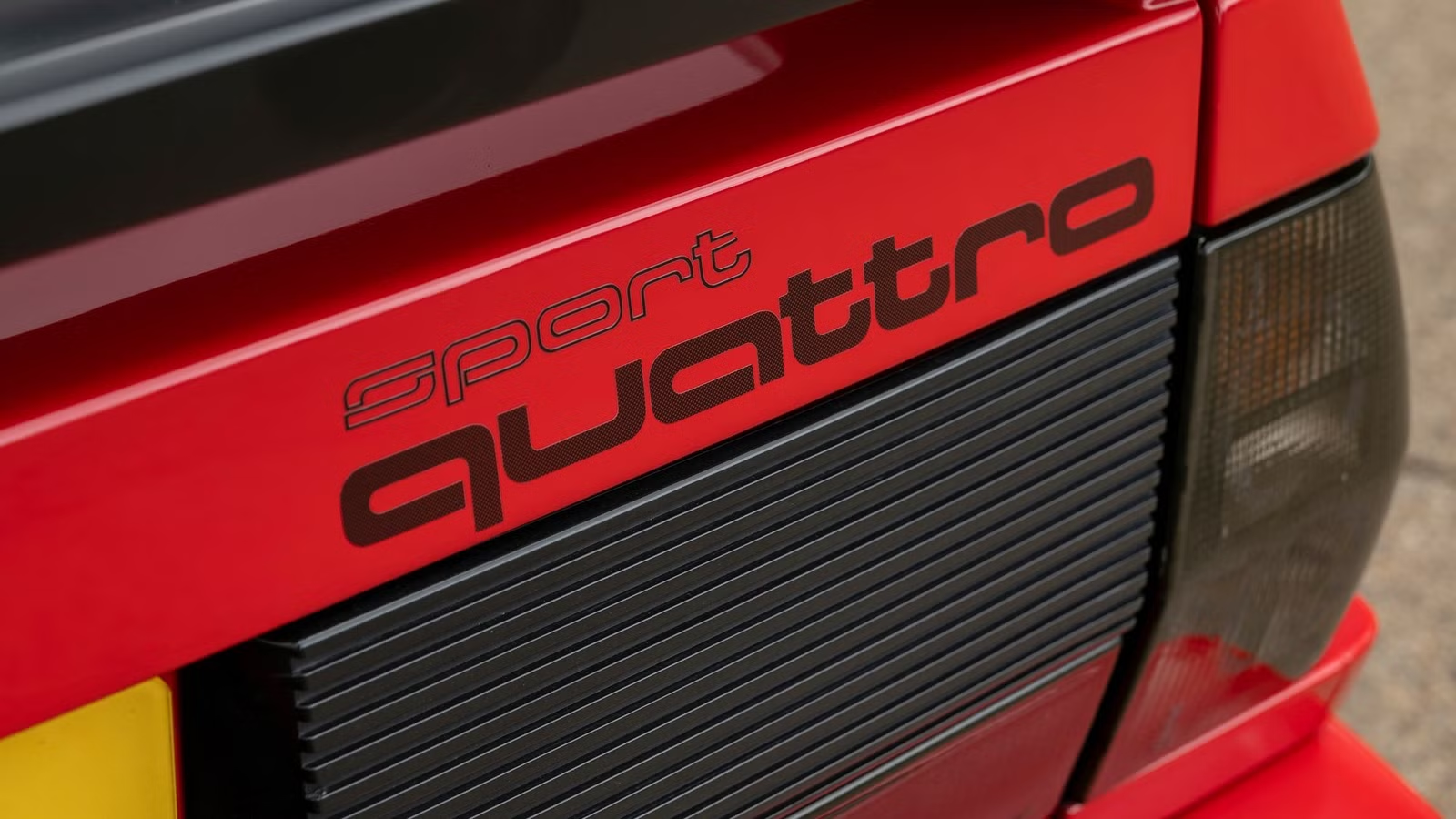
1984 Audi Sport Quattro Red Rear BadgeAudi / CarBuzz
As a testament to the significant increase in the Audi Sport Quattro’s value over the last decade, an example with similar specs, mileage, and condition sold for just $484,000 in 2017. While an unmodified example selling for more than $700,000 should come as no surprise, even modified examples fetch a hefty sum; the only other example sold in 2025 was a modified example that fetched $643,000 at auction.
Audi Tried To Revive The Sport Quattro In 2013
2013 Audi Sport Quattro Concept Exterior Finished In Yellow With Silver WheelsAudi
The Audi Sport Quattro is remembered as one of the German automaker’s greatest hits, and today we look back at it as the first hot-blooded Audi model with a five-cylinder engine at its core.
Decades after production of the Audi Quattro and the more potent Audi Sport Quattro ended, Audi tried its hand at reviving the icon in the form of the Audi Sport Quattro Concept. Debuting at the 2013 Frankfurt Motor Show, this striking two-door hatchback concept was designed as a modern rendition of the Audi Sport Quattro.
1980 Audi Sport Quattro Concept Exterior Finished In YellowAudi
Although its design was worth drawing enough attention, it was the powerplant on which it relied that distinguished it. Unlike the model it was meant to honor, this concept car employed a 4.0-liter naturally aspirated V8 paired with a hybrid drive system, resulting in a total output of 690 hp and 590 lb-ft.
Sources: Audi, Hagerty, RM Sotheby’s, Classic.com
