

The hybrid SUV and crossover market is rapidly becoming a competitive and popular market in the U.S. for a number of reasons. New car buyers are desperately trying to cut their monthly gasoline bills down, even if that means spending more on an efficient car option. The new generation of hybrid technology also makes cars more efficient than ever while still producing impressive performance outputs. Manufacturers from all corners of the globe are so invested in hybridization, that they’re now reeling back their full electrification transition strategies.
Honda is one of these companies, announcing that it would be sticking back to its hybrid roots and focusing on gasoline-electric hybrid drivetrains over fully electric vehicles. Hybrids in the U.S. are more popular than fully electric cars and are starting to outsell some of the most popular ICE options. Toyota’s RAV4 Hybrid has dominated the American crossover market for years, outselling competitors by margins so wide that most automakers have given up trying to catch up. But September 2025’s sales figures tell a different story—one that no industry analyst saw coming.
UPDATE: 2026/06/06
This article has been updated with a closer look at how this hybrid compares to its closest rival.
The Hybrid SUV Market Is No Longer Toyota’s To Lose
2027 Toyota RAV4 front shotTopSpeed | Michael Frank
For years, the hybrid SUV conversation in America had an obvious default answer. Buyers who wanted strong fuel economy, proven reliability, and crossover practicality naturally gravitated toward Toyota, especially the RAV4 Hybrid. It became the benchmark because it offered the exact mix most shoppers wanted: better mileage than a gas-only SUV, fewer charging concerns than an EV, and a reputation for long-term dependability.
TopSpeed | Michael Frank
That dominance made it easy to assume the rest of the segment was fighting for second place. Honda, Hyundai, Kia, Ford, and several other brands have all pushed deeper into hybrid SUVs, but Toyota’s grip on the category has often felt too strong to seriously challenge. The RAV4 Hybrid was not just another competitor; it was the model everyone else had to measure themselves against.
That is what makes the latest sales shift so important. The hybrid SUV market is still growing, but it is no longer moving in only one direction. Buyers are starting to reward comfort, value retention, cabin quality, and daily usability just as much as raw MPG figures. And in September 2025, that change created one of the most surprising upsets in the segment.
The Honda CR-V Hybrid Dominates HEV Sales Charts
Even The RAV4 Hybrid Can’t Keep Up With Its Success
2026 Honda CR-V TrailSport Hybrid front 3/4 shotHonda
Once again, the Honda CR-V Hybrid emerges as the champion of the hybrid crossover and SUV segment for the month of September 2025, besting the likes of the Toyota RAV4 Hybrid. For 2025’s third quarter, Honda confirms that it has sold a total of 358,848 cars. For September in particular, the brand confirmed 28,549 CR-V sales, 54 percent of which were hybrid models. The Honda CR-V Hybrid didn’t just beat the RAV4 Hybrid in September—it demolished it, selling 15,416 units versus Toyota’s 12,830. That’s a 20% advantage in a segment where Toyota was supposed to be untouchable.
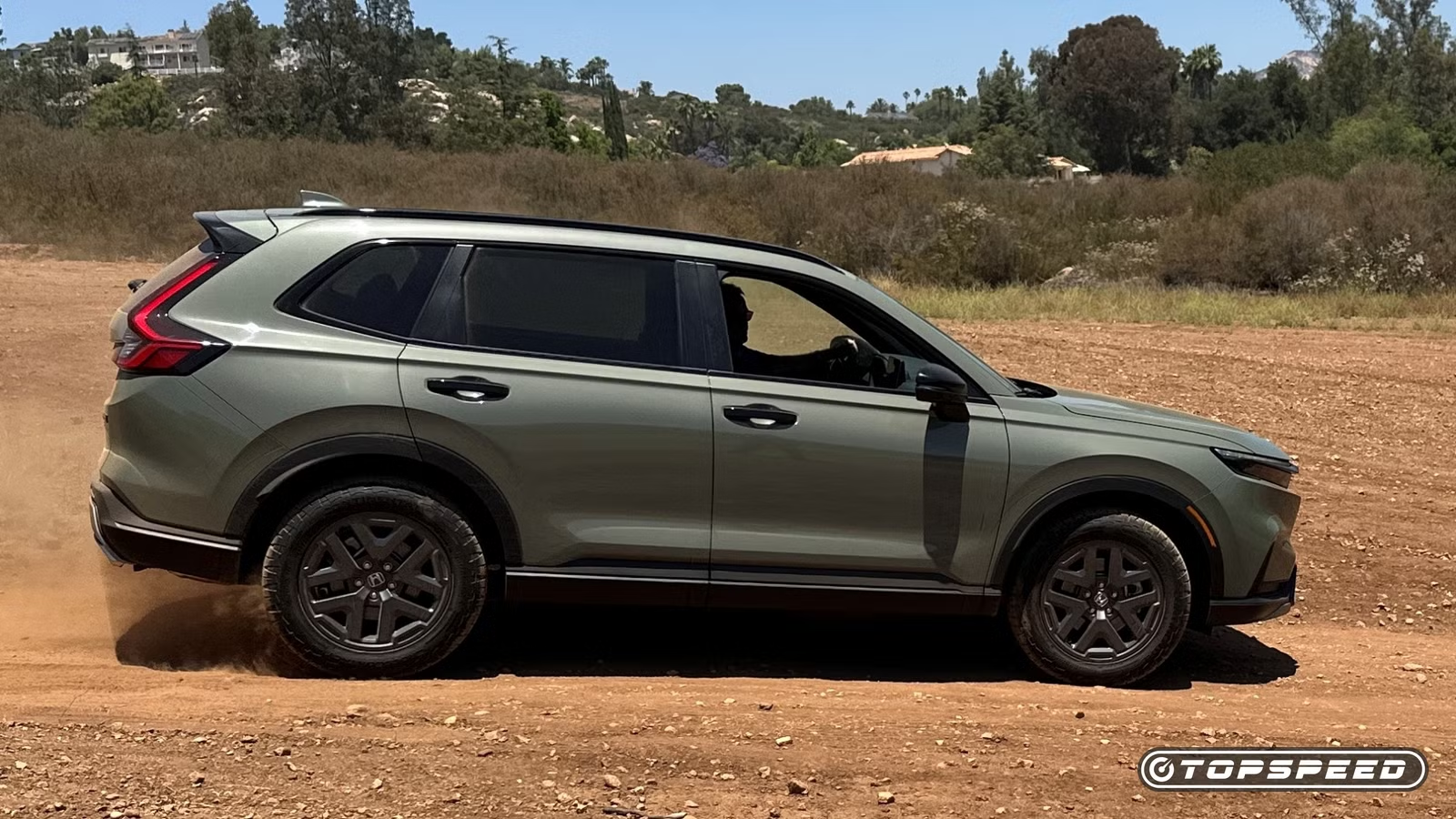
2026 Honda CR-V TrailSport off roadNicole Wakelin | TopSpeed
Honda fails to provide a quarterly sales figure, but it declares an average of 34,166 copies per month for the entire CR-V range, reflecting a 3.1 percent sales increase year-on-year. Year-to-date, the model enjoys a 3.6 percent sales increase, reflecting a steady demand incline. But raw sales numbers only tell part of the story. The real surprise is how Honda achieved this dominance despite a major pricing disadvantage.
Low Cost And Depreciation Contribute To Its Success
2025 Honda CR-V ariel shotHonda
According to Edmunds, the base Honda CR-V Sport Hybrid loses $10,388 of its $35,630 base MSRP over the course of five years and 60,000 miles, which is an incredible value retention rate by midsize SUV standards. Using the exact same metrics, CarEdge indicates that the very same model loses 34 percent of its value, resulting in it being worth $23,507.
2025 Honda CR-V Hybrid True Cost To Own
Year 1
Year 2
Year 3
Year 4
Year 5
Total
Insurance
$723
$748
$774
$802
$830
$3,877
Maintenance
$183
$632
$353
$2,226
$2,279
$5,673
Repairs
$0
$0
$101
$239
$350
$690
Taxes & Fees
$1,834
$93
$93
$93
$93
$2,206
Financing
$2,196
$1,773
$1,316
$827
$300
$6,412
Depreciation
$3,388
$1,705
$1,612
$1,891
$1,792
$10,388
Fuel
$1,195
$1,231
$1,268
$1,306
$1,345
$6,345
True Cost to Own®
$9,519
$6,182
$5,517
$7,384
$6,989
$35,591
iSeeCars holds a similar sentiment with the CR-V Hybrid, highlighting that it will lose 43 percent or $14,755 of its value after five years, resulting in the Japanese HEV SUV earning an 8.0/10 retained value score. J.D. Power gives the exact same model an 85/100 score for resale. Joining this is an 83/100 driving experience, 84/100 quality and reliability, and 81/100 dealership experience score, bringing its overall consumer-verified rating up to 83/100.
That long-term value helps explain why buyers trust the CR-V Hybrid, but Honda’s advantage is not just financial — it also comes from how easy this SUV is to live with every day.
Related
This Is The Used Hybrid SUV To Buy If You Have A Budget Of $30,000
This two-year-old Japanese HEV is a steal if you’re not looking to spend more than $30,000.
204 Horsepower At Your Disposal
The Drivetrain Is Optimized For Efficiency
2024 Honda CR-V Hybrid Sport Touring AWD engineLyndon Conrad Bell | TopSpeed
Honda offers the CR-V Hybrid with a choice of front- or all-wheel drivetrains, both of which produce a combined 204 horsepower and 247 pound-feet to the wheels via a direct-drive eCVT. The brand claims an eight-second 0-60 MPH time for the front-wheel drive model and a 7.6-second time for the all-wheel drive variant. This is a less powerful, and resultantly slower option, compared to the RAV4 Hybrid range.
2025 Honda CR-V Hybrid Performance Specifications
Sport Hybrid FWD
Sport Hybrid AWD
Powertrain
2.0-liter Four-Cylinder And Two Permanent-Magnet Motors
2.0-liter Four-Cylinder And Two Permanent-Magnet Motors
Horsepower
204 HP
204 HP
Torque
247 LB-FT
247 LB-FT
Transmission
Direct Drive eCVT
Direct Drive eCVT
Driveline
Front-Wheel Drive
All-Wheel Drive
Battery
1.1 kWh Net
1.1 kWh Net
0-60 MPH
8.0 Seconds
7.6 Seconds
Top Speed
111 MPH
111 MPH
Towing Capacity
1,000 Pounds
1,000 Pounds
Honda limits both drivetrains to a 111 MPH top speed. The brand opts for a conventional driveline to the rear wheels for its all-wheel drive system. This is opposed to applying an additional electric motor to the rear axle, and explains why the model’s output remains the same, regardless of your preferred setup. In terms of towing, it’s not necessarily the best option that you can consider, as the brand limits its capacity to just 1,000 pounds.
There’s still enough power to climb a long, steep grade without running out of breath, and the CR-V can execute a pass on a two-lane road without much drama.
– Brett T. Evans, CarBuzz Journalist
The CR-V Hybrid may not be the quickest option in the segment, but its real strength appears when that power is paired with its fuel-saving hybrid system.
Impressively Attractive Efficiency Estimates
The Honda CR-V’s hybrid system employs a supplementary 1.1-kWh lithium-ion battery pack, resulting in a pretty impressive 43/36/40 MPG EPA consumption estimate on the city/highway/combined cycle for the front-wheel drive option. The all-wheel drive model returns a slightly worse 40/34/37 MPG result.
2025 Honda CR-V Hybrid EPA Estimates
Front-Wheel-Drive
All-Wheel-Drive
Fuel Consumption (city/highway/combined)
43/36/40 MPG
40/34/37 MPG
Range
560 Miles
518 Miles
Fuel Savings In Five Years
$2,500
$2,000
Annual Fuel Cost
$1,200
$1,300
Cost To Drive 25 Miles
$1.98
$2.14
Cost To Fill The Tank
$44
$44
Tank Capacity
14 Gallons
14 Gallons
The 14-gallon gasoline tank gets you 560 miles of range in front-wheel drive guise, which the all-wheel drive system lowers to 518 miles. Honda’s hybrid system is a series-parallel variation, which means it allows the operation of the electric motor independently. The eCVT runs on a clutch-based system, allowing the motor to act as a generator for auxiliary functions, including the starter and climate control.
Those fuel savings make the CR-V Hybrid an easy rational choice, but its sales success becomes even more impressive when you look at what Honda charges for it.
Where The RAV4 Still Has The Edge
Front 3/4 view of a 2026 Toyota RAV4 Hybrid LimitedToyota
The CR-V Hybrid’s sales dominance doesn’t mean it wins every category, and buyers who cross-shop the two seriously will find a handful of areas where the RAV4 holds a clear advantage. The most significant is towing capacity. The CR-V Hybrid is rated for just 1,000 pounds, which limits its usefulness for buyers who occasionally haul a small trailer, a boat, or recreational equipment. The RAV4 pulls 1,750 pounds at the lower end — not class-leading, but meaningfully more practical for that use case. Higher trims are capable of 3,500 pounds of towing.
Performance is the second gap. The RAV4 FWD’s 226 combined horsepower (236 for the AWD) edges the CR-V’s 204, and that difference is noticeable in the real world, particularly on highway on-ramps and at altitude. The RAV4 also offers a PHEV variant, which gives plug-in buyers an option within the same nameplate. Honda has no direct equivalent to the RAV4 PHEV in the CR-V lineup.
Price remains a factor. The RAV4’s $31,900 starting point undercuts the CR-V Hybrid by nearly $3,800 at the base trim, and while the Honda arguably packs more standard equipment at that price gap, it’s a real consideration for buyers working within a strict budget. The CR-V Hybrid wins the overall value argument at the transaction level, but the RAV4 isn’t conceding the segment without a fight.
Related
Why You Should Only Buy The Hybrid RAV4—Not The Plug-In Hybrid
The Toyota RAV4 outsells every other SUV in America, but did you know there’s a surprising reason to choose the hybrid over the plug-in version?
Pricing Starts At $35,630
Success Despite Being More Expensive Than The Toyota
Rear three quarter shot of a silver 2023 Honda CR-V Sport Hybrid with bikes mounted on its roof, parked on a mountainHonda
The latest CR-V Hybrid range starts at $35,630 for a base Sport derivative in front-wheel drive guise. For reference, the RAV4 Hybrid range starts at $31,900, but this base model isn’t as well kitted out as the Honda. This model comes standard with 18-inch alloy gloss black alloy wheels, roof rails, full LED headlights, and dual exhaust finishers. Within the cabin, you’ll find cloth upholstery with orange stitching for the seats, front seat heating, electronic adjustments for the driver’s seat, a one-touch electronic sunroof, and dual-zone climate control. You also get a nine-inch touchscreen infotainment system connected to a 240-Watt six-speaker audio system, with the added benefit of wireless Apple CarPlay and Android Auto.
2026 Honda CR-V TrailSport dashboardNicole Wakelin | TopSpeed
The Trailsport Hybrid is an all-new configuration that is based on the entry-level model, but with a more adventurous aesthetic to appease would-be wanderers; this is also only available with all-wheel drive. For $38,880, you get features that include:
- Bespoke 18-inch alloy wheels
- All-season floor mats
- All-terrain tires
- An electronic-lifting tailgate
- A 10.2-inch digital instrument cluster
- A heated steering wheel
- An eight-speaker 320-Watt audio system
The Sport-L is essentially a more premium extension of the base model, increasing the price to $38,725. For this, you get leather seat upholstery with orange stitching, memory functions for the driver’s seat, and a wireless smartphone charger.
That higher starting price should have made the CR-V Hybrid a tougher sell, but instead, buyers appear to be rewarding the Honda for feeling like the more complete hybrid SUV.
2025 Honda CR-V Hybrid Pricing
FWD
AWD
Sport Hybrid
$35,630
$37,130
Trailsport Hybrid
N/A
$38,800
Sport-L Hybrid
$38,725
$39,775
Sport Touring
N/A
$42,250
The Sport Touring sits at the very top of the range before options. This flagship derivative includes a hands-free function for the tailgate, a Google-based operating system, and additional driving modes, including Snow, Sport, Economy, and individual. You also get 19-inch gloss black alloy wheels, a Bose premium audio system, and satellite navigation. You can only have this option with the all-wheel drive system. You also need to be mindful of Honda’s $1,350 destination and handling fee, which applies to all CR-V Hybrid models.
Optional extras are minimal, and limited to five visual packages, ranging between $402 to $1,424. These include All Season Protections, the HPD performance-inspired kit, and a utility package. Most of the parts in these packages are also available individually via the accessories catalog. Standard color options include Canyon River Blue Metallic, Crystal Black Pearl, Meteorite Gray Metallic, and Solar Silver Metallic. For $455, you can specify Platinum White Pearl, Radiant Red Metallic, or Urban Gray Pearl.
Source: Edmunds, CarEdge, iSeeCars, J.D. Power, and the EPA.
