

When you get old enough, you start to see cars that were once common on the road of your youth become collectibles, chiefly because enough time has passed for people to covet them. For those who were kids in the 1980s, for example, the Oldsmobile Cutlass was the most popular model sold in the US in 1980, ’81, and ’83, so seeing them on the roads was a very common sight. Nowadays, you’d be lucky to see one or two a year from that era. They’ve also sharply increased in value over the past few years, to boot.
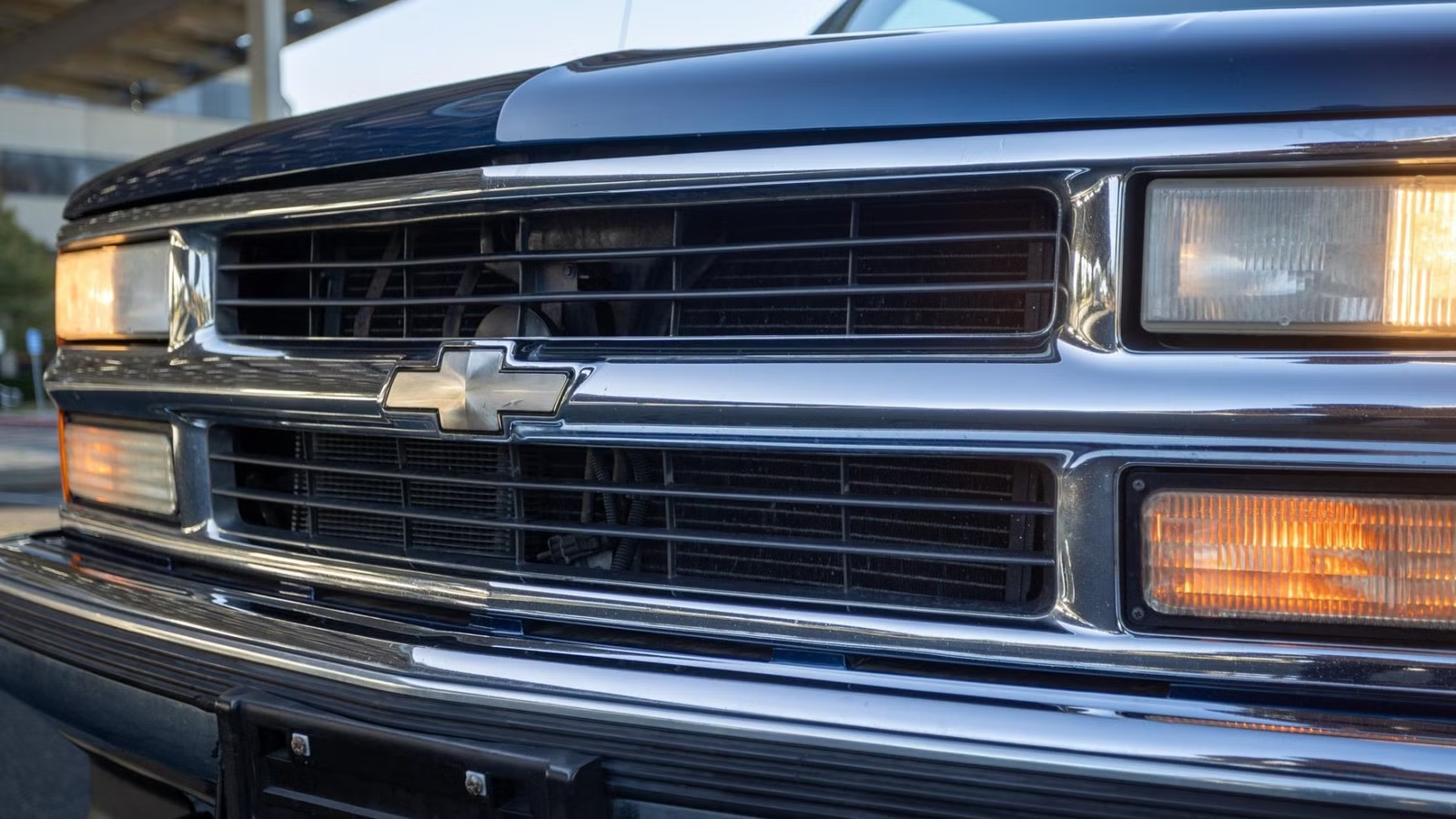
Now, for those a bit younger, you’ll probably remember the sheer number of Chevrolet Suburbans on the road during the 1990s and early 2000s, and how very few are left. As it stands now, the eighth-gen Suburban, built between 1992 and 1999, is enjoying a quiet resurgence in popularity. A few key factors are behind this, but, overall, the eighth-gen Suburban is shaping up to be something of a present-day collector’s goldmine, and here’s why.
1990s Suburbans Were Family-Hauling Powerhouses
1992 Chevrolet Suburban front 3/4 angle in blue and whiteBring A Trailer
By the time the eighth-gen iteration came out, the Suburban name had been in use since the 1930s. It was, and still is, one of America’s favorite full-size SUVs, and the eighth-gen version was especially popular. While nailing down definitive, accurate sales figures for the entire generation is difficult, Chevy sold about 139,000 of them in 1999, which was roughly a 27% increase over the 1998 model year. Using that figure as a guideline, we can surmise that the entire eighth-gen was a massive success for the brand, with some sources indicating a total of 600,000 to 650,000 examples sold.
However, its huge popularity led to one of the major reasons few remain these days. Because they were absolutely everywhere, most folks didn’t really think to save them. SUVs tasked with hauling kids, pets, stuff, and boats around usually lead hard lives and are used as tools rather than as ornaments worth preserving. So, once the family tool is deemed obsolete or no longer of use, it’s replaced by something new. Then the used tool, in this case the eighth-gen Suburban, goes on to be either crushed, parted out, or simply parked to rot for eternity.
Of course, that’s not to say every family treated their eighth-gen Suburban like a pack mule. Many folks carry at least some sense of mechanical sympathy in their hearts and take care of their cars even if they’re not particularly interesting. The great thing about these older eighth-gen Suburbans is their simple construction, which allows them to run for quite a long time without much mechanical intervention. That fact alone was, and still is, enough to garner them a good amount of attention.
Related
The American SUV That’s Older Than The Chocolate Chip Cookie
We’re celebrating the history of America’s longest-running nameplate and SUV. And cookies.
Here’s What Made Them So Good
1995 Chevrolet Suburban 2500 4×4 Lingenfelter White Front Angled ViewBring a Trailer
The crux of the Suburban’s dependability is its simplicity, which begins under the hood. The eighth-gen Suburban offered a choice between three engines. At base level was a 5.7-liter (350 cubic inch) small-block V8. It came equipped with throttle-body injection, a pushrod valvetrain, and both its cylinder heads and block were made of cast iron. Optionally, buyers could spring for a 7.4-liter (454 CID) big-block V8, also sporting throttle-body injection and cast-iron construction.
However, you’d have to pony up for a 2500-series Suburban, which was a heavier-duty version with a thicker frame, larger, eight-lug axles, and a higher towing capacity. The third engine on offer was a 6.5-liter Detroit Diesel turbo diesel V8, which joined the fold in 1994. While you also had to get into a 2500-series Suburban to get the diesel mill at first, this changed in 1995 when Chevy began offering it on the standard 1500 model.
1992 Chevrolet Suburban rear 3/4 angle in white while parkedBring A Trailer
Backing up these engines was one of two automatic transmissions. The base gearbox was a four-speed 4L60 unit, later updated to the electronically-actuated 4L60-E. For 2500-series models or 1500s equipped with the Detroit Diesel engine, the tougher 4L80-E was standard. As for the drivetrain, rear-wheel drive was standard, with four-wheel drive available as an option. Its suspension consisted of a rear live axle supported by leaf springs, and an independent front end that provided a more car-like ride than its predecessor. Its platform, the GMT400, was shared with the Chevrolet/GMC C/K Series pickup trucks and the Chevrolet Tahoe/Blazer and GMC Yukon.
Eighth-Gen Chevrolet Suburban Specs
5.7L NA V8
7.4L NA V8
6.5L Turbo Diesel V8
Horsepower
- 1992–1995: 190 hp
- 1996–1999: 250 hp
- 1992–1995: 230 hp
- 1996–1999: 290 hp
215 hp
Torque
- 1992–1995: 300 lb-ft
- 1996–1999: 335 lb-ft
- 1992–1995: 385 lb-ft
- 1996–1999: 410 lb-ft
440 lb-ft
Max Towing Capacity
7,500 lbs
10,000 lbs
10,000 lbs
Curb Weight
5,200–6,600 lbs
Overall Length
219.5 inches
*Specs courtesy of MotoGallery.com & GMTCentral.com
Reliability
1992 Chevrolet Suburban interior view of the front cabinBring A Trailer
When it comes to dependability, the eighth-gen Suburban scores slightly above average. According to CarSurvey.org, the entire generation scores a 7.7 out of 10 for its reliability, giving it a solid C+. However, while that’s not overly impressive, something to keep in mind with the eighth-gen Suburban is parts availability. Its two gas engines enjoy a huge amount of aftermarket support, even today. That means parts are plentiful and cheap. Not to mention, because the eighth-gen Suburban is, essentially, an older pickup truck underneath, it’s very easy to work on, so those with even a tiny amount of DIY know-how can work on their own ride.
The eighth-gen Suburban does suffer from a couple of common problems, however. The 4L60-E transmission is known to have issues, mainly due to failing solenoids both inside the transmission and on the torque converter clutch. They are also prone to overheating while towing. In addition, the 1996-1999 models equipped with the 5.7-liter engine are known for intake manifold gasket failures, causing coolant to seep past.
Related
Best 9-Seater SUVs Of 2026
These massive SUVs have unmatched space for people and cargo.
Demand For Eighth-Gen Suburbans Is Growing
1995 Chevrolet Suburban 2500 4×4 Lingenfelter White Side ViewBring a Trailer
As we touched on at the beginning of this article, clean examples of the eighth-gen Suburban are dying out. According to an NHTSA study, roughly 87.9% of all light trucks built 25 years ago are no longer on the road, and the eighth-gen Suburban falls into this category. Each day that passes means fewer are around, which drives demand steadily upward. Couple that fact with an overall increase in interest, and you’ve got yourself a recipe for a boom at some point soon.
Another fact to consider is the next generation of collectors: younger Millennials and elder Gen Z-ers. At this point in their lives, they might have some extra money to throw around, and the eighth-gen Suburban is an extremely nostalgic vehicle since many of us grew up with one in or around the family. Tons of road trips, boating excursions, and family outings were had in one, making them especially desirable for folks in the aforementioned age groups.
GMT400 Suburban values have fluctuated over the past year, but there has been a steady increase. For example, in July of last year, the eighth-gen Suburban’s average auction sale price sat right at $12,300 near the middle of the month. On June 1st of this year, though, that average price rose to $15,362, a 20% increase in just under 11 months. Currently, its market seems to be in a dip, as well.
Related
The Next Generation of Classic Cars: 10 Picks Under $30,000
These 10 future classics can all be had for around $30,000.
The Eighth-Gen Suburban Might Be The Next Squarebody
1995 Chevrolet Suburban 2500 4×4 Lingenfelter White Rear Angled View Close-UpBring a Trailer
Many of us grew up either during the age of the Chevy Squarebody pickups, or during a time before the market for them exploded. With all the interest being seen in SUVs from the 1990s nowadays, the market may follow a similar trend. The eighth-gen Suburban is already working to prove that hypothesis correct, as its 20% valuation increase occurred in just over 10 months, and it’s easy to see why.
The SUV offers nostalgia, simplicity, toughness, plenty of modern-day usability, and multiple V8 engine options. In the age of technology and turbocharged four-bangers, who wouldn’t want an old Suburban to tootle around in?
Sources: Chevrolet, GM Heritage, MotoGallery.com, CarSurvey.org, LangdaleFamily.com, Driving.ca, GMTCentral.com, NHTSA, Classic.com
