

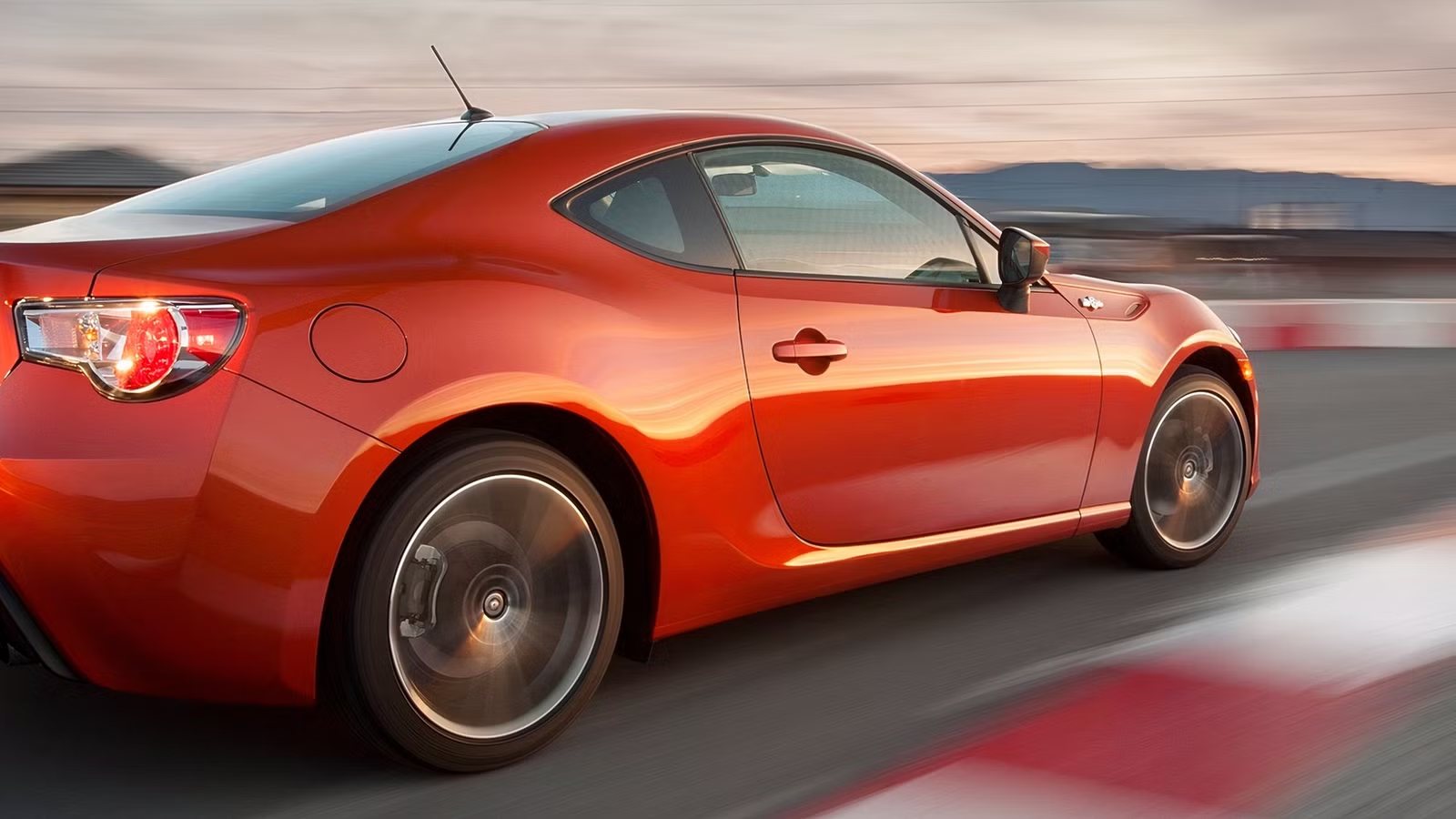
One Saturday morning in 2013, I came across a Hot Lava orange Scion FR-S sitting atop the black tile floor of the Scion section at a Toyota dealership. I remember opening the door and seeing three pedals beneath the dash, not to mention the odd-looking shift lever poking out of the center console. My ten-year-old brain couldn’t comprehend anything apart from how cool this car looked.
If I think hard, I can still feel the seat bolsters against my shoulders and how the steering wheel felt in my hands. I recall this moment from the middle of my head each time I think about what cars made an impact on me as a car-obsessed kid. To me, the FR-S was the orange sports car my dad should’ve bought instead of our Camry. But to Toyota, it represented the company’s tribute to one drifting Corolla it had no idea would become so popular, not to mention its attempt to become cool again.
The Scion FR-S Was All The Car It Needed To Be
The FR-S fulfilled the purpose Toyota gave it when the company first tasked engineers with designing a lightweight sports coupe with an ultra-low center of gravity. The car didn’t need more power to be that much more fun, given that driver engagement isn’t always rooted in power, but in how well the vehicle can dance with the most tender of inputs from its driver.
The FR-S and its Subaru twin, the BRZ, were the poster children of light, affordable sports in the early 2010s. The only direct alternatives at the time were the Mazda MX-5, a two-seat roadster, and the Hyundai Genesis Coupe, a heavier, more expensive vehicle if you opted for the 3.8-liter V6 rather than the turbocharged 2.0-liter four-cylinder.
Toyota teased a twin-charged FR-S that bumped power from 200 horsepower and 151 pound-feet of torque to an intriguing 320 horsepower and 310 pound-feet of torque. We knew Toyota wouldn’t put it into production, but that didn’t stop owners from modifying their cars themselves. Turbo kits were common – which may or may not have led to explosive outcomes. The more common, slightly cheaper modification was to equip new exhaust headers and revise the engine control unit (ECU) to eliminate the 2.0-liter boxer’s mid-range torque dip. If 200 hp was enough to handle in a 2,750-pound car, performance tires, suspension bits, and aero kits were available to squeeze the best out of a bone-stock power plant.
Even if we put aside, for a moment, the power (or lack thereof, if you subscribe to that mentality), the FR-S was a sports car built from the ground up on its own platform, with a unique purpose: to be fun. The engineers who crafted the FR-S and BRZ twins weren’t tasked with making the cars entertaining after they were built to meet other requirements. It was made for smiles from the start. Other models in Toyota’s lineup needed to be robust, people-moving machines that were efficient, spacious, comfortable, and utilitarian. All the Scion brand needed to be was youth-focused, affordable, and fun, the exact requirement of the nameplate’s most iconic model.
Where The FR-S Came From
Apart from the marketing pitch Toyota gave at the car’s launch, the project came about in the same fashion as any other sports car built by Toyota. Akio Toyoda, the company’s then-CEO, wanted a car that paid homage to the original AE86 Corolla’s blueprints of a feather-weight vehicle, available with a rev-happy engine up front, and rear-wheel drive. To accomplish this, engineers took a long walk to the end of Toyota’s heritage collection and studied the company’s first-ever sports car.
The Sports 800 was Toyota’s first attempt at building a sports car, and the reason why you don’t know about it is that Toyota’s subsequent attempt was the 2000GT. The teeny Sports 800 used a two-cylinder boxer engine to produce 44 horsepower and 49 pound-feet of torque in a package that weighed just 1,278 pounds. The idea became part of the formula the FR-S would follow, and rather than build a boxer engine from scratch, Toyota worked out a deal with Subaru and got to work co-developing a powertrain for their torch-bearing sports car.
2013 Scion FR-S 2.0L NA 4U-GSE/FA20 H4 EngineScion
Subaru’s 2.0-liter boxer four-cylinder was given a revised fuel-injection system designed by Toyota, and both cars featured a 6-speed manual transmission as standard, with an optional 6-speed automatic with paddle shifters. The FR-S was the first Toyota vehicle to feature a boxer engine and rear-wheel-drive layout since the Sports 800, and it even included design cues familiar to anyone who’s studied the 2000GT’s greenhouse.
Toyota and Subaru used their new sports cars to remind buyers that they could still be fun. Specifically for Toyota, even after the Scion brand folded and the FR-S was sold as the Toyota 86, it brought about a new generation of modern performance cars from the automaker. Both the GR Supra and GR Corolla owe their existence to the FR-S, since it put eyes back on Toyota after a period of producing strong-selling, yet fairly boring cars.
Scion FR-S Price Guide
Scion FR-S Release Series 1.0, frontToyota
Both original and modified examples of the FR-S see similar prices depending on age and mileage. The biggest factors influencing values are miles driven and overall condition, with any modifications increasing value if the car is otherwise pristine, or plummeting the price if the mods were done poorly. Prices for unmolested cars with high miles range between $11,000 and $14,000, while low-mileage, tastefully modded cars go for closer to $20,000.
The FR-S was around long enough for there to be special edition models. A handful of limited-production variants were produced, the rarest of which is the FR-S Release Series 1.0. Only 1,500 units of this model were made in 2014, each with a bright coat of yellow paint and other visual distinctions from basic models, such as chrome exhaust tips and a TRD suspension setup with snazzy wheels. Expect to pay around $20,000 when one comes up for sale.
Also for 2014 were 2,000 FR-S Monogram editions, which added leather and Alcantara seats, as well as other luxury features like dual-zone climate control, push-button start, and navigation. Not many come up for sale, so it’s hard to assess any appropriate price. Scion produced 10,000 10th Anniversary Editions across each of its models, 2,500 of which were for the FR-S. These models got illuminated badging, silver seat belts, and an illuminated shift knob. Prices range from $13,000 to $18,000 for these models.
Where The 86 Picked Up After Scion Dropped Off
2017 Toyota 86 front end in red driving in snowToyota
Starting for the 2017 model year, the Scion FR-S was rebadged as the Toyota 86. Nothing changed beneath the skin, but Toyota gave the front and rear ends a makeover that should last a few more years before returning to the drawing board. Power was up 5 horsepower in the new car, but that wasn’t the kind of power upgrade many were looking for. By this time, the word Supra was already on the tongues of the press, and any mention of the 86 needing more power might crimp the Supra’s style, even though it would go on sale a few years later with no manual transmission and cost twice as much.
By 2021, the 86’s interior was a decade-old design that didn’t receive the trimmings it needed to stay fresh, nor was the added power enough to quench the thirst of the next round of enthusiasts looking to score the next-generation 86. The GR86 arrived for the 2022 model year with more than just a different face, and enough performance to put any doubts to rest for the time being. Toyota’s mission to provide a cheap, lightweight sports car remained, and the redesigned model put up a stronger fight than it had before.
2022-2025 Toyota GR86 Red Front Angled View Track DriftingToyota
There was 228 hp from a larger 2.4-liter boxer four-cylinder going to the rear tires. Where the current GR86 sits in Toyota’s 2026 lineup is a long way from where the original FR-S sat. It was on its own in a world of FWD sedans and crossovers at Toyota dealerships, but the sports car gained some roommates over the years with the Supra in 2019 and the GR Corolla in 2022.
The FR-S may not exist today in the formal sense, but its transformation into the GR86 over 13 years is a remarkable effort made by a brand to continue selling an impractical, low-volume sports car. Should the FR-S have been a Scion-only venture, it would have lived a short 3 years before dying with the rest of the brand.
If any other brand started as late as Toyota did to build a sports car only to dissolve the brand it sold under, it wouldn’t have survived as long as it did. Toyota already had plans to introduce more sports cars back into the lineup and thought it best to continue making the two-door sports coupe to diversify not only its entire portfolio but also its sports car offerings.
Sources: Toyota, Autoweb
