

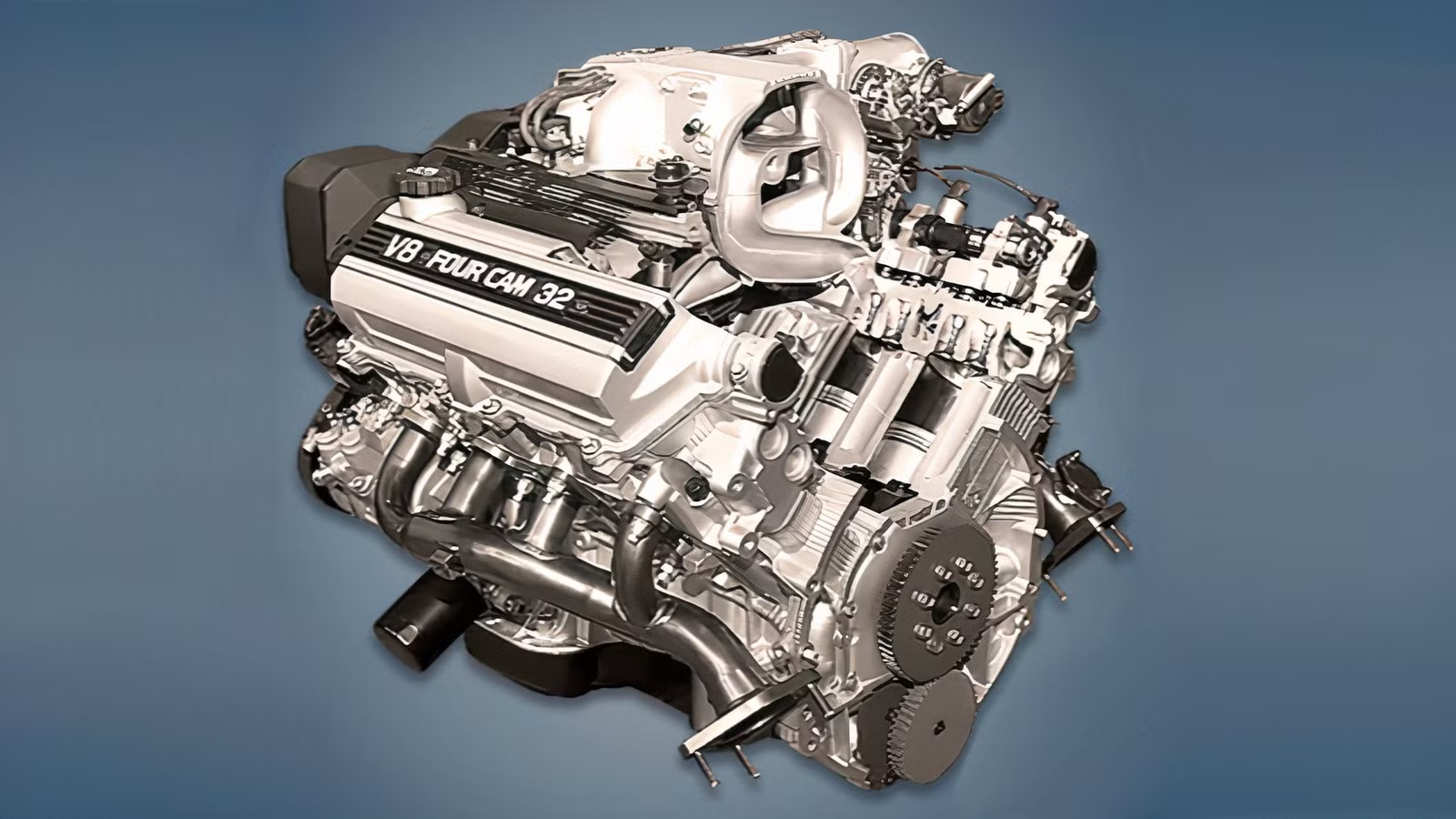
It was 1989 when Toyota launched Lexus and debuted the 1UZ engine—an all-aluminum 32-valve V8 that quite literally redefined what a luxury car engine could be. The duty that it served during this time is what underpinned the powertrain as one of the greatest naturally aspirated V8s ever built, first making an appearance in the new brand’s first model, the very first Lexus LS.
Toyota’s UZ family of engines essentially comprises three members, with the 1UZ being the first. And while the 1UZ has been out of production now for over two decades, it’s still being swapped into everything from drift cars to kit cars and everything in-between. Here’s why.
This article explores the specifications and history of the Toyota 1UZ-FE engine, as well as common problems and applications. Information is correct at the time of writing.
The Toyota UZ Engine Family
Are All Of Toyota’s V8s Legendary?
The UZ engine family consists of three different engines, namely the 1UZ-FE (4.0-liter), 2UZ-FE (4.7-liter), 3UZ-FE (4.3-liter). The 1UZ launched the UZ family in 1989 and was specifically designed for the Lexus LS 400. Toyota’s ambition here was to build a V8 that was quieter and lighter than anything BMW or Mercedes-Benz was manufacturing at the time. Of the three, the 1UZ is still the most celebrated of Lexus’ UZ V8s.
1UZ Engine Specs
Toyota 1UZ-FE engine, view of engine in darkness, engine block topToyota
Toyota 1UZ-FE Engine Specifications
Variant
1UZ-FE (Non-VVT-i)
1UZ-FE (VVT-i)
Displacement
3,968 cc
3,968 cc
Configuration
32v DOHC
32v DOHC
Bore x Stroke
87.5 x 82.5 mm
87.5 x 82.5 mm
Compression
10.0:1
10.5:1
Ignition
Distributor
Coil-on-plug
Production
1989-1997
1998-2002
The 1UZ-FE was unusually advanced for 1989, with its all-aluminum block and cylinder heads keeping weight low in an era when most V8s still relied on cast iron construction. It featured cast-iron cylinder liners that were inserted into the aluminum block, which were crucial for longevity, thus resulting in the kind of long-term bore integrity that would define the unit’s reputation for reliability. Its 32-valve DOHC architecture gave it a high-revving character that was uncommon in luxury V8s of the time, and its 90-degree V-configuration contributed to the astonishingly low NVH levels that left journalists and consumers stunned at launch.
The earlier non-VVT-i engine featured ignition via a distributor, while the later VVT-i engine featured individual coil-on-plug ignition and variable timing on the intake cam. One crucial maintenance item to pay attention to in both generations was the use of a timing belt as opposed to a timing chain, a non-issue if the vehicle has been correctly maintained.
1UZ Power Output
For a naturally aspirated luxury V8 of its era, the 1UZ horsepower outputs were impressive, and the VVT-i unit pushed the envelope further still. Export-spec non-VVT-i units produced 250 hp, while JDM versions were rated at 260 hp. With the introduction of variable intake cam timing, the power figure rose to 290 HP, a power figure that most certainly wasn’t out of place among European rivals. Torque outputs were strong, too, with the VVT-i models producing 300 lb-ft, which was more than enough to give the LS 400 effortless composure on long-distance journeys.
Toyota 1UZ-FE Power and Torque Outputs
Variant
1UZ-FE (Non-VVT-i) Export
1UZ-FE (Non-VVT-i) JDM
1UZ-FE (VVT-i)
Power
250 hp
260 hp
290 hp
Torque
260 lb-ft
264 lb-ft
300 lb-ft
Peak rpm
5,400 rpm
5,400 rpm
6,000 rpm
Lexus And Toyota Applications Of The 1UZ Engine
Lexus
The Toyota UZ engine made its debut in the Lexus LS 400 in 1989, a vehicle that caused shock waves throughout the industry thanks to its remarkable refinement and statement of intent—namely taking on the Germans at their own game. The 1UZ continued through two generations (UCF10 and UCF20) until 2000, at which point the powertrain had also made its way into the SC 400 grand tourer from 1991, as well as the GS 400 sport sedan from 1993. The second generation of the GS, introduced in 1998, made use of the more powerful VVT-i variant of the engine. From 1996 to 1997, the LX 450 also carried the 1UZ, albeit briefly, before the larger 2UZ took its place in the LX 470.
Toyota
Several JDM flagship models were powered by the 1UZ, running parallel to their Lexus equivalents in the US. The Celsior was the direct equivalent of the LS 400, making use of the same platform and engine across both of its generations. Both non-VVT-i and VVT-i versions were used in the Crown Majesta across S140 and S170 generations, and the Soarer Z30 was an exact mirror of the SC 400 in the Japanese market. The last Toyota to make use of the 1UZ was the V8 Aristo, somewhat less celebrated than its 2JZ sibling but arguably just as significant.
1UZ Tuning And Aftermarket Potential
One of the 1UZ-FE’s drawcards is just how well it responds to modification, suggesting just how confident Toyota were in the fundamental architecture of the engine. In standard form, it was modestly tuned, allowing for quite a bit of headroom for more power to be extracted. Intake and exhaust bolt-ons, as well as forced induction by way of turbocharging and supercharging, yield significant gains, all of which are well-documented among the 1UZ community. It’s the combination of the cast iron-lined block’s dependability as well as tuning flexibility that has really kept the 1UZ relevant in drifting, motorsport and kit cars long after the engine’s discontinuation.
Reliability; Known Strengths & Maintenance Items
The 1UZ’s reliability is legendary; documented evidence of examples having clocked well over 250,000 miles on original internal components is not uncommon, and there have been no known endemic failures of the ilk that haunt some of the engine’s contemporaries. No notorious head gasket issues, no spun rod bearing patterns, and not even a hint of piston or bore wear issues, the latter as a result of the cast-iron liners placed in the aluminum block.Known maintenance items can be predicted, so they aren’t too problematic or overly expensive. A timing belt and tensioner service at 60,000-mile intervals, as well as some attention to coolant pipes on higher-mileage examples, is well-advised. Distributor caps are also something to take a look at on pre-VVT-i vehicles.
1UZ vs 2UZ: Which Is Better?
One should consider that these two engines were designed with different briefs in mind. The 1UZ is more architecturally sophisticated, being a twin-cam, 32-valve, high-revving unit tuned to accommodate the demands of a refined, luxury vehicle. By contrast, the 2UZ is a SOHC 16-valve engine with a larger displacement of 4.7 liters, optimized for low-end torque and long-term durability in high-load applications—perfect for vehicles such as the Land Cruiser 100 or Tundra. Interestingly, the 2UZ produces slightly less peak power than the VVT-i 1UZ, despite its larger displacement.
Toyota 1UZ-FE & 2UZ-FE Comparison
Engine Name
1UZ-FE
2UZ-FE
Displacement
3,968 cc
4,663 cc
Valvetrain
DOHC 32v
SOHC 16v
Peak Output
290 hp
282 hp
Character
High-revving, refined
Torque-biased, load-rated
Best application
Luxury passenger cars
SUVs and trucks
Legacy And Collectibility Today
When the 1UZ arrived on the scene, it was intended to ruffle feathers and prove a point, and it seemed to do so by exceeding all expectations of it. The ultimate testament to its engineering is the fact that the swap community has been actively seeking out and installing the unit into vehicles despite it having been out of production since 2002. From a collector’s perspective, well-maintained LS 400s and SC 400s are appreciating in value, a significant factor of this being the 1UZ beneath their hoods.
Related
The Most Reliable Toyota Engine Of All Time
Select older Toyota engines are synonymous with longevity and solid reliability. But which one is considered to be the most reliable of all time?
FAQs
What car has a 1UZ engine?
The 1UZ-FE engine was used in a number of Lexus and Toyota models between 1989 and 2002, most notably the LS 400, SC 400, and GS 400. It was also found in the Toyota Celsior, Crown Majesta, Soarer, and V8 Aristo.
How much hp does a 1UZ have?
The 1UZ produces between 250 HP and 290 HP, depending on the variant and the market specification. The most powerful version is the later VVT-i-equipped engine, the power increase being courtesy of variable timing on the intake cam.
Is the 1UZ the most reliable V8 ever?
The 1UZ makes a compelling case for the world’s most reliable V8, given its reputation for hassle-free motoring well past the 250,000-mile mark on original internal components. Add to this the fact that maintenance on these engines is rather straightforward, and you’d be hard-pressed to find another V8 that offers similar reliability and affordable maintenance in equal measure.
Is the 1UZ or 2UZ better?
It isn’t necessarily fair to compare these two engines owing to the fact that their intended purposes differ somewhat. Technically, the 1UZ is more refined and technically advanced, despite being the older unit. The 2UZ’s focus is torque and durability, as evidenced by the SUV and truck models that it can be found in.
Sources: Lexus, ClubLexus, Lexus Owner’s Club
