

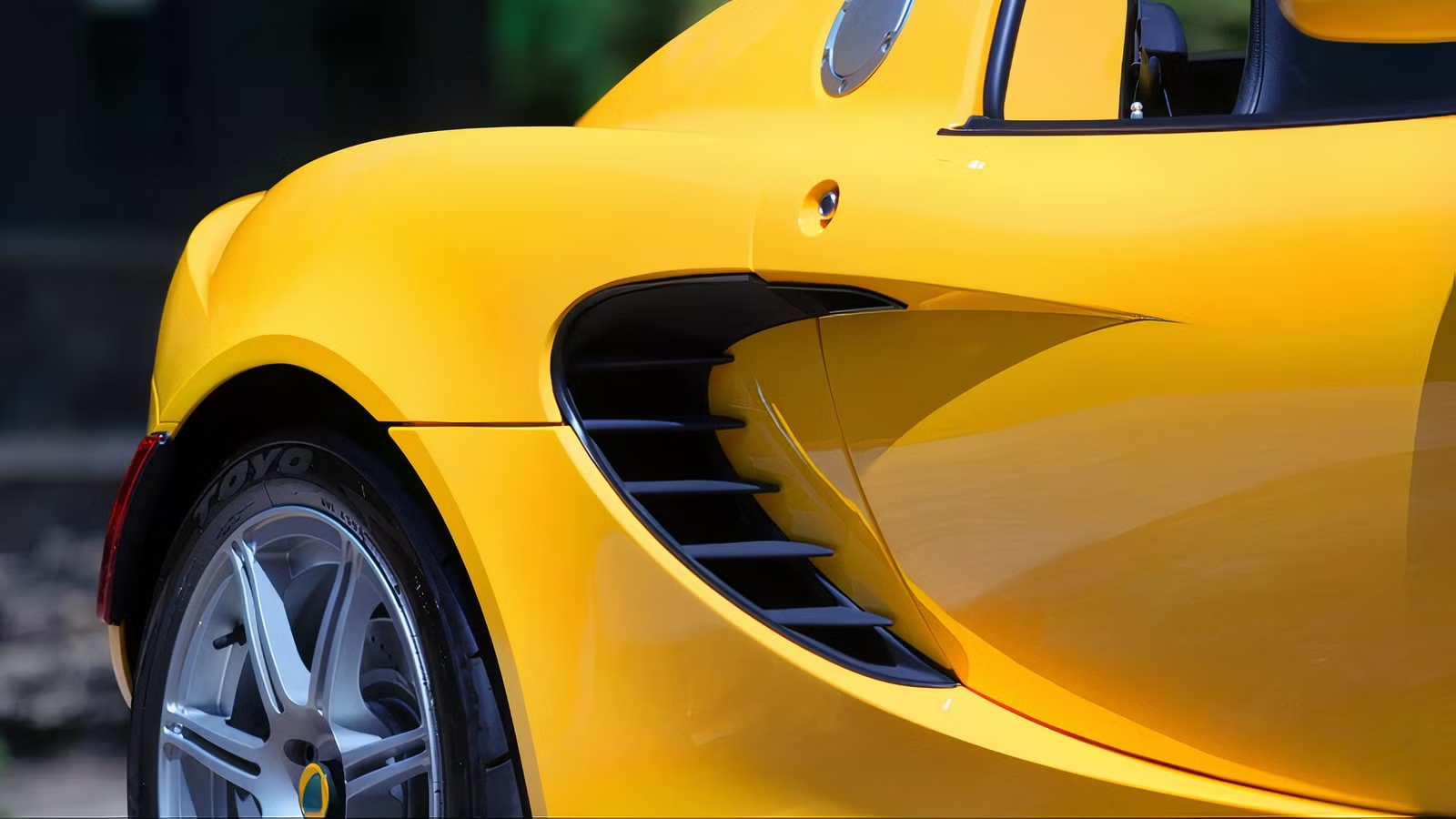
Finding a truly pure sports car in today’s market is harder than ever. Manufacturers keep adding weight, technology, and driver aids until the raw, analog experience that made these machines special in the first place is all but gone. That makes the used market increasingly compelling — and one car in particular stands out as a genuine time capsule of what a sports car should feel like: the Lotus Elise S2. Light, focused, and built around a bulletproof Toyota engine, it remains one of the most rewarding driver’s cars money can buy, new or used.
The British have long had a gift for building drop-top two-seaters that prioritize feel over comfort. The catch, historically, has been reliability — British sports cars from every era have a well-earned reputation for encouraging their owners to get cozy with a wrench, a local mechanic, and an open wallet.
One model, however, decided to buck that trend in the early 2000s by pairing the classic British sports car formula with ultra-reliable Japanese engineering. No, it’s not the Miata — it’s Mazda’s way more focused, lighter, and all-round better British alternative: the Lotus Elise S2.
Everything A Lotus Sports Car Should Be
lotus elan front yellow on a trackLotus
We’ve all heard the old saying, “simplify, then add lightness,” and for good reason. That wasn’t just an interesting quote plucked from Colin Chapman’s – founder of Lotus Cars – mouth; it was the ideology behind his now-storied brand. His earliest road cars embodied this perfectly, the Lotus Seven and Elan, both weighing considerably less than the first-generation Miata, thanks to minuscule dimensions, a complete absence of anything unnecessary, and very modest powertrains.
Lotus Elise Series 1 (1996-2001)Lotus
While this ethos has certainly departed from Lotus in recent years — the British automaker having turned to electrification and even SUV manufacturing — the philosophy remained firmly at the brand’s core when work on the original Elise began.
The cabin was dominated by exposed metalwork, the seats were paper-thin, and there was nothing in the way of electronic assistance. No ABS, no power steering, no airbags, and not even the suggestion of air conditioning or power-adjustable anything. Sadly, this stripped-back sports car was kept from American shores, although the revised Series 2 model did eventually make its way over.
The Elise S2 Improves Upon Perfection
Front shot of a yellow 2005 Lotus Elise.Bring A Trailer
Elise S2
Engine
1.8-liter naturally aspirated inline-four
Transmission
6-speed manual
Power
189 horsepower
Torque
138 lb-ft
0 to 62 mph
4.8 seconds
Top speed
150 mph
Largely, the S2 Elise looked very similar to its predecessor, save for a happier front fascia and a more sculpted rear end. The cabin was still sparse, luxurious amenities were still nowhere to be seen, and the powertrain was still decidedly modest. However, with a curb weight of just 1,975 pounds — some 100 lbs or so lighter than an ’89 Miata — there really was no need for a high-performance engine.
Instead, the Lotus Elise, which arrived on US shores for the 2005 model year, sported a Toyota-derived inline-four engine. Unlike base-model examples sold in Europe, the entry-level US Elise produced 189 hp, which was enough to propel the diminutive two-seater from 0 to 60 mph in just under five seconds, and it would carry on all the way to 150 mph if you kept your foot in it.
Rear shot of a yellow 2005 Lotus Elise.Bring A Trailer
That’s plenty of performance for your favorite back road, and it’s on those twisty country lanes where the nimble chassis really comes alive, delivering far more smiles-per-mile than any 500-hp super- or muscle car, which would only be able to tiptoe through the same playful corners.
Be Careful — Not Every Elise Beats With A Japanese Heart
A word of warning for our non-American readers. Not every Elise was created equally — before the Toyota 2ZZ engine arrived, the Elise was powered by the infamous Rover K-Series unit. There’s no need to drag it entirely through the mud: it produces up to 190 hp in some applications, and when properly maintained, can prove to be a solid powertrain.
Engine shot of a yellow 2005 Lotus Elise.Bring A Trailer
However, it does have a reputation for being temperamental. The Rover unit is a common culprit of overheating and head gasket failure, and while that may be more in keeping with the traditional British sports car ownership experience than the wonderfully dependable Toyota unit, it’s not exactly ideal for those who prefer driving to tinkering.
The changeover from Rover to Toyota power came with the 2005 model year, which means American shoppers are safe from the less favorable Rover unit. Both engines displace 1.8 liters and produce similar outputs, depending on the exact specification.
Lotus Thrills On A Camry Budget
Nose shot of a yellow 2005 Lotus Elise.Bring A Trailer
So, not only is the Elise S2’s engine wonderfully reliable — with some examples having covered well in excess of 200,000 miles — it’s also remarkably cheap to maintain. To fans of the ZZ family of engines this will come as no surprise, as a number of proven cars have been built around this engine, including the RAV4, MR2 Spyder, and Celica GT. These are typical Toyotas with typical Toyota running costs, and that benefit passes straight into the hands and wallets of Elise owners.
Shifter shot of a yellow 2005 Lotus Elise.Bring A Trailer
Most owners will be mechanically minded and will tackle routine servicing such as oil changes and filter renewals themselves, saving on labor costs. Other expenses include tires — more so for the enthusiastic driver — and consumables such as rotors and pads. Generally, owners report maintenance costs of below $1,000 per year, and that figure reflects preventative measures as well, rather than just adhering to the manufacturer’s service schedule.
Here’s How Much You’ll Spend
Steering wheel shot of a yellow 2005 Lotus Elise.Bring A Trailer
Lotus Elise S2 Pricing Overview
Hagerty Good Condition Value
$33,500
Recently Sold Examples
- 2005 Lotus Elise — 78,000 miles — BaT: $30,500
- 2005 Lotus Elise — 36,000 miles — BaT: $42,000
- 2005 Lotus Elise — 18,000 miles & 1 owner — BaT: $60,000
So, keeping an Elise running and driving in great order need not break the bank — but what about buying one in the first place? Considering that the S2 arrived with an original MSRP of $39,985, you might assume that two decades of depreciation has made these wonderfully affordable. Wishful thinking. As is usually the case with well-crafted driving toys, the residual values of these cars are impressively solid, and buying one today can easily cost as much as a new one did when it launched.
Alloy wheel shot of a yellow 2005 Lotus Elise.Bring A Trailer
Previously damaged, repaired, or “story” cars will be the cheapest, but still expect prices north of $20,000 for even the roughest running and driving example. Cars you’d actually want to own start at around $30,000, though they may carry higher mileages at that price point — high mileage being relative for this type of car, so a sub-100,000-mile example is still findable here.
Clean cars with modest miles, solid service histories, and desirable specifications can easily command near-original asking prices — around $40,000 or more. For the very best examples, add another $10,000–$20,000, and you’ll secure a collector-grade future classic. Sure, it’s a significant outlay, but if it’s a weekend toy you’re after, this is about the most focused machine you can buy for GR86 money. The best part: keep it in good condition, and you’ll likely not lose a penny when the time comes to sell — and you’ll be grinning every single time you drive it, and every time you service it, thanks to those comically low running costs.
Sources: Lotus, Bring A Trailer, Hagerty, Lotus Talk.
