

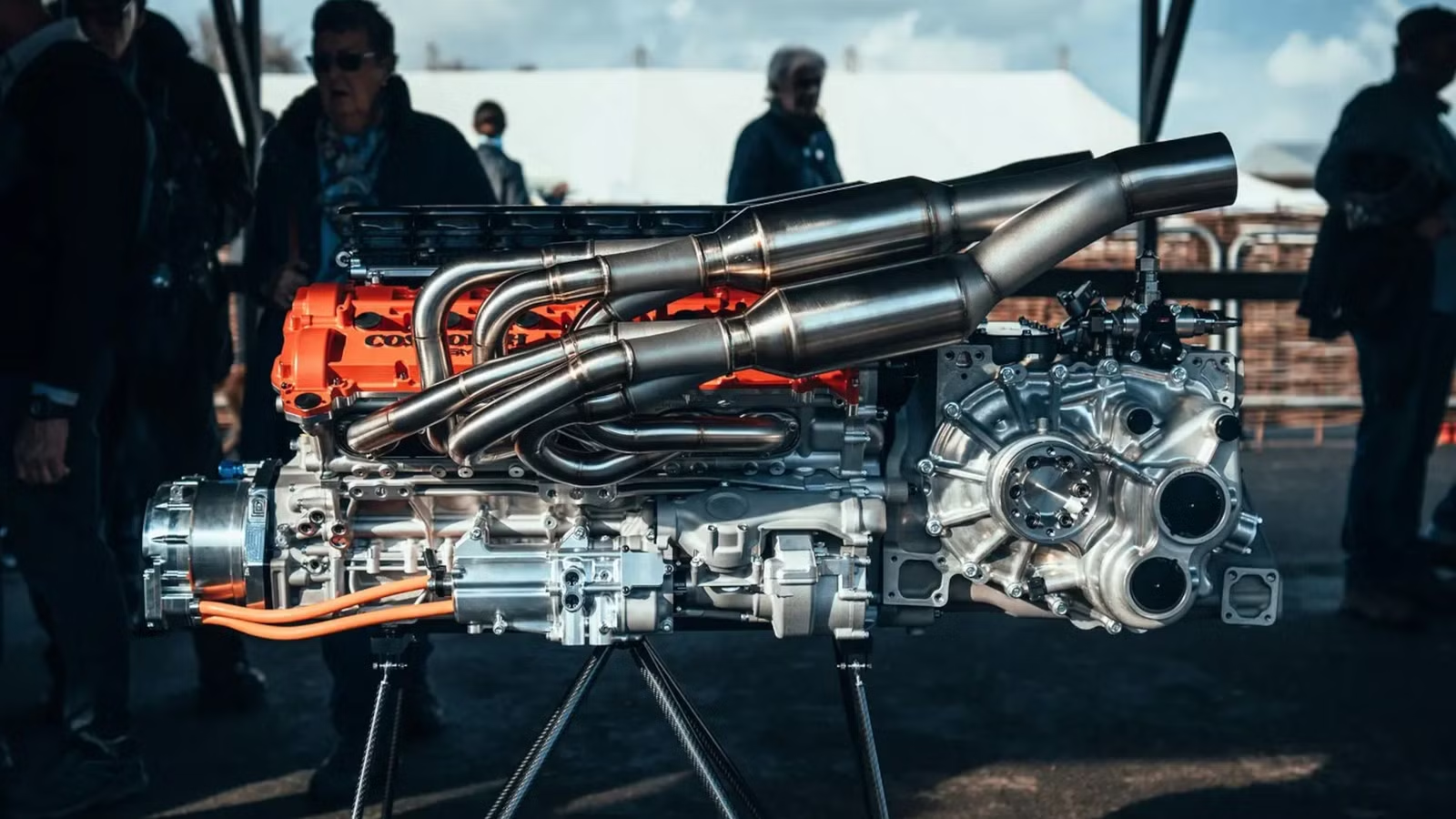
With cars being so subjective, there aren’t many ‘bests’ that can truly be justified. It’s safe to say, though, that Cosworth is the best engine manufacturer if you’re a high-performance brand looking for the absolute pinnacle of engine technology. Working with Gordon Murray Automotive, Aston Martin, and Red Bull, among many others, the British company has been able to harness its rich history in motorsport to develop road engines, even if it isn’t at the top flight of motorsport anymore. CarBuzz caught up with Commercial Director Chris Willoughby at this year’s Goodwood Festival of Speed, and learned that he feels Cosworth is in a golden era equal to that of its F1 peak.
A New Golden Era Driven By Engineering Passion
The T.50 is legendary designer Gordon Murray’s modern take on his classic McLaren F1, long considered to be the greatest car on the planet. The T.50’s Cosworth V12 revs to more than 12,000 rpm.Gordon Murray Automotive
While the public might have looked around and saw the Cosworth DFV engine in Formula 1 and later the Ford Cosworth partnership, its operations are slightly more exclusive nowadays. It focuses on the bleeding edge of technology in some of the world’s most exclusive cars. Examples include the Red Bull RB17’s wild V10 engine that revs to 15,000 rpm, the GMA V12 and its sky-high 12,100-rpm redline, and pushing the boundaries with a V16 engine for the new Bugatti Tourbillon.
With the Cosworth name now thrust back into the limelight, we asked whether Cosworth was in a golden era that could compare to its F1 glory days. According to Willoughby, who was there for both phases of the brand’s success, and the low points in between, the passion around the factory is just as strong as it was at the height of its F1 success.
“With cars like the [Aston Martin] One-77 and the Valkyrie at Goodwood and beyond, the place has definitely got a real buzz back to it.”
– Chris Willoughby, Cosworth Commercial Director
According to Willoughby, who joined the operation in 1990, the golden era of Cosworth in F1 is equal to its current successes. “We won races with Senna and championships with Schumacher, and the place had a real buzz about it then,” he says. “I’d say the place has the same buzz about it now.” He mentions a time in the 2000s where the company focused on consultancy as a slightly less exciting time in the history, but with its latest projects, the feeling of success is back.
Cosworth’s Latest Projects Are Worthy Of The Excitement
Building the world’s coolest and most advanced engines doesn’t happen when you don’t have a team on your side. Cosworth’s latest dynamic debut at the Goodwood Festival of Speed was the Red Bull RB17. Built in collaboration with the Formula 1 team and legendary designer Adrian Newey, a V10 designed by Cosworth was chosen as its beating heart. Hearing it in a natural environment instead of the dyno is something Willoughby says was extra special.
“In the dyno, you’ve got three layers of glass and a science exhaust, so to actually hear it for the first time, it sounds amazing, and it references the 90s Formula One era,” Willoughby explains with a smile. “I think there’s an emotional side of making a V10 for this car, particularly given the nature of it. It’s something everyone’s pretty behind.”
Designing and building these engines takes a huge amount of time, and Willoughby even mentions that the company had thought about the engine for a year before it started to formally design anything. The GMA T50’s V12 is one of the fastest revving engines ever produced, and the Aston Martin Valkyrie’s V12 weighs only 451 lbs. Such stats aren’t only important for the brand, but could slowly influence regular engine design.
CarBuzz Insight — Why Companies Like Cosworth Still Matter
2024 GMA T.33 Cosworth 4.0L NA V12 Engine SideGMA
For most people, a brand like Cosworth doesn’t have any impact on their everyday lives. But as enthusiasts, we know that the most extreme engines usually represent what will come next in our mass-market engines. Cosworth pioneered some of the first mass-produced four-valve engines, and the 1960s DFV engine was designed to be a structural part of the chassis, something you see in modern cars like the Porsche Carrera GT.
“I think the RB17 is the first road car to use air valve spring technology, which is only found in F1 at the moment,” Willoughby says. “You have to also be conscious of the fact it won’t always be operated by a team of engineers, too.” Cosworth may be looking to improve internal combustion engines, but it’s also looking out for its carbon footprint while doing so, pioneering hydrogen, hybridization, and even synthetic fuel to future-proof combustion engines.
For an engine manufacturer as steeped in history as Cosworth to be seeing a resurgence like this is special. For the last few years, shifting legislation has made enthusiasts feel targeted as global governments try to take away the combustion engine we love so much. But seeing Cosworth growing from strength to strength and developing wilder and wilder engines instead of the cookie-cutter formulas so many mainstream automakers follow gives us hope that the best years for the combustion engine still lie ahead of us.
