

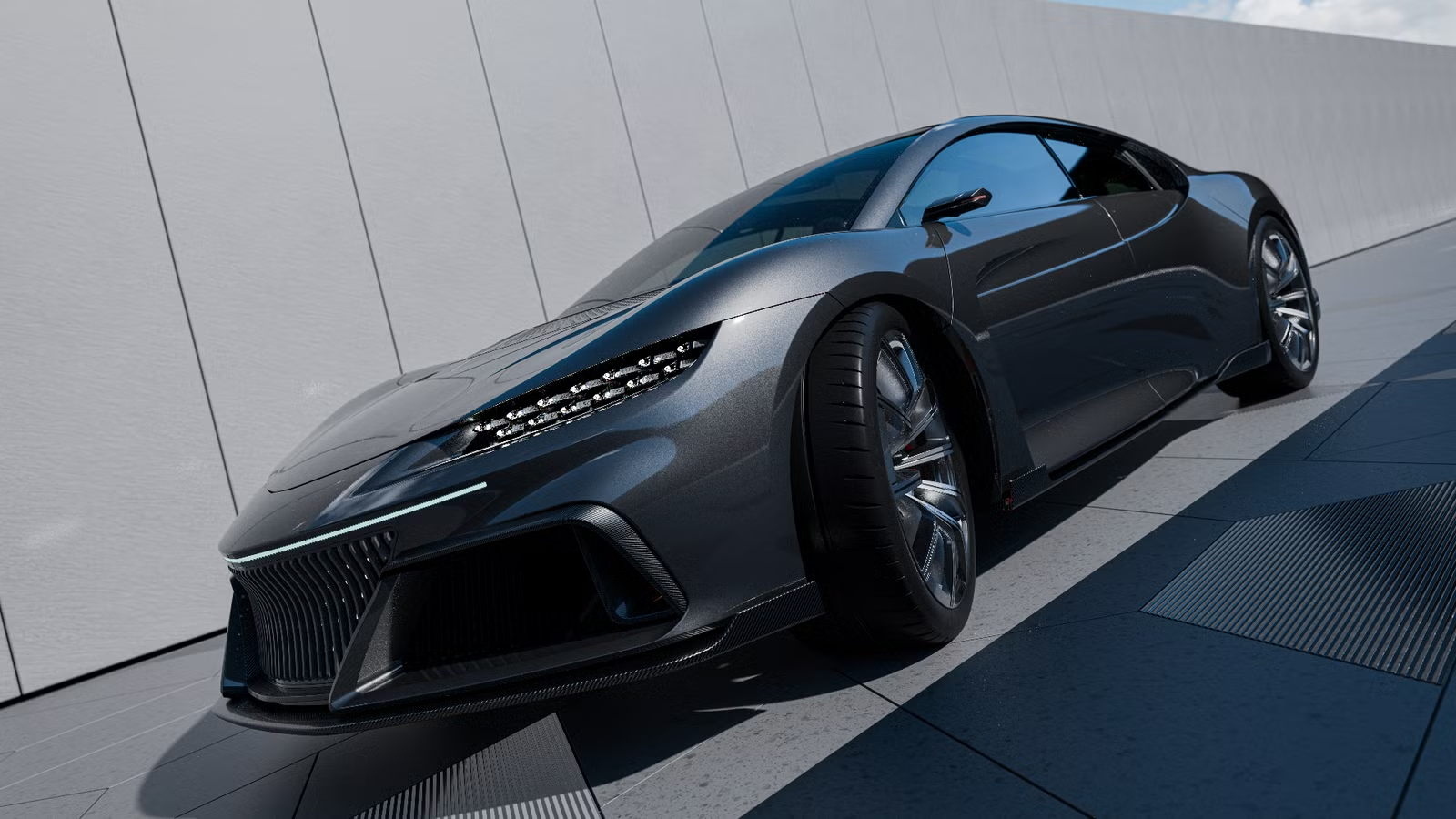
Kosmera is a new premium-vehicle company owned by the Chinese consumer-products business Dreame. The fledgling automaker aims to introduce a three-vehicle range of EVs in the coming years, including an SUV, a four-door grand touring car, and a hypercar. Kosmera already has offices across the world and intends to have its first products available by 2029.
The company is now revealing details about the powertrain for its models and is showing fresh renderings of the Star Razer electric grand tourer. And let’s just say that Kosmera’s ambitions are… ambitious. The company wants to deliver vehicles making more than 3,000 horsepower from four cutting-edge electric motors. The automaker’s internal propulsion research unit, Axion Power, is developing the powertrain components.
Over 3,000 HP In A Sedan
Kosmera Star Razer RenderingKosmera
The Star Razer and other forthcoming Kosmera vehicles would use four electric motors housed in dual-motor modules, each powering an axle. The company is targeting each module to produce 1,556 hp (1,160 kilowatts), which would give a vehicle a total of 3,112 hp. The setup also means there’s all-wheel drive and torque vectoring to tailor the output to the driving conditions. The system would run on a 1,200-volt electrical architecture at a time when more mainstream automakers are just starting to adopt 800-volt setups.
Like the new Mercedes-AMG GT 4-Door Coupe, the Star Razer and other forthcoming models would use axial-flux electric motors. To keep their mass to a minimum, Kosmera makes them out of magnesium-aluminum alloy die-cast structures with carbon-fiber reinforcements, allowing the lightweight units to produce 81 horsepower per kilogram. Kosmera and Axion Power are also developing proprietary systems for thermal management, bearing systems, and magnetic flux control for the company’s future vehicles.
The Star Razer Super GT
Kosmera Star Razer RenderingKosmera
The Star Razer is still in development, but Kosmera has some wild projected specs for the car beyond making over 3,000 horsepower. The company claims the vehicle can reach 62 miles per hour in 1.7 seconds and hit 249 mph in 8.2 seconds. The top speed is a nearly unbelievable 342 mph – it’s unclear what kind of production tires could support this velocity, never mind a place outside of sanctioned land-speed record events where one could actually get to such speed.
The company has some stupendous claims about its battery technology, too. In the planned Hypera hypercar, the pack has a projected capacity of over 100 kilowatt-hours. Kosmera says the unit is power-dense enough to allow for 2.5 laps of the Nürburgring with less than 30% degradation.
In terms of braking, Kosmera says the Hypera would use Titanium carbon-ceramic stoppers with 10-piston calipers in front and four-piston parts at the rear. According to the company, the car can stop from 62 mph in 98 feet.
Related
Future Electric Cars: Every EV You’ll Soon Be Able To Buy
From Ferrari’s first EV to Scout’s revival, dozens of electric cars are launching through 2028.
Kosmera’s Parent Company
Dreame Technologies HypercarHao Yu/WeChat
So far, we’ve heard relatively little about Kosmera’s detailed automotive operations, but its parent company, Dreame, made a major splash in the international auto business fairly recently. In 2025, it debuted a concept vehicle resembling a Bugatti Chiron with an extra set of doors, and around the same time, the company also showed a vehicle remarkably similar to a Rolls-Royce Cullinan. At CES 2026, Dreame premiered the Dreame Nebula Next 01 hypercar with a claimed output of 1,876 horsepower. The business later announced plans for the Nebula to be available with solid-fuel rocket motors to achieve a zero-to-62-mph time of under 1.0 second.
Related
Bugatti Beaten! Yangwang U9 Xtreme Hits 308 MPH To Become World’s Fastest Car
The Chinese Yangwang U9 Xtreme has hit 308.3 mph, beaten even the Bugatti Chiron Super Sport 300+.
CarBuzz Insight – Why This Matters:
Kosmera Star Razer RenderingKosmera
The numbers that Kosmera is claiming border on being unbelievable and might even be impossible given current technology. Anyone can write numbers on a brochure. The real challenge is achieving the goals, and frankly, we’ve seen all kinds of similar fantastical claims spring up from new companies, only to never hear from them again.
Let’s see if Kosmera can actually build a functioning car, and then turn it into a hypercar that accomplishes what the business is targeting.
