

Few people would immediately associate a 2026 Toyota Corolla Hybrid with the Industrial Revolution. After all, the Corolla is a prime example of modern technology, with an electronic system that can calculate power delivery in milliseconds, electric motors that can recover energy during deceleration, and a state-of-the-art hybrid propulsion system. Yet the combustion part of that powertrain relies on a sequence that you can trace back 150 years to 1876, when Nicolaus August Otto first demonstrated the same fundamental architecture. And today, Toyota engineers are still trying to extract as much useful work as possible from the same mechanical blueprint.
The Four Strokes That Made Engines Practical
Otto’s Four-Stroke-Cycle Internal Combustion Engine at the National Museum of Nature and Science in TokyoDaderot/Wikimedia Commons, CC0
Otto harnessed combustion principles to build an engine that could operate repeatedly and efficiently enough to have long-term potential. He came up with the idea of a coal gas engine that could compress its charge before combustion and then run through four distinct strokes. His prototype drew in a fuel-and-air charge, compressed it, and ignited it so that the expanding gases could push a piston downward. The moving piston would then expel the exhaust and enter a cycle where intake, compression, power, and exhaust completed the process. Otto’s invention would enter series production in 1877, with licensed manufacturing in both England and the US.
Other historical documents suggest that French engineer Alphonse Beau de Rochas had already been working on a similar four-stroke principle as early as 1862. He apparently described the thermodynamic sequence and part of his work even helped invalidate some of Otto’s German patent application in 1886. Nevertheless, Otto still came forward with a working machine that went on to change the very fabric of society. Today, more than one billion engines worldwide now operate according to the same four-stroke principle that Otto revealed, showing the durability of his practical solution.
Benz Put Otto’s Logic On Wheels
Mercedes-Benz Motorwagen Two-Stroke Automobile IllustrationMercedes-Benz
While Otto had come up with the breakthrough engine technology, it fell to Carl Benz to supply the missing vehicle. Benz completed this in 1885, featuring a rear-mounted, single-cylinder, four-stroke engine that developed 0.75 hp. The invention gave the Industrial Revolution a set of wheels as part of an integrated vehicle featuring a chassis, ignition, cooling, drivetrain, and engine.
Mercedes-Benz claims this was the very first automobile and proudly cites its patent as proof. Some historians may disagree and point to other experimental machines, but Benz nevertheless proved that it was possible to develop a practical, self-contained form of road transportation propelled by a compact four-stroke engine.
From that point on, Otto’s invention gradually became a preferred mode of powering road transportation worldwide. It represented a commercially viable solution, and many other designers and engineers would get to work on its subsequent development. Eventually, this rudimentary engine would become highly sophisticated, leading to innovations such as overhead camshafts, electronic ignition, variable valve timing, and computerized control. And while the Toyota Corolla Hybrid is dramatically more sophisticated than that original Benz machine, it still relies on the same basic architecture as that early trailblazer.
Atkinson Found More Work From The Same Fuel
Atkinson-Gas-Engine illustrationJames Atkinson (1846–1914), Public domain, via Wikimedia Commons
The original internal combustion engine underwent a significant development phase in 1882, when James Atkinson introduced his Differential engine. Today, this is often referred to as an “Atkinson cycle” engine, and it introduced a complex linkage to the picture. This allowed the piston to complete its intake, compression, expansion, and exhaust movements within one revolution of the main crankshaft. The result was significant efficiencies and, importantly, allowed the expansion movement to differ from the compression movement itself.
With the old Otto engine, compression and expansion would occur over broadly similar piston travel. But with the Atkinson system, the hot combustion gases could continue to expand before the exhaust valve opened, extracting additional work. This approach also captured more energy overall, rather than allowing it to prematurely leave through the exhaust. But while the system improved efficiency, it also tended to produce less engine torque. And this approach continued for more than a century, significantly affecting a vehicle’s ability to accelerate strongly without an additional power source.
Modern Toyota hybrids operate in an Atkinson-like manner, even though the company doesn’t copy the original linkage concept. Toyota’s piston still travels through conventional mechanical strokes, but its engineers achieve high expansion ratios through valve control. Here, the intake valve remains open during part of the compression stroke. This allows some of the fresh charge to move back into the intake tract, thereby reducing the effect of the compression phase but still preserving the engine’s full physical expansion stroke. Toyota’s interpretation of this modern ingenuity first appeared in its production hybrid system in 1997.
Toyota Used Electricity To Erase Atkinson’s Weakness
2016 Toyota Prius VToyota
Today, the electric motor is a component that can make an efficiency-focused combustion cycle even more usable in everyday traffic. The very design of an Atkinson cycle engine means it is most comfortable operating within a much narrower, more efficient speed-versus-load range. And that means the Atkinson engine is less efficient at low RPMs or when it needs to repeatedly vary its output in stop-and-go traffic. But electric motors are perfect for that kind of job, delivering high torque from zero RPM and instant power during acceleration.
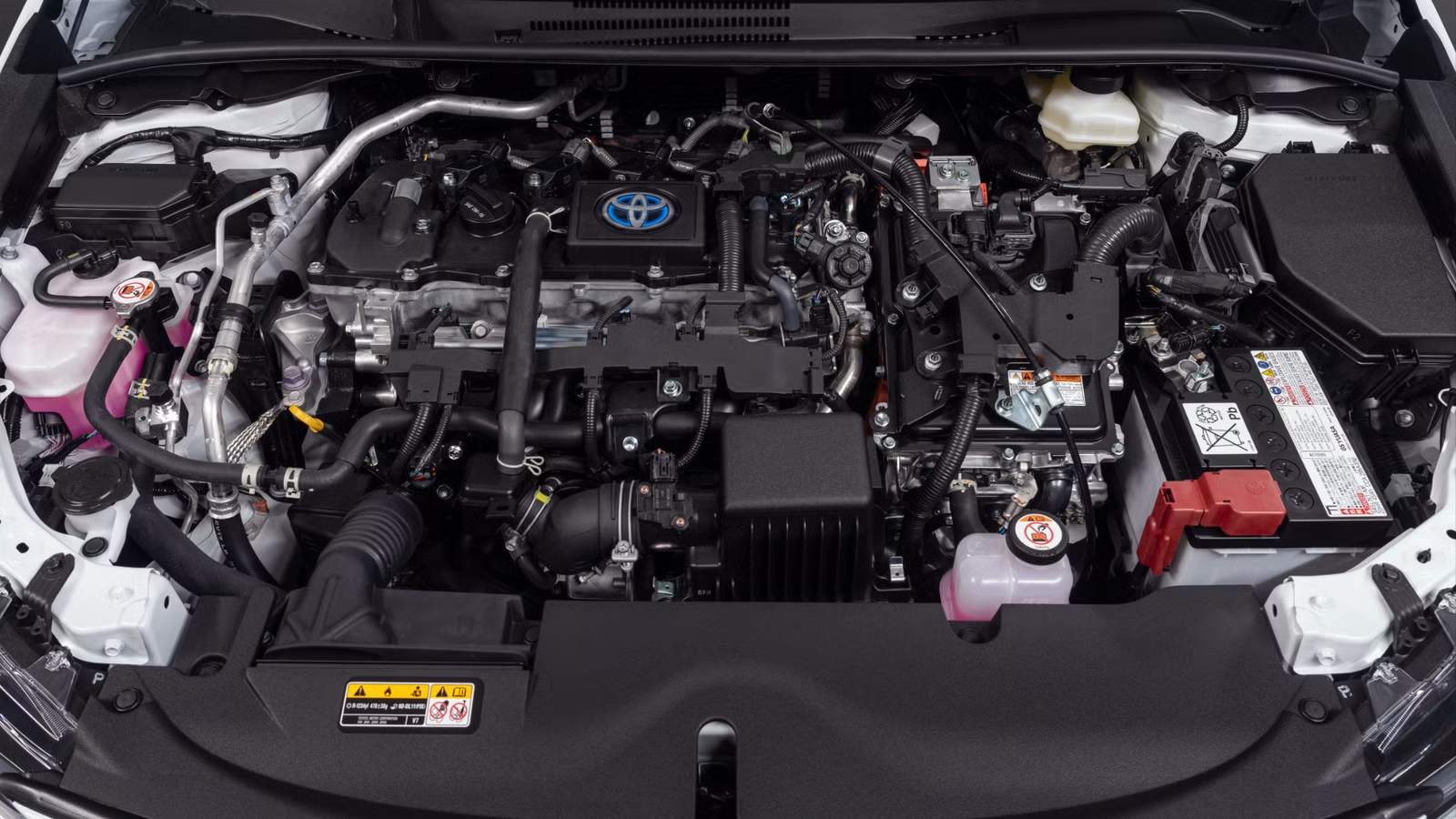
Toyota has a power-split hybrid architecture in which the engine and motor generators share the work. The system can shut down the gas engine if it’s not needed, while regenerative braking systems can also return energy to the battery for reuse. Toyota featured this system in its first US Corolla Hybrid, which used a 1.8-liter 2ZR-FXE Atkinson-cycle engine, two motor generators, and a planetary-type electronically controlled CVT.
For the fourth-generation Prius that came out in 2015, Toyota refined the same engine family with improved combustion, cooled exhaust gas recirculation, and fewer mechanical losses. And today, the automaker features its fifth-generation hybrid system, first in the Corolla for the 2023 model year. This has an even more compact and higher-output drive motor with a redesigned magnet and electromagnetic steel. Toyota also introduced a compact lithium-ion battery that it put beneath the rear seat. Through these and other improvements, Toyota is now able to extract 138 hp from the Corolla’s 1.8-liter internal combustion engine.
The 2026 Corolla Hybrid Is A 150-Year Verdict
2026 Toyota Corolla Hybrid front quarterToyota
In 2026, Toyota offers the Corolla Hybrid in LE, SE, and XLE trims, with electronic on-demand AWD on the first two. The vehicle can return up to 53 mpg city, 46 mpg highway, and 50 mpg combined, and goes on sale starting at $24,975 before processing and handling fees.
As a mark of just how efficient these internal combustion engines can be, Toyota has been able to add all-wheel drive to the mix without troubling the gas engine itself. It doesn’t just run a conventional mechanical drive shaft from the front engine to the rear axle. Instead, it has a separate rear electric motor that turns on automatically and provides rear propulsion as needed.
Toyota’s 2026 Corolla engine still remains a very different interpretation of Otto’s machine. It now features aluminum construction, variable valve timing, electronic controls, overhead camshafts, emissions systems, hybrid integration, and myriad other innovations. While even the Atkinson cycle designation differs from Atkinson’s original mechanism, the lineage is still evident. It’s just that today’s Corolla engine is one of the most complete expressions of traditional engine engineering, humming along very efficiently with the help of some state-of-the-art energy management.
The Principle Has Nevertheless Survived
2026 Toyota Corolla Sedan hybrid engine detail shotToyota
In 1876, Otto made the four-stroke pre-compressed engine a commercially practical proposition before Benz turned the same idea into independent road transportation. Later, Atkinson would introduce a longer-term, more effective expansion phase to improve engine efficiency. Eventually, Toyota would introduce systems that made the internal combustion engine even more effective for everyday use.
It’s possible that electric technology may define the future of transportation, but today the internal combustion engine remains the most significant part of the transportation picture. The origins of that engine trace all the way back to 1876, and while the hardware may now be very different, the governing philosophy has never really disappeared.
Sources: Toyota, Deutz, Smithsonian, Mercedes-Benz.
